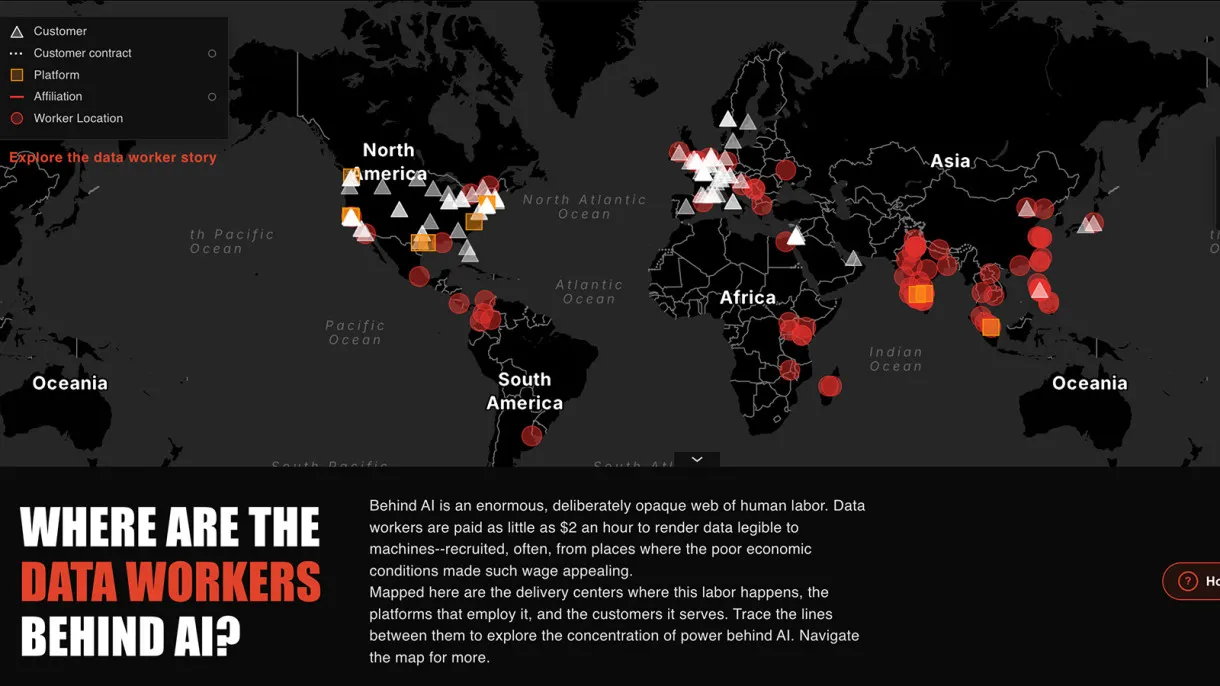
Brown student maps the hidden global labor powering AI
PROVIDENCE, R.I. [Brown University] — Most people know by now that artificial intelligence powers much of the online world, sifting social media posts, planning driving routes or helping to choose a movie to watch. But …
以下正文同步自 Hacker News,版权归原站所有,已转换为易读排版。
PROVIDENCE, R.I. [Brown University] — Most people know by now that artificial intelligence powers much of the online world, sifting social media posts, planning driving routes or helping to choose a movie to watch. But what goes largely unseen is the human labor — often people working for low wages in the Global South — that makes this careful algorithmic lifestyle curation possible.
Cunyan Ma, an undergraduate at Brown University working with the University’s Center for Technological Responsibility, Reimagination and Redesign, is trying to bring that hidden labor to light. As part of an ongoing project to explore the material underpinnings of the digital world, the Brown senior has created an interactive map linking technology companies and their intermediaries to data workers around the world. The map, which is freely available online, aggregates existing data worker databases, Ma’s own data collection and news reports describing the conditions many data workers experience.
“My primary motivation is to visualize the idea of AI colonialism in an impactful and immediately accessible manner,” Ma said. “The gap I’m trying to fill is that most of what we know about data workers comes from anecdotal reports from authors and journalists. Those are great because they give us a very detailed look at working conditions and pay, etc. But I’m hoping this might start to fill in a larger picture of what AI colonialism actually looks like.”
For an AI model to do much of anything, it must be trained by humans. At a basic level, that could mean people simply labeling objects in photos or parts of speech in a sentence. It could also mean transcribing long passages of speech, rating good or bad responses from chatbots, or identifying tumor boundaries in a medical scan. Much of the work is tedious, but Ma notes there can be even darker aspects to it. To filter out disturbing images or posts, or to keep chatbots from creating such content, AI systems have to be able to recognize it. That means that data workers must view horrifying images or text passages to label that content.
正文由 探How 从来源站点 RSS 同步,内容未经改写;遇到排版缺失或需要图片、视频时请以原文为准。