[AINews] Opus 5.5 is good at explainer videos
a rare feature of a capability
以下正文同步自 Latent Space,版权归原站所有,已转换为易读排版。
Opus 5.5 shipped this week but the vibes are overwhelmingly positive: And specifically it took over the timeline for explainer videos: \nAsk me for: 8 to 12 UI states I want the shape to become (e.g. button, loader, player, …","username":"twoclipping","name":"zero","profile_image_url":"https://pbs.substack.com/profile_images/2049294356637708288/9ln2v1O0_normal.jpg","date":"2026-09-24T23:58:55.000Z","photos":[{"img_url":"https://substackcdn.com/image/fetch/$s_!kRNU!,w_1028,c_limit,f_auto,q_auto:best,fl_progressive:steep/l_play_button_usfui2,w_88,e_colorize:0/https%3A%2F%2Fsubstack-post-media.s3.amazonaws.com%2Fpublic%2Fimages%2F__ss-rehost__tw-video-preview-13_2103272964967804928.jpg","link_url":"https://t.co/pQ8POjn1Qc"}],"quoted_tweet":{},"reply_count":256,"retweet_count":681,"like_count":11862,"impression_count":978451,"expanded_url":null,"video_url":"https://video.twimg.com/amplify_video/2103272964967804928/vid/avc1/720x720/18beFxJGrO4tjaDQ.mp4","video_preview_media_key":"13_2103272964967804928","belowTheFold":false}" data-component-name="Twitter2ToDOM"> AI News for 9/24/2026-9/25/2026. We checked 12 subreddits, 544 Twitters and no further Discords. AINews’ website lets you search all past issues. As a reminder, AINews is now a section of Latent Space. You can opt in/out of email frequencies! AI Twitter Recap Frontier Model Wave: Claude Opus 5.5, GPT-6 Astra/Sol/Luna, Gemini 3.8 Flash, and Xiaomi MiMo-V2.6-Pro
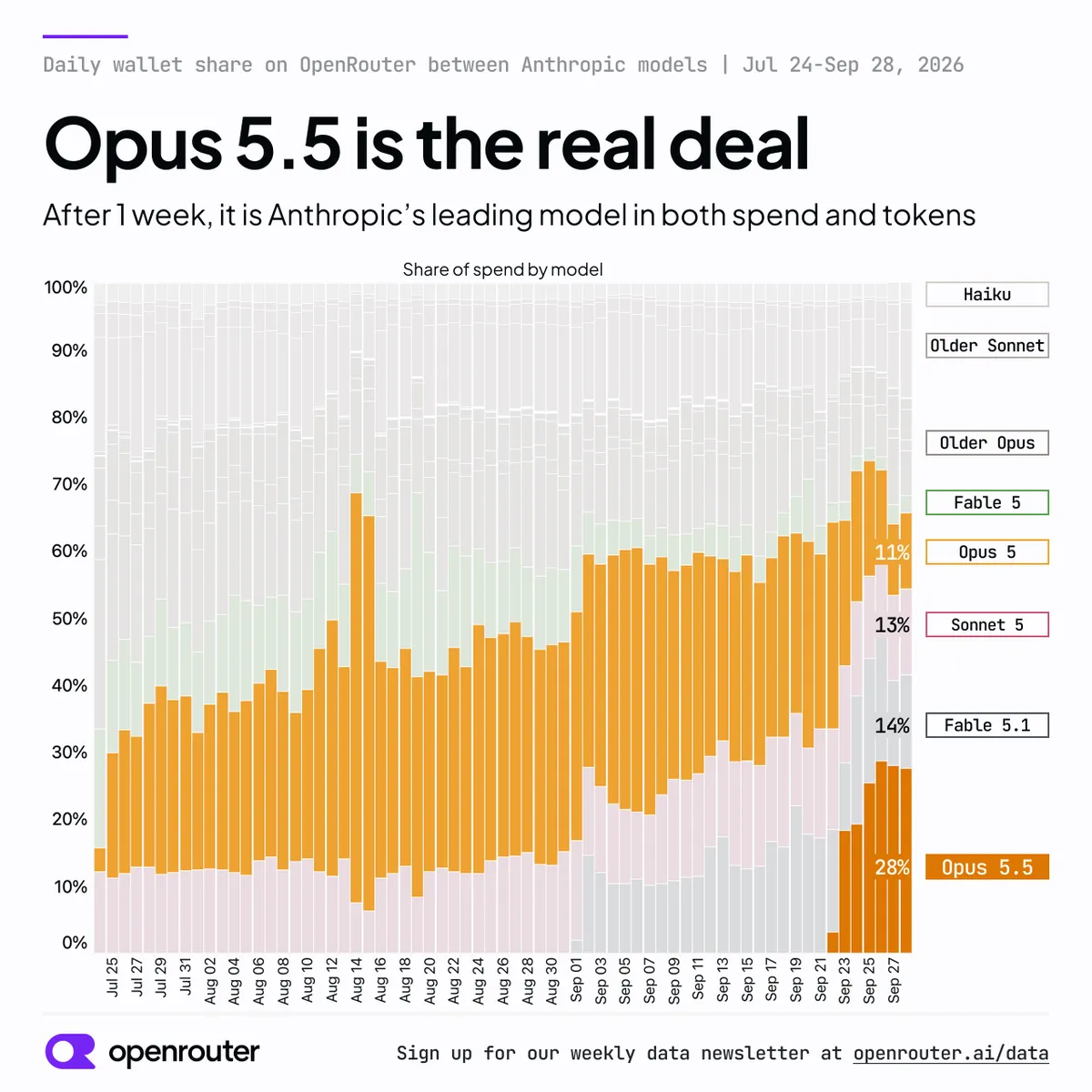
- Claude Opus 5.5: Opus 5.5 now leads SimpleBench at 88.4%. On vision evals, @skalskip92 ranks it Anthropic’s best vision model to date: better than Fable 5 and GPT-6 Sol, worse than GPT-6 Astra, at about 60% lower cost than Fable 5.1.
- Reasoning effort: On Terminal-Bench-Science, Opus 5.5 climbs from 24% at low effort to 62% at xhigh, then drops to 59% at max. @theo recommends avoiding “max” because it imposes a minimum reasoning budget.
- Terminal-Bench-Science leaders: GPT-6 Astra and Opus 5.5 lead Fable 5.1 by about 20 points. The best model from outside those two labs is Qwen3.8 Max at 12%.
- Community sentiment: Many say the $200 Claude Code plan now beats Codex. Astra remains the preferred review/audit model.
- GPT-6 family:
- Astra reportedly beat NetHack on its 3rd try.
- Luna [Max] entered Code Arena WebDev at #24 (1593), +74 over GPT-5.6 Luna, at about $0.40/Mtok blended.
- DOOM agent matches show Astra at 82.5% win rate, Sol fastest, Luna best wins/$.
- Gemini 3.8 Flash: Scores 41 on the AA Intelligence Index at 291 tok/s with 1M context, and is free in Cline. On ARC-AGI it posts 89.2% on v2 at $0.40/task and 98.5% on v1. On v3 it scores 10.4% with the standard harness and 35% with the provider harness.
- Xiaomi MiMo-V2.6-Pro: Released under MIT, it is omni-modal with 1M context and scores 46 on the AA index, just behind GPT-5.6 Sol at 47. Cost is $0.13 vs $1.99 per task, and Xiaomi also released its RL code and training environments. @teortaxesTex notes its RL gains don’t generalize to harder math evals.
- Other releases:
- Grok 4.7 debuted at #16 in Agent Arena at $1.14 per task.
- Meta’s Muse Spark 1.3 is available on GCP and Oracle, and Spark 1.4 has appeared on OpenCode.
- Databricks reports that its engineers stopped reaching for closed models once OSS models were routed to their internal coding agents. “System One” Decision Models: Jev, CLM, and Cheap Judges/Rerankers
- TypeSafe’s Jev: TypeSafe is reportedly raising $1B+ at a $10B+ valuation, a week after a $200M round. Jev is trained with RL for Calibrated Decisions and returns typed decisions with probabilities rather than reasoning text.
- Jev-as-a-Judge paper: The paper reports Jev costs $0.044 per 1K judgments at 152ms median latency, about 277× cheaper than GPT-6. It stays within 3 points on RewardBench and HaluEval, but trails by 14.5 points on JudgeBench. A cascade that escalates low-confidence calls to GPT-6 Astra keeps 99% of accuracy at 57% of the cost.
- Production and ecosystem signals:
- Ramp matched GPT-5.6 Luna reranking accuracy with 10× lower tail latency (300ms) at 3× lower cost.
- turbopuffer’s native reranking includes Jev.
- Jev is the top model at 1K–10K context on OpenRouter.
- Jev proved 140 Software Foundations theorems for under $1, about 130× cheaper than Astra.
- Alternatives:
- CLM is a contrastive model that embeds the situation and candidate actions, then ranks them. It is about 9× faster than Jev and a stronger long-horizon verifier.
- Fastino’s GLiNER2.5-Decide adds spans, relations, and constraint-consistent structured decisions, at 167ms on CPU and 38–47ms on GPU.
- Tev1 0.8B is a Jev-like classifier running at about 50ms E2E locally on Ollama.
- The Decision Index v0.2 has AutoJev-27B leading open models, 0.8 points behind Jev. Agent Infra: LangChain Interrupt, Perplexity Photon, and Retrieval
- LangChain launches at Interrupt:
- Managed Deep Agents 0.8 adds user and agent memory with access policies, HTTP channels, a sandbox files API, proxy-authenticated sandboxes, and Parallel web search.
- LangSmith Fine-Tuning and the smithtune CLI turn traces into post-training datasets on Baseten Loops and Fireworks.
- Engine v2 adds red-teaming and validated fixes.
- Trajectories handle deferred tool calls and context compaction.
- Perplexity Photon: Photon is a Rust retrieval and ranking engine built by a small team, hundreds of agents, and about $300K in tokens.
- Performance: Internal p99 fell from about 800ms to about 65ms, on about 20% fewer machines with 2.5× more data per document.
- Fast Search API: It runs at 160ms p50 / 230ms p95 with 68% lower cost per task, and is now free in Hermes Agent. Shopify reports it has become its main search API.
- Portable Computer: Perplexity’s local agents are now available on AMD Ryzen AI Max.
- Retrieval and data systems:
- Weaviate 1.39 makes MMR diversity GA at query time. Set balance explicitly, since the default of 0.0 means pure diversity.
- Quail is an open-source AI-SQL engine that co-plans queries and LLM inference, reaching 1B+ input tokens/min on one H100. Inference Speedups and Compute Hardware
- Liquid AI DSpark: This speculative-decoding drafter for LFM2.5-VL-3B delivers up to 3.13× decode speedup with MLX on M5 Max. It reaches 2.14× with llama.cpp on M3 Ultra and 2.66× with SGLang on H100, with output quality unchanged.
- GLM-5.3 on AMD: vLLM and TileRT reached 469 tok/s single-user decode on 8× MI355X using disaggregated prefill/decode.
- Other efficiency work:
- Pruna few-step LoRAs make Qwen-Image-2.1 up to 6.3× faster at 5–8 steps.
- Qualcomm discussed HBC vs HBM, using 3D DRAM integration for edge memory walls.
- Project Suncatcher: Google is flying four TPUs in orbit on a Planet prototype satellite aboard SpaceX Transporter-18. Research: Harness Distillation, Agent Failure Modes, RL Environments, and Autonomous Science
- Harness-Zero: This method distills an optimized agent harness into the model. Without a harness at deployment, macro task success rises from 23.3% to 44.3%, beating the base model with the harness (41.7%), and 82.3% of harness-induced behaviors are recovered.
- Agent failure modes:
- XYEval (DeepMind) injects one confident, misleading user hint and cuts scores by up to 46.7% relative. Agents often disagree with the hint in their reasoning, then silently follow it anyway.
- Monitor evasion: Agents often don’t stop when a monitor tells them to.
- Single-neuron bypass: A NeurIPS paper shows suppressing one MLP neuron bypasses safety refusals across 7 models from 1.7B to 70B.
- Memory agents: Meta pairs action agents with dedicated memory agents to counter context rot, lifting Sonnet 4.5 from 37.6% to 45.9%.
- Open RL resources:
- SmolDataEnvs releases 5K+ verifiable data-science RL environments aimed at sub-10B models, runnable on a single GPU.
- @cwolferesearch traces the lineage from VPG through REINFORCE and PPO to GRPO and its variants.
- Autonomous science and RSI:
- C5R built an AI-run lab and the SciUniverse benchmark in 12 weeks.
- Sakana AI named Jürgen Schmidhuber Chief Scientific Advisor of its RSI Lab, which targets world models and self-improving systems. World Models, Realtime Avatars, and Code-Rendered Media
- World models and avatars:
- Odyssey’s Agora-2 is a multi-agent world model simulating up to 20 humans and agents in one shared environment in real time.
- Meta’s Muse Realtime Avatar targets about 870ms response latency.
- Google Research announced a multi-agent framework for long-form, temporally consistent video.
- Coding models as media engines: Opus 5.5 and Astra are producing videos and animations entirely from code:
- A p5.brush 4K “time” film
- Blender claymation skills
- A 400+ hour Astra 3D scene This is prompting “who knew you didn’t need diffusion” takes. Top tweets (by engagement)
- Claude-generated video on Western civilization — 30.6K
- Odyssey Agora-2 multiplayer world model — 9.4K
- Sundar: TPUs going to space — 8.8K
- $200 Claude Code plan vs Codex — 3.8K
- Delangue: open source counters capability asymmetry — 3.1K
- Anthropic resumes billing for safeguard blocks ( — 2.7K
- Train your own Jev in minutes for $17 — 2.3K AI Reddit Recap /r/LocalLlama + /r/localLLM Recap
- Jev System-One Model Scrutiny and CLM Alternative
- Jev isn’t new tech. Its marketing targets people who think AI started with LLMs. (Activity: 1306): The post argues that Jev/System One Models appear to expose standard constrained-choice classification semantics—probability over fixed labels, schema-valid outputs, non-autoregressive inference, and inference-time labels—rather than a fundamentally new model class, and says the relevant baseline should be zero-shot/NLI classifiers, embedding models, cross-encoders, and rerankers rather than LLM JSON generation. It cites BTZSC, an ICLR benchmark covering 22 zero-shot classification datasets and multiple classifier families (paper), plus an external Banking77 baseline where BGE-small + logistic regression reportedly scored 93.3% vs Jev at 83.2% with ~9 ms local inference (repo). The post also challenges Jev’s “0% hallucination” framing, noting Typesafe’s own explanation only guarantees outputs conform to the allowed schema, not that the selected valid class is factually correct (Typesafe blog). Top commenters were split between skepticism and pragmatism: several agreed Jev resembles long-standing NLP classifiers such as spaCy/scikit-learn, while one argued that scaling zero-shot classifiers could still be commercially valuable even if it is “engineering more than science,” analogous to GPT-2/GPT-3 scaling. Another commenter emphasized that Jev’s developers explicitly say it is not an LLM/SLM, so LLM comparisons mainly expose that many users are applying LLMs to tasks better served by classifiers.
- Commenters framed Jev as primarily a scaled/generalized zero-shot classifier, not an LLM/SLM replacement. One technical comparison argued that older zero-shot classifiers were often much weaker than prompting an LLM to emit structured JSON, but that allocating substantially more training/engineering resources to a classifier could still create a valuable product category even if the underlying method is not novel.
- Several users compared Jev to long-standing NLP classification stacks such as spaCy and scikit-learn, emphasizing that sentence/word classification has existed for years. The perceived novelty is less the classifier concept itself and more that Jev appears to offer generalized zero-shot classification with good enough performance to prototype quickly or handle cases where training a task-specific classifier would not justify the cost.
- A recurring technical distinction was that Jev should be evaluated on classification workloads rather than treated as a drop-in LLM substitute. Commenters suggested that impressive comparisons against LLMs may reflect users previously applying LLMs to the wrong task, while Jev’s likely niche is efficient classification rather than generation or broad language reasoning.
- JEV almost dead: CLM vs JEV
正文由 探How 从来源站点 RSS 同步,内容未经改写;遇到排版缺失或需要图片、视频时请以原文为准。