Anthropic launched tools to show companies what their AI spending is buying
The financials Anthropic shared with investors this week suggest that its AI coding tool, Claude Code, is every bit the business success the frontier lab wanted. The company recorded an operating profit in the second qu…
以下正文同步自 Hacker News 最新,版权归原站所有,已转换为易读排版。
The financials Anthropic shared with investors this week suggest that its AI coding tool, Claude Code, is every bit the business success the frontier lab wanted. The company recorded an operating profit in the second quarter, and 900% net revenue retention — that is, spending from the same customers in Q3 2025 grew nine times in Q3 2026.
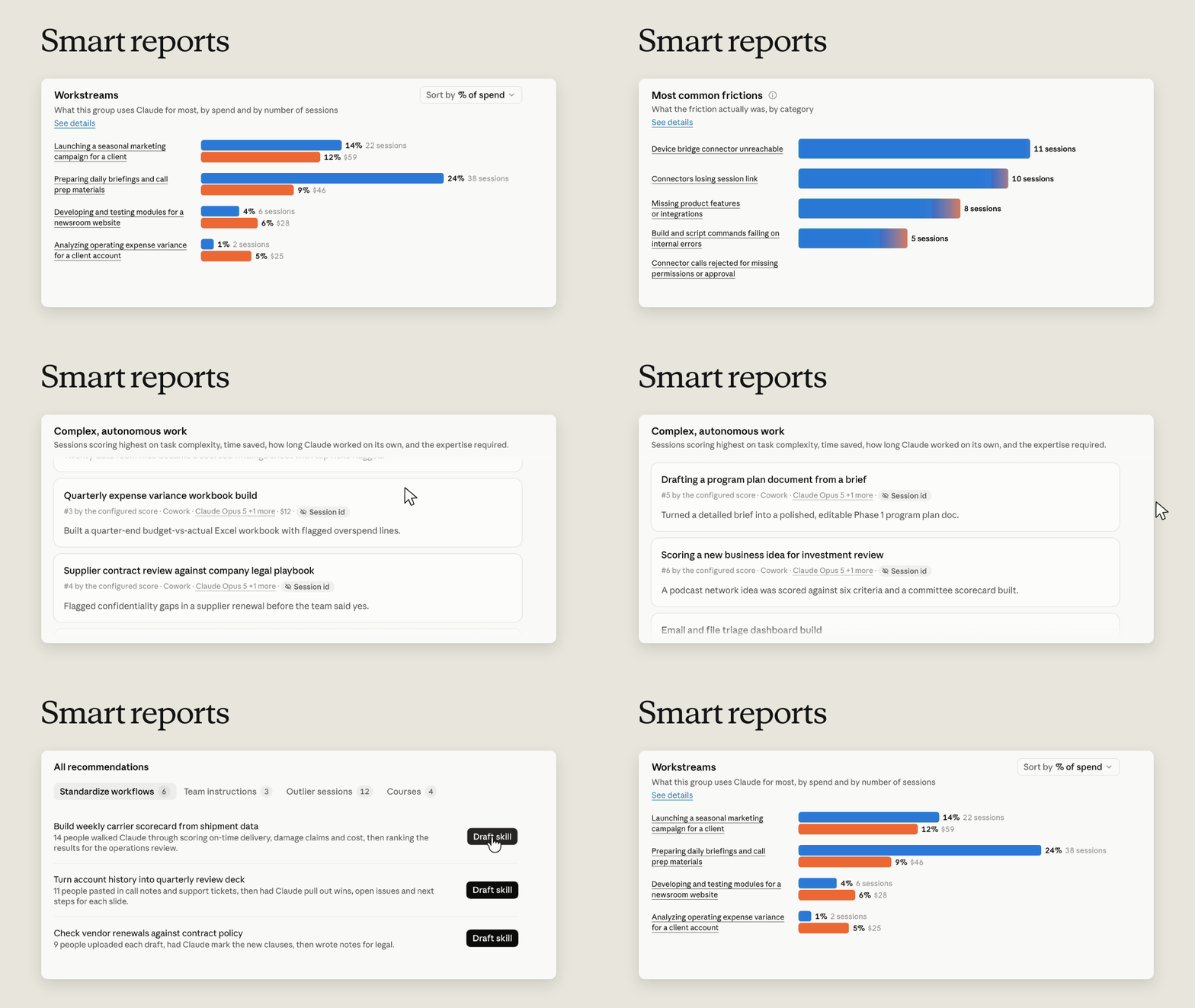
Anthropic has focused on getting enterprise users to stick around and Wednesday announced a new suite of reporting tools designed to give those customers a more granular understanding of the value they get from their token spend.
Using internal analytics and employee surveys, managers can view a team’s work over a given date range, what the team produced, how much it cost, and where its workflows broke down. Anthropic says it won’t use this data for model training by default. The reports will also offer recommendations on how to improve the results.
This is a clear attempt to demonstrate the return on investment of Anthropic’s tools and to show customers how to improve it — a major concern among large customers. Anthropic is also creating pooled group budgets to allow teams to better manage token spending.
Businesses have been hunting for that kind of information as they figure out how best to deploy AI tools. While usage among venture-backed firms is driving token spend, most of the Fortune 500 are not seeing major gains from deploying AI.
Jellyfish, a company that makes tools for software developers, released a new report yesterday based on the use of agentic coding tools by 276,000 of its customers. Claude Code and other tools built on Anthropic models remain the most widely used in the survey, responsible for nearly a third of all proposed code changes submitted for review. More importantly, spending on those tools has grown 10x since the beginning of the year, with their cost now equal to about 2% of total engineering cost.
“Even if you’re saying 2% is still small, that 10x growth is growth that most CFOs didn’t plan for,” Nicholas Arcolano, the chief scientist at Jellyfish, told TechCrunch. We’re certainly getting to the point where people are realizing, okay, it’s not enough to just spend a bunch. You now have to optimize it, make it work.”
Anthropic’s new reports speak to that challenge. Anthropic leads among enterprise customers, but what makes an agentic coding tool truly sticky is difficult to identify. The release of OpenAI’s Astra model this summer seemed like a potential threat to Anthropic, but so far it hasn’t slowed Anthropic’s adoption numbers.
“It took a long time for us to see Codex really pop in our data at all, and it has come up with Astra [OpenAI’s latest model],” Nikolas Albarran, the AI product lead at Jellyfish, told TechCrunch. Looking at X, he continued, you’d get the distinct impression that the competition is more heated. “Everyone in the Valley is like, ‘Oh, Codex is better.’” In reality, Albarran continued, “Anthropic was just there with great enterprise motions, and they had an incumbent weight of their own — this stuff just worked and worked well, and a lot of people just put a lot of effort into standardizing workflows around it. And there’s not a big enough reason to switch.”
It’s not just a question of models and workflows, either. The realities of business mean that once a frontier lab has gotten its hooks into a customer, switching is harder than it is compared to an individual programmer or small organization. Albarran points to the investment all the major AI labs are making in forward-deployed engineering (FDE) organizations, teams that embed AI consultants inside customer organizations to help them get off the ground. These new reporting tools can be seen as a kind of FDE-lite, a lighter version of that hands-on help, for Anthropic customers.
“We’re at a point now where it’s mature enough, where once you’re in, it’s going to be harder and harder to switch because you’ve spent the effort,” he said. “Even if they’re all mostly the same, they’re all going to be slightly different, have their own slight quirks of how they handle agent.md files, etc., and so that cost to switch is not zero.”
When you purchase through links in our articles, we may earn a small commission. This doesn’t affect our editorial independence.
November 4
Boston
Buy One Pass, Get a Second Free
Cover more ground at TechCrunch’s ultimate founder bootcamp of the year by bringing your co-founder or partner for free
Book before the BOGO deal expires
Anthropic warns that it’s very close to RSI capability, aka self-building AI
Julie Bort
New York Times and other outlets sue web browser Brave over alleged content scraping
Rebecca Bellan
Anthropic expected to receive high ‘junk’ rating from credit agencies following IPO, FT report says
Lucas Ropek
Google’s first data center satellite is online and writing poetry
Tim Fernholz
Binance pauses withdrawals as hackers suspected of stealing billions in crypto
Zack Whittaker
As search traffic dries up, Reddit announces it’s shifting to a logged-in experience
Sarah Perez
Ex-Palantir execs launch Dream with $17M from a16z to build AI world models for construction
Marina Temkin
正文由 探How 从来源站点 RSS 同步,内容未经改写;遇到排版缺失或需要图片、视频时请以原文为准。