The cannibalistic allometry of the DRAM Crisis
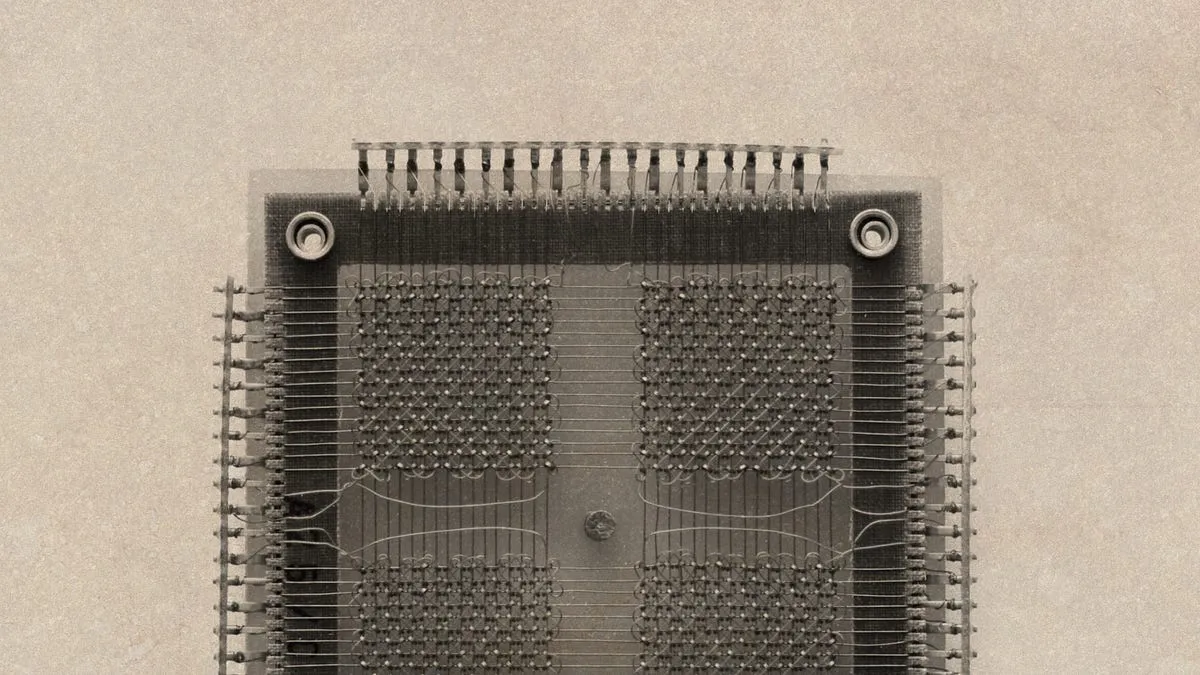
Magnetic-core memory — The main computer memory of the mid-1950s-70s, which was replaced by DRAM. (image: “Core Memory Module” by Konstantin Lanzet [CC BY-SA 3.0] via Wikimedia, edited by Edson de la O)
以下正文同步自 Hacker News 最新,版权归原站所有,已转换为易读排版。
Santa Fe Institute
Oct 30, 2026
58
6
14
Share
Magnetic-core memory — The main computer memory of the mid-1950s-70s, which was replaced by DRAM. (image: “Core Memory Module” by Konstantin Lanzet [CC BY-SA 3.0] via Wikimedia, edited by Edson de la O)
Adam Smith in The Wealth of Nations compared an expert to an expensive machine, whose work “over and above the usual wages of common labour, will replace to him the whole expense of his education, with at least the ordinary profits of an equally valuable capital.” Training skilled workers is a capital outlay amortized through their working life.
Smith observed that every artifact involves two debts. The first is a debt of construction, and the second the debt of its operation. The ratio between these two debts, between the cost of making something and the cost of running and maintaining it, turns out to be a variable quantity describing all machines, in both the non-living and the living worlds.
Organisms grow by synthesizing new tissue and are maintained at considerable energetic cost, through an ongoing expenditure of metabolic energy working against the second law of thermodynamics. In his monograph What is Life?, Erwin Schrödinger described an organism as “feeding upon negative entropy,” noting that “the device by which an organism maintains itself stationary at a fairly high level of orderliness really consists in continually sucking orderliness from its environment.”
My colleagues Geoffrey West, Jim Brown, and Brian Enquist have described this negative entropy process as a partition of a fundamental equation that splits a lifetime metabolic budget between the production of new mass and the maintenance of mass. It is the maintenance term that eventually halts growth because as a body grows, the cost of maintenance rises until it consumes the whole metabolic budget. From a sparrow to a whale, across several orders of magnitude in mass, the fraction of lifetime energy devoted to growth barely rises above a few percentage points. Every animal, regardless of size, is overwhelmingly working as a maintenance machine. As Giuseppe Tomasi di Lampedusa wrote in his novel The Leopard: “If we want things to stay as they are, things will have to change.”
A data center through this metabolic framing functions like a vast biological machine. For all of its technological scale, its construction cost is modest when weighed against projected operation costs measured in megawatts over decades. Whereas a laptop, which is at least zoomorphic in its appearance, is not at all like an animal. The energy required for its fabrication, including its silicon, exceeds the modest amount of energy it expends over its life. Roughly seven-tenths of a MacBook’s lifetime energy is spent before it is switched on.
Increasing efficiency drives technological artifacts away from the patterns of energy expenditure in the biosphere. This is because with every generation, operation becomes more efficient, whereas fabrication stays at an approximately fixed cost. This means that the more power-efficient a technology, the more its energy migrates into its construction costs. The efficiency that our society commends on energy labels turns out to be a cipher-text whose plain-text message describes the relocation of energy costs into the supply chain. Big inefficient fab labs make fabulously small and efficient gadgets.
The memory shortage of 2026 is often described in terms of hyperscalers buying up the world’s wafers to put into high-bandwidth memory and about dynamic random-access memory (DRAM) prices rising faster than gamers can keep up. But a deeper reading is allometric, a scaling relation, capturing the ontogenetic tradeoff between the two Smithian processes of growth-construction and repair-running. The great ignominious maintenance-dominated machines of our era, data centers, are competing for the same silicon materials as construction-dominated laptops. Since high-bandwidth memory for data centers consumes three wafers for every one in a consumer product, the trophic logic of the data center is to emulate the supersized biological organisms that they resemble and eat the bodies of laptops and just about every other consumer-grade technology.
The current crisis is what happens when a huge maintenance-dominated machine and a small making-dominated machine consume the same finite supply of matter. And there are few biological precedents for this, because life has not been so overwhelmingly dominated by the cost of growth the way that technology has been. The pathology of the DRAM crisis is that the broken symmetry between the cost of making technological things (high) and the cost of running them (low) has started to symmetrize. The only thing that could possibly prevent the extinction of this unprecedented reallocation of energy budgets is to amortize the working life of a gadget or service. And this is not an easy feat when the gap between investment and revenue in new technology rivals the GDP of a mid-size nation, and new species of energy-efficient, open-source models are invading all of their niches.
— David Krakauer President, Santa Fe Institute
正文由 探How 从来源站点 RSS 同步,内容未经改写;遇到排版缺失或需要图片、视频时请以原文为准。