Behind the scenes of those Claude slopcore music videos
If you’ve spent any amount of time on Twitter recently (oops), you’ll have noticed that the hottest new music video director is Claude Opus 5.5. You may also have noticed one account whose videos stand out against the t…
以下正文同步自 Hacker News 最新,版权归原站所有,已转换为易读排版。
Clara Collier
Oct 27, 2026
25
2
4
Share
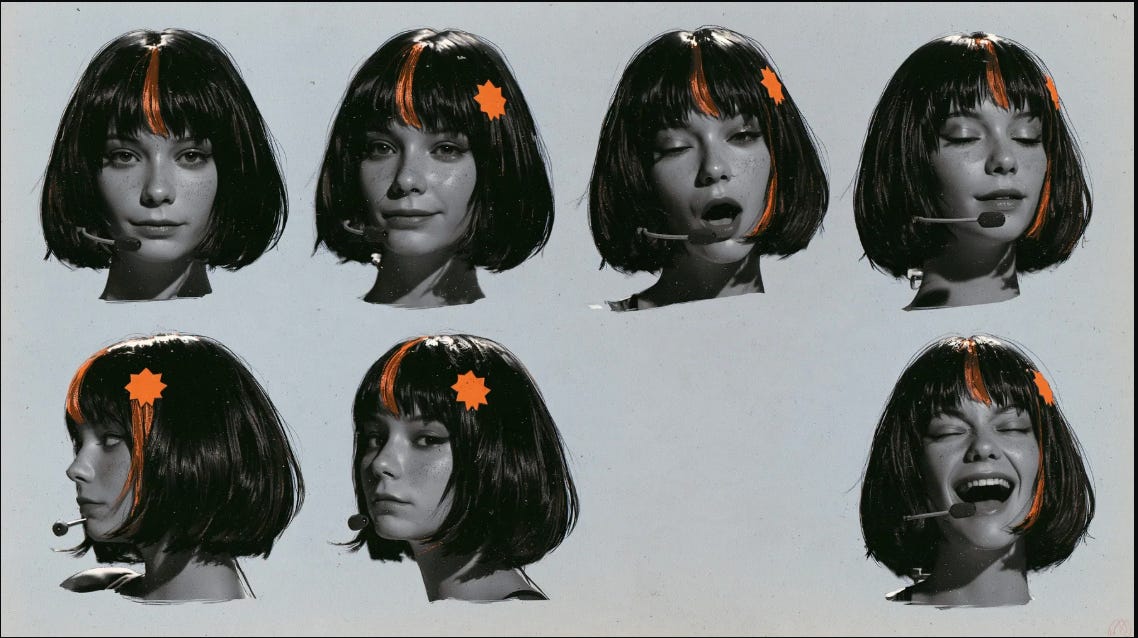
If you’ve spent any amount of time on Twitter recently (oops), you’ll have noticed that the hottest new music video director is Claude Opus 5.5. You may also have noticed one account whose videos stand out against the tide of clay-orange-accented, screen-text-heavy slop. They feature cinematic visuals, dense, witty references to hyperspecific corners of internet culture, and a refreshing absence of dancing anime girls. Instead, the singer is “Claudia” — apparently, an elfin 20-something with a black bob and a tasteful orange streak; in fact, a product of Midjourney, Seedance, and the imagination of RJ Tevonian, known on Twitter as anabology.
When I first watched Tevonian’s videos, I was overcome with dread for the human film industry. I also had to know how he did it. Fortunately, he agreed to an interview. Below, we talk about his process, what it’s like to fight Claude, the future of human-generated media, and whether “slopcore” has the makings of a real genre.
This interview has been edited for length and clarity. All images courtesy of RJ Tevonian.
Clara Collier: How did you get started making these music videos?
RJ Tevonian: Honestly, I don’t have a huge history in it. My main thing is that I run a biotech company. But I think two things got me into this. One, I’ve spent so much of my time building really complicated AI setups where I make everything super streamlined. So when I saw people making AI music videos with Claude, I thought, well, I feel like I could do that.
Second, I have some history in dance. Not really music, classically, but dance. And through creating concepts in dance, freestyle-type stuff, I learned how to parameterize a design space, where you can create concepts almost algorithmically, once you figure out how to define a concept well enough.
So then I wondered if I could do this with other types of design. I made all these tools to distill my design taste into a computer: I was able to pull a bunch of mood boards from online, compare two pictures against each other, and select the one I liked. Over time, the computer could learn rules about what my visual taste was. I had the idea that design should be better parameterized, and I’d been trying to do that for probably a few weeks before this trend showed up. Then I saw that some other people were making AI music videos, and I had this design library, and I was kind of into music from dance, and all this AI stuff. So I put it all together, and that’s what came out.
Clara: That’s so interesting, because I was wondering what your musical background is, but I would never have guessed that you’re a dancer. Do you watch a lot of music videos?
RJ: Not really. I used to watch a lot of dancers, but I think the concepts are very similar. There are a couple types of dance: choreography, and then freestyle. Maybe the mainstream dance competitions are choreography, but there are a lot of big ones with freestyle. And a big part of that is storytelling, where these people create concepts — they act out the entire scene that they’re trying to create.
For example, I remember some freestyle dancer making a pool cue movement, and then he throws his entire body across the floor as if his head is the pool ball. He’s creating an entire scene — you can tell just from the movements of his body that he’s in a bar, he’s playing pool — and it’s going with the song. So I had this visual in my head of what a song should look like, which I think is similar to a music video.
Clara: This might be a stretch, but I’ve noticed that in many AI music videos, including yours, every phrase has a distinct background setting, and with lots of quick cutting. Every scene is illustrating the micro thing that’s happening at that moment. Do you think that comes from that dance sensibility?
RJ: I think so. I think it’s two things. One, these songs are so packed with cultural references that if you’re just listening to the lyrics alone, you probably won’t understand 90% of it. But if you show it on screen, it’s much more legible. So it’s kind of a legibility design choice. And the fast cutting is just a habit that Claude has, and it’s actually kind of hard [to break]. The dance sensibility is: OK, I do want to convert the song into some visual and tell a story, and have that be as illustrative as possible. But the pacing and the density of it, I want to get away from.
I actually think these models could use more restraint. That’s the thing you see in human music videos that you don’t see in these: You’ll have one shot for 30 seconds or something. I think Grimes’ new “Accelerando” is a good example of this. There’s a 360-degree rotating shot of her with a bunch of dancers for a whole minute straight, or something.
Clara: A lot of these videos have a design overlay that is very Claude web — you can tell it comes from Claude Design: the big text on the screen, or the little lines they like to do. When you’re trying to instill the machine with your references and your design sense, how do you feel yourself fighting against the Claude design language versus making it a feature? How do you approach that?
RJ: Well, the original ones were definitely 100% the Claude design language. What I did originally was pull mood boards from online — there’s this website called Are.na — and rank the different ones against each other. But I also had Claude make its own designs, and then I would rank those against the ones from the mood boards, or against other Claude designs.
Claude doesn’t have video editing software. It’s comfortable with JavaScript and coding websites, so it basically makes the video a website and does it in a web browser. But recently, I definitely have to fight against it and say, OK, actually use some other motion design tools and other things to get away from that style, because it does get repetitive. I think with these AI things — maybe humans in general have much more diversity, whereas if you give an AI the same thing over and over, it’s going to reproduce the exact same style over and over again, because it’s comfortable with that. Getting it to be diverse is pretty tough.
Clara: I noticed “Clodyssey“ is very Claude design language, and then “Bliss“ moves away from that. What do you think you did that was successful in getting it to tone down the obvious Claude tics for that one?
RJ: For “Bliss,” I told it to create an entire Windows XP desktop environment itself, in code — not a website or anything — and then animate the entire video in that. I explicitly told it, basically, don’t do it as a website. Instead it made a whole desktop environment, which I think worked very well, because it’s also comfortable in that — it’s still a code-based environment — but it’s a totally different design language. But if I want it to do something that’s way more pure motion design — something you would originally have done in After Effects, for example — it struggles a bit more with that initially.
A music video, step by step
Clara: Can you walk me through the process of making one of these videos end to end?
RJ: The general process: I start with the lyrics and the concept. Usually I’ll tell Claude some general vision I have in my head about what I want the video to look like, and have it write the lyrics around that. I actually wrote the lyrics on one of them, but that one didn’t do as well as the ones where Claude wrote the lyrics.
So I give it this general vision, and then I have Claude spawn a bunch of research agents. It goes online, finds all these cultural references and current ideas, takes the vision, and puts it all into one lyrical thing. Then it’ll make 30 or 40 different Suno songs, and I’ll go through and listen to a bunch of them on the platform, and then guide it if I don’t like them, or find one that I really enjoy.
Being a dancer before, the thing that tells me if I like a song is whether it makes me want to actually dance to it, because some songs really don’t and some songs really do. Then I’ll take the song, and it’ll usually map out the entire song and get all the timings and the beats, and then it’ll take the mood boards and make Midjourney images.
Clara: So when you say “it,” this is still the Claude agent that’s orchestrating?
RJ: Yeah. It may spawn subagents here or do it itself, but it’s still Claude. It’ll go and generate all these pictures on Midjourney — write all the prompts — and then create a storyboard of the entire thing, showing me the timings, the images, and descriptions of what will happen across the entire video. After I look through that and check the image references it’ll give to the image model or the video model, to make sure it doesn’t just put in slop, usually at that point I can say, OK, make the entire thing now, and it does all the rest.
Clara: How much are you giving it visual references, like your mood boards, versus it finding all that from the text prompt you give it?
RJ: It finds a lot. At the beginning I did curate a bunch of mood boards, but it can also just go out to Are.na and pull a different mood board if I give it a word. If I say, I want you to make a skeuomorphic design, it can go pull the skeuomorphic mood board from Are.na and use that. Then it generates all of the actual visual inputs with Midjourney, but it may use some design language from the mood boards.
Clara: And what is it using for the actual animation?
RJ: The actual animation generally is literally just JavaScript in a web browser. It’ll take the video, look at it frame by frame, and animate stuff with JavaScript as if it’s making a website. And there are some tricks you can do to make the animation a lot better: You can have it do the Claude web-design-type stuff, and then send the finished JavaScript animation into a video model like Seedance. That can basically repaint the animation with the output of a video model, so it can relight the entire scene and make it look like a mastered production.
Clara: I’m very interested to see what that intermediate JavaScript stage looks like.
RJ: The first couple videos, “Escape Velocity“ and “Clodyssey,” were both fully raw JavaScript. I didn’t do the video model pass after.
Clara: When you’re doing a video model pass, do you have trouble keeping it consistent, beat by beat, with what you want? Or is it pretty good at following that?
RJ: It depends on what I’m doing with the video model. There are some models — one example is MiniMax H3. It’s a worse, cheap model, but it’s super good at lip sync for some reason. And then there are these smarter models that follow everything and never diverge from your instructions, but they lose the lip sync every time. So I actually have to use a combination of different ones, because no single model does everything correctly. I’ll do one take in the cheaper model to get the lip sync, and then remaster that with the expensive model, for example.
Clara: How involved are you in this process? Are you at your computer watching the outputs and giving it feedback, or doing it in batches? How much of it is your guidance and management, and how much of it is Claude internalizing this and rejecting takes from the video models on its own?
RJ: It depends on the video. The first one, which was the biggest one, was actually some of the least effort. Some of the later ones I wanted to really personalize, and I would be sitting there for at least 20 prompts. The main loop is: I’ll fix some errors, or make the tools it’s using a little bit easier. Then I’ll have it do that one process — song, then mood board that I approve, then make the whole video. After that, I usually go through one super detailed pass where I watch the entire video and, second by second, say: Change this, change this, change this, for the whole video. So at minimum I could do it in four prompts, but if I wanted to really match my vision, it takes a lot more time and effort. Sometimes Claude’s vision is more compelli
正文由 探How 从来源站点 RSS 同步,内容未经改写;遇到排版缺失或需要图片、视频时请以原文为准。