Can Gambia vs. Myanmar Help Establish Genocidal Intent in Russia's Ukraine War?
Since Russia’s full-scale invasion of Ukraine in February 2022, its forces have committed all five acts listed in the Genocide Convention: killing Ukrainian civilians; causing them serious bodily or mental harm; deliber…
以下正文同步自 Hacker News 最新,版权归原站所有,已转换为易读排版。
Since Russia’s full-scale invasion of Ukraine in February 2022, its forces have committed all five acts listed in the Genocide Convention: killing Ukrainian civilians; causing them serious bodily or mental harm; deliberately inflicting conditions of life calculated to bring about their physical destruction; imposing measures intended to prevent births; and forcibly transferring Ukrainian children to Russian families or Russian-controlled institutions.
The harder question — for the purposes of establishing State responsibility — is whether Russia committed those acts “with intent to destroy, in whole or in part, a national, ethnical, racial or religious group, as such.” In other words, did it act with genocidal intent, the dolus specialis?
Over the past 16 months, the International Human Rights Clinic at Harvard Law School (led by Susan and with significant contributions from George) and the legal team at International Partnership for Human Rights (led by Anastasiya) have conducted extensive analysis of Russia’s rhetoric and conduct in Ukraine. We conclude that, under existing international law, (i) the rhetoric of Russian representatives provides a strong basis for establishing Russia’s intent to destroy the Ukrainian national group, and (ii) Russia’s conduct provides a credible basis for inferring genocidal intent. Our findings have been shared with Ukraine’s Office of the Prosecutor General and will be published in early 2027.
The International Court of Justice’s (ICJ) forthcoming judgment in The Gambia v. Myanmar bears directly on those findings. Brought by The Gambia in 2019, the case alleges that Myanmar committed genocide against the Rohingya, a predominantly Muslim minority, through widespread killings, sexual violence, and forced displacement during military operations in Rakhine State.
The Court will have the opportunity to affirm three legal propositions:
(1) rhetoric that convincingly demonstrates a general plan can establish a State’s genocidal intent without a separate inference from its conduct;
(2) genocidal intent may coexist with other objectives, and can be inferred where it is necessary to explain the perpetrator’s conduct; and
(3) a comparatively low death toll does not preclude an inference of genocidal intent where the perpetrator’s opportunities to destroy are constrained.
These propositions are central not just to our assessment of Russia’s acts in Ukraine, but to any assessment of genocidal intent. Affirming them would keep the bar for establishing genocidal intent very high while ensuring that genocide remains provable in war and under occupation.
To establish genocidal intent, the ICJ may draw on the rhetoric of State officials where it “convincingly demonstrates” the existence of a general plan to destroy, in whole or in part, a national, ethnical, racial or religious group (Bosnia v. Serbia, ¶¶ 371, 373).
In The Gambia v. Myanmar, The Gambia argues that State rhetoric can convincingly demonstrate a genocidal plan independently of a pattern of conduct (¶ 7). Myanmar disagrees (¶ 32). We expect the ICJ to affirm The Gambia’s position. In Bosnia, the Court held that intent must be shown by particular circumstances “unless” a general plan can be convincingly demonstrated (¶ 373). In Croatia v. Serbia, it tacitly accepted the parties’ shared view that direct and indirect evidence are alternative routes to proving dolus specialis (¶ 143).
Such a holding would be directly relevant to assessing Russia’s war in Ukraine. Kremlin officials, legislators, and occupation authorities, as organs of the State, have repeatedly and consistently used genocidal language targeting the Ukrainian national group. State-controlled media amplify these messages.
The following examples are illustrative, drawn from an extensive body of evidence.
First, Russia falsely accuses Ukraine of genocide against Russians to justify its own conduct, a tactic known as “accusations in a mirror.” In February 2022, Putin claimed the full-scale invasion’s purpose was to protect people who had suffered “humiliation and genocide perpetrated by the Kiev [sic] regime.”
Second, Russia equates Ukrainian national identity with Nazism and calls for the “denazification” of Ukraine. In 2024, Putin told Tucker Carlson that Ukraine had built its national “identity upon some false heroes who collaborated with Hitler” and that Ukrainians “consider themselves a separate people […] on the basis of Nazism, the Nazi ideology.” In this framing, “denazification” is a euphemism for the assimilation of those willing to become Russian, and the removal or destruction of those who are not. As State Duma deputy Alexei Zhuravlyov put it, “two million people” in Ukraine should be “denazified, which means to be destroyed.”
Third, Russia dehumanizes Ukrainians in language that has repeatedly accompanied past genocides. Dmitry Medvedev, former president and current deputy chairman of Russia’s Security Council, has called Ukrainians “animals” to be euthanized, “typhus-ridden neo-Nazi lice,” and “worms.” The U.N. Independent International Commission of Inquiry on Ukraine found that such language may amount to “direct and public incitement to commit genocide” (¶ 774).
Finally, Russia openly calls for the destruction of the Ukrainian national group. Pavel Gubarev, former “people’s governor” of the so-called Donetsk People’s Republic, said that Russia cannot “commit genocide to them all,” but would have to “re-educate” Ukrainians, “create concentration camps,” and “kill as many people as necessary.” In January 2026, prominent State TV host Vladimir Solovyov declared: “[a]ll of them should be eliminated […] If they’re staying quiet, then they deserve this fate. Death!”
This rhetoric has taken hold among Russian soldiers. A recent survey of Russian prisoners of war found that 48 percent believed that “Ukraine is committing genocide of Russian speakers,” 42 percent that “[d]enazification is the main goal” of the invasion, and 42 percent that the average Ukrainian is “not fully human.” Soldiers voice such rhetoric on the ground: for example, Ukrainian survivors of sexual violence have reported Russian soldiers saying “now you won’t give birth to any more Nazis.”
The same tropes, euphemisms, and dehumanizing language emanate from Russia’s president, Foreign Ministry, parliament, occupation authorities, State-controlled media, and armed forces. They are broadcast on State television, transmitted through official talking points and military materials, and invoked during violence against Ukrainian civilians. The consistency and breadth of this rhetoric, as well as its connection to conduct, provides a strong basis to conclude that it convincingly demonstrates a general plan to destroy the Ukrainian national group.
Genocidal intent can be inferred from a pattern of conduct that “could only point to the existence” of such intent (Bosnia, ¶ 373). Genocidal intent must be “the only inference that could reasonably be drawn” (Croatia, ¶ 148).
The parties in The Gambia v. Myanmar dispute the meaning of that standard. In its 2024 rejoinder, Myanmar acknowledged that, as a matter of law, genocidal intent may coexist with non-genocidal objectives (¶ 4.44). On the final day of hearings, however, Myanmar’s counsel argued that genocidal intent must be exclusive: “[i]f other intents, in addition to genocidal intent, can reasonably be inferred from circumstantial evidence, then genocidal intent is not the only reasonable inference” (¶ 76).
The latter, stricter interpretation is wrong. Whether individually or collectively, people almost always act with more than one intent; a test requiring only one intent misunderstands human behavior. Nor does the ICJ’s formulation require a single intent. As Ireland’s intervention put it, “[t]hat the pattern of conduct could only point to the existence of such intent is not to say that it could point to such intent only” (¶ 36). In fact, the ICJ has never held that non-genocidal objectives preclude genocidal intent; it has found only that genocidal intent was not established on the facts. And the narrow reading would make genocide almost impossible to prove during armed conflict, where perpetrators pursue military objectives alongside genocidal ones. Such an outcome would be contrary to Article I of the Genocide Convention, which confirms that genocide is a crime whether committed “in time of peace or in time of war.”
The real question is not whether competing intents exist, but whether genocidal intent can be established among them. In The Gambia’s positive formulation: “irrespective of the existence of any other” non-genocidal intents, “a genocidal intent also must have been present” (¶ 37, emphasis added). William Schabas, counsel for Myanmar early in the proceedings, stated the same test in negative terms: unless “another reasonable [non-genocidal] explanation of the intent for the acts can be excluded, the application must fail” (¶ 19, emphasis added). Either way, what is required is that some feature of the conduct — a particular act, a subset of acts, or the pattern as a whole — cannot reasonably be explained without genocidal intent.
Should the ICJ affirm this reading in The Gambia v. Myanmar, it will be critical to assessing whether Russia’s conduct in Ukraine is genocidal.
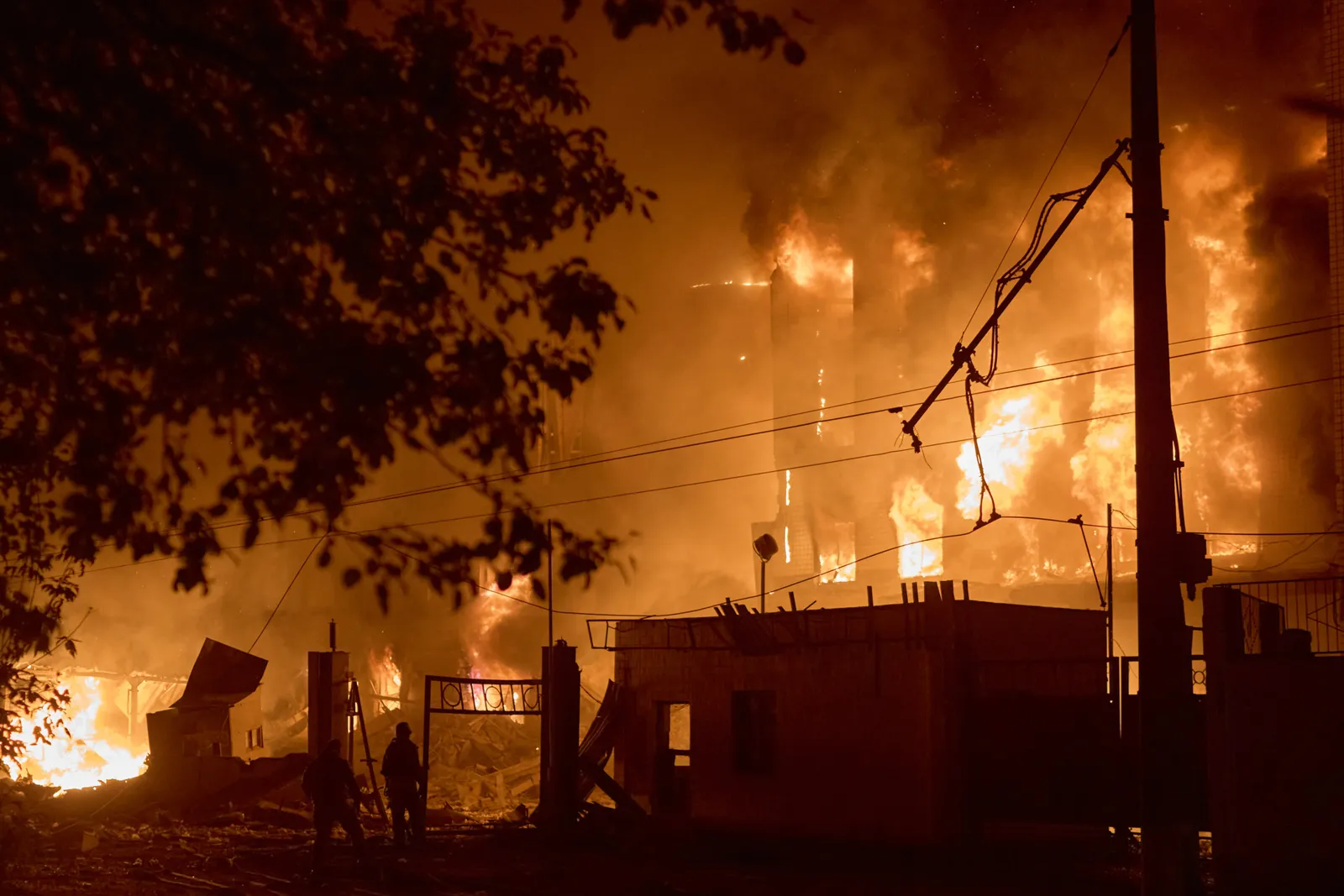
In the parts of Ukraine that it controls, Russia’s forces kill or disappear community leaders, forcibly transfer Ukrainian children, and confront everyone else with a choice: assimilate to Russian national identity, or face removal or brutal violence. In Ukrainian-controlled territory, where Russia’s soldiers cannot physically reach Ukrainian civilians, it resorts to aerial attacks on civilians and civilian infrastructure. Across Ukraine, Russia seeks to erase Ukrainian culture by destroying or appropriating cultural property and suppressing Ukrainian language, history, and art.
Of course, non-genocidal objectives may explain some of Russia’s conduct. Its aerial strikes against civilians in the Ukrainian-controlled territories may be intended to instill terror in an effort to compel Ukraine to surrender and advance Russia’s territorial conquest. In the occupied areas, Russia may intend to forcibly assimilate or displace Ukrainian nationals, eliminating the threat that Ukrainian national identity itself poses to Russia’s expansionist “Greater Russia” project. These likely non-genocidal objectives can, however, coexist with genocidal intent. The ICJ has already recognized that forced displacement (“ethnic cleansing”) may occur in parallel with genocide, and under some circumstances may indicate genocidal intent (Bosnia, ¶ 190).
Still, certain aspects of Russia’s conduct — and, indeed, the pattern as a whole — may not reasonably be explained by non-genocidal objectives alone. A policy of assimilation or removal does not require calls to kill “hundreds of thousands” or “one million, or five million.” Sexual violence can terrorize a population into assimilating or leaving, but it does not explain reports of castration, permanent reproductive injuries, or a soldier’s stated aim that his rape victim never give birth to “new Ukrainians” again. Nor does assimilation or removal require identifying, through “filtration,” civilians who display symbols of Ukrainian national identity, and then killing, disappearing, torturing, or raping them. Nor does it require methodically trapping and starving residents of Oleshky who lack Russian passports. Similarly, military objectives alone cannot explain why Russian intelligence reportedly prepared lists of Ukrainian-language teachers, journalists, writers, and priests before the invasion, or why its forces subsequently disappeared or killed those listed. Nor can conquest reasonably explain why Russia, in its aerial attacks, modifies weapons to increase civilian harm, targets kindergartens and playgrounds, carries out “double-tap” strikes on civilians, and escalates its destruc
正文由 探How 从来源站点 RSS 同步,内容未经改写;遇到排版缺失或需要图片、视频时请以原文为准。