The Sane Asylum
The people of Silicon Valley are unwell. Too many of my friends are spiraling. I don’t know how we’re supposed to live and work like this.
以下正文同步自 Hacker News 最新,版权归原站所有,已转换为易读排版。
The people of Silicon Valley are unwell. Too many of my friends are spiraling. I don’t know how we’re supposed to live and work like this.
If you work at a frontier lab or decacorn that’s still 10x’ing every six months, you’ve actually got it bad. You may be the chosen ones—the permanent upper class—but that doesn’t mean you aren’t worse for wear. You haven’t seen your kids, your girlfriend’s annoyed, and invites from friends to hang out are waning. I’ve heard reports of weddings and starting families being put on hold.
You’d do the same if you saw what they saw. Knowledge workers probably won’t have jobs in two years. We may be dead in 10. This is the time to make your mark and make your money. I overheard someone at an SF coffee shop begging for a referral to Anthropic from his friend, who repeatedly replied, “There’s nothing I can do, man.” I was so uncomfortable I had to put my headphones on so I couldn’t hear them anymore. A “perk” of being the chosen one is being surrounded by the most talented people in tech. But you’re finding elbows are sharp in a roomful of people used to being the most important in the room. You’ve been advised not to wear company swag in public: security risk. People treat you differently now. Or maybe it’s you that sees them differently.
If you’re building a startup that’s trying to compete with or be one of these companies, you’ve also got it bad. Maybe you passed up a job offer at one a couple years back, which means you left $100mn on the table, you fucking idiot. Can’t miss your chance to get rich or get your fingerprints on the next great product this time. For the ones that manage to break out, it sure feels like product-market fit. Those basis points are starting to look pretty good for your paper net worth, too. Your company just received an enormous infusion of venture capital, the fourth in 12 months, and there’s a headline in The New York Times to prove it. But below that story in your feed is another one questioning whether companies like yours can survive. You keep telling yourself how fun it is to be the underdog, but it’s harder than you thought it’d be to hire or get your hands on compute. If you’re not on track to a billion dollars of Annual Recurring Revenue this year, or to tweet about your next $100 million soon, you’re cooked.
If you’re working on a pre-AI startup, you’ve likewise got it bad. Not too long ago you were the belle of the ball, but now your 30% year-on-year growth doesn’t feel like growth at all. It feels like death. Your once-proud investors have taken your company’s logo off their firm’s homepage, and you’re no longer invited on podcasts. The AI-natives don’t want your tricks, old dog. You’re in the group chat +1’ing texts saying, “I guess we should just get acquired and get it over with.” But you’re also seeing the reports of Bending Spoons acquiring Airtable and Miro for peanuts. “But these companies had such healthy ARR,” you think to yourself. You don’t even want to consider what it means for your personal finances. In the meantime, attrition on your team is getting out of control. Everyone’s leaving for the same places. They post their goodbye messages in Slack with “tremendous gratitude for how much I learned working with you.” But alas, it’s time to join the actually ambitious people in the AI arena now. You’re not sure whether to begrudge them or join them.
It’s not just the uncertainty about the future that has us all spinning. I think it’s just too much, too fast. Too much money, too much growth, too much power, too much change. A new frontier model is released every month. A new unicorn is minted every day. This isn’t histrionics; 300 days into the year 2026, and 311 unicorns have been minted so far. We were shocked when Cursor went from $0 to $100mn in a year. That was less than two years ago. Now it’s everyone’s goal, teetering on the norm. Companies double headcount every month. Raise another mega round every six months. The expectation for what’s possible and what’s expected, and on what timelines, keeps getting higher and higher, faster and faster. There are no signs of it settling down any time soon.
You’re doing your best to keep up. You’re 9-9-6’ing, sometimes 0-0-7’ing. You didn’t actually rest during rest week, did you? What are your agents up to? Hopefully getting a lot done while you’re reading this. Have you tried the latest personal assistant? Optimized your workflows to accommodate the strengths of the latest model? Have you gone viral on X lately? Have you been angel investing? Have you locked in your Bay Area mortgage? If not, you know you’re fucked, right? You’re enslaved to your keyboard, timeline, and Slack. You’re tired, but your ambition is also Icarus-ing. Your FOMO is spiking. Your capacity is redlining. Is your moral compass spinning?
It’s hard to watch this unfolding in my community. I know it is a tremendous privilege to be alive and working in a time when we can see and shape a technology that’s so transformative. And I know some people are finding the scene right now electrifying. But I know a lot more people who aren’t. And I see that the experience of trying to hang in the ring for yet another round is breaking something inside so many of us.
The Silicon Valley spirit has always been about thinking big, moving fast, delivering impact, and doing things our own way. But I fear this game is getting the best of us.
In my hunt for safe havens, my attention and work have turned to a small group of elite companies playing a different game.
These are companies like Midjourney, Pierre Computer, Increase, turbopuffer, and I’m sure many more. They are AI-native, ambitious, profitable, and have a very healthy relationship—if any—to venture capital. They are not the lifestyle businesses for the unambitous, one-person unicorns for the antisocial, buyouts for the MBAs, or invisible companies for the people that don’t care to have a LinkedIn. They have stacked teams, raving customers, financial freedom, legibility to other techies, and swag their employees are free and proud to wear in public.
After spending time with these companies, I appreciate their imperviousness to the weird incentives and hype games of the “decacorn exit ASAP or nothing” venture-backed playbook. Most strikingly, they seem totally free to be themselves. The fuel source for the thing they’re doing appears to be equal parts outcomes and the experience itself. I suspect it’s this mindset that staves off the psychoses other companies are experiencing.
I know we say this every time a breakthrough technology emerges, but there has never been a better time in history to build a highly profitable business with significant scale without raising or hiring a ton. As I study these companies, I am learning that you can operate at the exciting forefront without going insane.
Silicon Valley has watched and admired a small handful of companies who explored this path over the years—Linear, Basecamp, Valve, Obsidian, and early GitHub, to name a few. Have you noticed these companies bubbling up in the zeitgeist more lately? Me too. And I don’t think it’s a coincidence. In the coming years, I think and hope that we will see a lot more very successful companies built in this model. They will take advantage of our new AI toolkit to generate financial freedom and build organizations perfectly fit to the things they want to work on, with the people that they want to work with, at the scale, ambition, and pace that works for them.
For what it’s worth, I also get the sense that the confidence to build a company like this comes more naturally to people that have already made some money. (And just sayin’, we’ll have a bunch more builders that meet this definition hitting the scene soon.) I hope—and expect!—this all comes together to create a much wider spectrum of company types, so that we can all find the size and shape of the company that works best for us.
Starting this summer, I set out to explore the culture of one company that’s doing all this already: turbopuffer, the Ottawa-based startup powering the search infrastructure for many of the AI darlings. I’ve been working with them for the last six months to help with marketing and communications. I’ve joined their Slack, attended their offsites, and teamed up to ship some work together, all to get a feel for the place.
What follows is a love letter to the way they are building their company. I hope a look inside this one startup will open the aperture for what life and work in the time of AI can look like, and that more ambitious builders and aspiring founders feel inspired to try it for themselves.
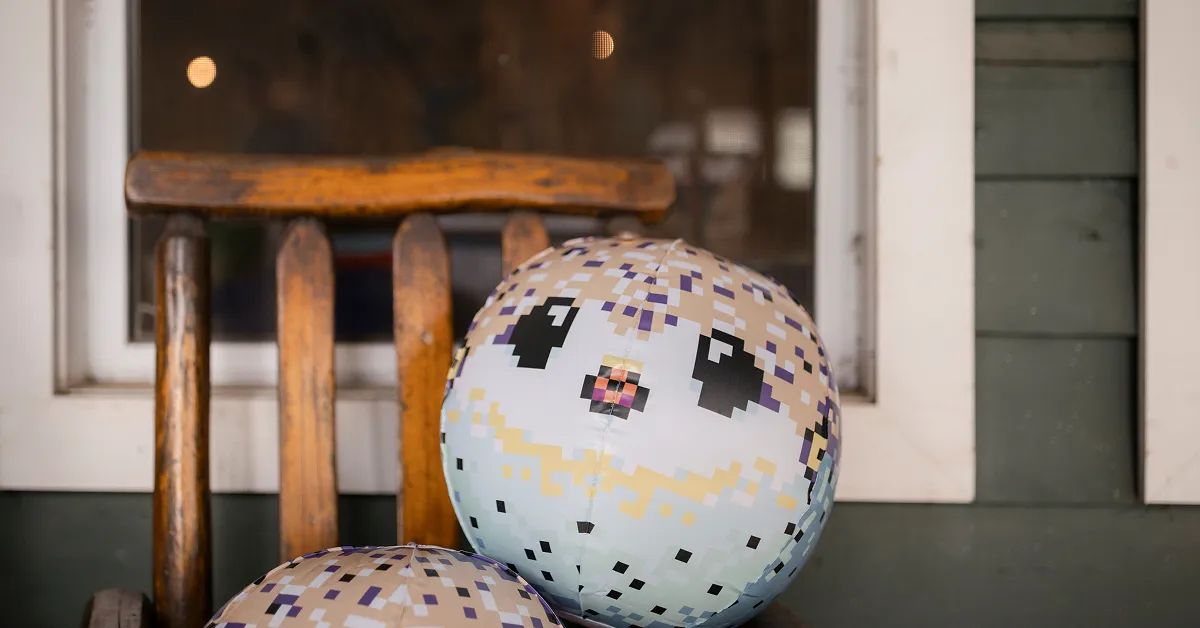
The name turbopuffer makes people smile the first time they hear it (even an octogenarian behind me in line at the airport did when he saw it on my hat). The logo is an 8-bit pufferfish with pursed lips, ready for a smooch, and there are 20 remixed versions of it for every imaginable scenario. CEO and co-founder Simon Hørup Eskildsen has a knit pufferfish on his desk, which I ask about during a Zoom call. He puts it up close to the camera, squeezes, and a sparkly blob oozes out from the mouth. It’s the work of head of brand, Devin Lewtan, he explains, who has befriended a prolific crocheter on Etsy. I’m soon sent my own knit pufferfish, which I squeeze into the camera during Zoom calls unrelated to turbopuffer, which is when I realize what a clever brand campaign Devin’s running.
All the best VCs want to invest in the company because it has more than $100mn in annualized run rate and the top performing companies in their portfolio rely on turbopuffer’s infrastructure to, very quickly and very cheaply, wrangle the mountains of data underlying their products. But turbopuffer’s not interested. “What do I need venture capital for?” Simon says, wearing an I ♥️ B2B t-shirt. “We’ve got customers!”
Simon likes to say that turbopuffer started as a blog post, became a project, and then a startup. He and co-founder Justine Li—“the best engineer I knew at Shopify”—started tinkering together in her living room in 2023. We get to talking about the role of ambition in company-building, and he tells me that “ambition should be something right at the edge of your reach. Anything beyond that is delusion.” If you’ve grown up professionally in Silicon Valley, you know that’s not what you’re supposed to say. You’re supposed to want it all and more from day zero.
turbopuffer co-founders Simon Hørup Eskildsen and Justine Li walk in Ontario’s Camp Tamakwa, where the company hosted its 2026 annual Summer Camp for employees.
But Simon and Justine grew up professionally at Shopify in Canada (Simon in Denmark before that), and to them, it simply makes sense to let the path unfold as you go. It’s all very The Timeless Way of Building, of which Simon is a fan. Many people forget that Shopify didn’t raise much venture capital for its first four years and had time for a personality of its own to settle in.
In October 2023, after getting their novel storage architecture for 10x cheaper search working, Simon and Justine didn’t head to Sand Hill Road to pitch VCs. They went to a small office in Hayes Valley where an eight-person team was building a new AI coding tool called Cursor. Simon had already piqued their interest with his tweets and blog posts, mostly on infrastructure engineering, and their first live meeting was more like an extended coworking session (a practice that’s stuck with the turbopuffer team). Simon and Justine promised they could reduce their costs by 95% and, after building a couple features and showing promising early results, Cursor was happy to migrate their workload. Voilà. First customer.
By Simon and Justine’s account, the revenue was nice, but the real boon was the conviction that they had the search infrastructure other frontier AI companies needed. Time to start selling. They went door to door pitching better performance at a fraction of the cost. And it worked. Mor
正文由 探How 从来源站点 RSS 同步,内容未经改写;遇到排版缺失或需要图片、视频时请以原文为准。