Meta’s Generative Ads Model (GEM): Scaling the Central Model and Compute Engine for Frontier Ads AI
Last year, we introduced GEM, the industry’s largest recommendation system (RecSys) foundation model. GEM established Meta’s first LLM-inspired paradigm for ads recommendation, driving major performance gains. Building …
以下正文同步自 Meta Engineering,版权归原站所有,已转换为易读排版。
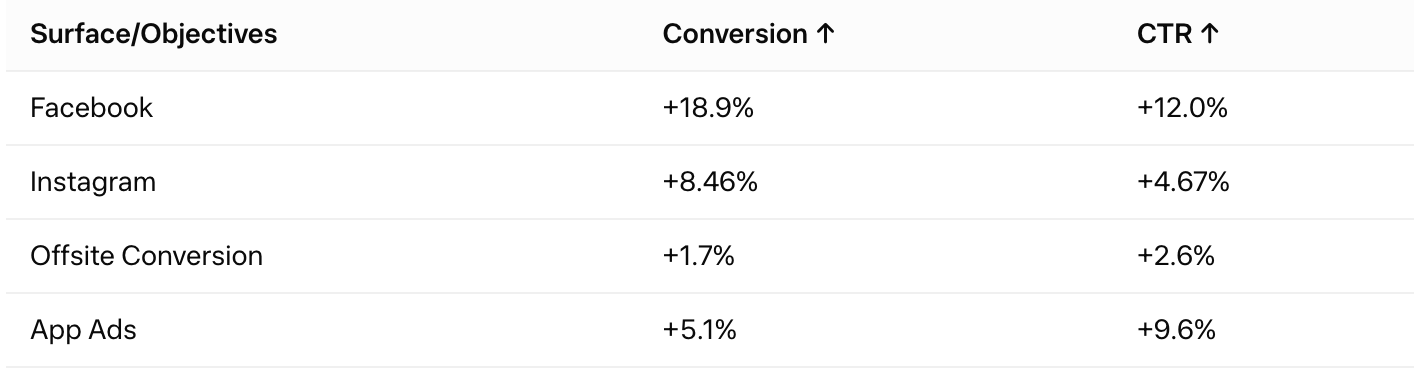
Last year, we introduced GEM, the industry’s largest recommendation system (RecSys) foundation model. GEM established Meta’s first LLM-inspired paradigm for ads recommendation, driving major performance gains. Building on this foundation, our next goal is to further scale both compute and intelligence transfer with next-generation hardware, and expand this capability across Meta’s entire ads ecosystem. This spans dozens of surfaces and objectives, delivering seamless full-funnel optimization across awareness, consideration, and conversions. The 2026 generation of GEM shifts from isolated per-domain optimizations — such as Facebook, Instagram, Reels — to a single central foundation model. It learns from data and signals across all of Meta’s ads platforms, bends the scaling curve at LLM-scale computation, and delivers strong advertiser outcomes through post-training techniques that provide a larger latency budget without requiring real-time evaluation of all ad candidates — all on a substantially more efficient training stack. The result is simultaneous ad performance gains across every surface and funnel stage, and deeper understanding that better matches ads to what people are looking for. GEM has delivered 18.9% conversion improvement and 12% ad click-through rate (CTR) improvement across Meta’s ad surfaces and objectives, and additionally contributed 5.8%, 4.1%, and 1.6% conversion uplift on Facebook, Instagram, and off-site conversion for targeted users over the past year. These gains span both upper-funnel surfaces and deep-funnel optimization goals, driving stronger returns for advertisers. GEM advances the frontier of recommender systems in the following four areas:
- Bending the Scaling Curve, Enabling 2.5x Model Complexity Challenge: Empirical scaling laws demonstrate that model performance predictably improves with compute, parameter, and data size using transformer model architecture. However, recommender system models do not exhibit similar scaling properties with transformer due to massive heterogeneous features and shifting distributions. Solution: We built an LLM-style architecture — Kunlun, co-designed with the latest GPU hardware, to make larger, deeper models substantially more cost-efficient and to enable long-context learning over user engagement history. We observed an LLM-like scaling law at our largest pre-training scale with 2.5x model complexity growth from earlier versions of GEM. The pattern mirrors frontier LLMs: more capacity and longer context produce emergent gains in ranking quality that translate directly into business results.
- Efficient Intelligence Transfer From GEM to User-Facing Models Challenge: Serving a model at this scale in real time is prohibitively expensive and drives up latency, compromising both user experience and advertiser ROI. Solution: The structured representation, LoopFM, a state-of-the-art post-training technique, transfers GEM’s internal representations and sequential historical memory to downstream models. Through computation sharing, it doubles the intelligence transfer together with the knowledge distillation deployed in the previous version, at no additional compute cost or latency. We also introduced elastic pre-computation (Solaris) to harvest the gains from the upstream model.
- Accelerating the Central Compute Engine With Large-Scale Cross-Surface, Cross-Domain Learning at Meta Ads Scale Challenge: Meta’s apps span dozens of surfaces — Facebook, Instagram, Reels, Stories, and more — with 3.6 billion people using at least one of our apps each day. Each surface and optimization objective previously had its own independent prediction system. As the platform grows in surfaces and objectives, so does the challenge of improving ad performance simultaneously. Solution: GEM accelerates one single, unified compute engine through the central foundation model that jointly predicts clicks and conversions across all surfaces, including Facebook and Instagram, and across every key advertiser objective from off-site conversions to mobile app installs. The generalizable representations learned on data-rich click tasks transfer into data-sparse conversion tasks. A new training recipe with cost-free data mixing and the domain expert framework makes this heterogeneous, large-scale learning tractable, with predictable scale and enhanced reliability.
- Scaling Total Training FLOPs by 4x While Doubling E2E Training Efficiency Across Thousands of GPUs Challenge: Training a RecSys foundation model across thousands of GPUs at this scale requires careful orchestration of compute, parallelism, communication, and memory. Today’s data center GPUs and their software stacks are mostly optimized for LLM workloads, whereas recommendation workloads have a fundamentally different profile due to unique data characteristics that make it extremely difficult to achieve high GPU compute utilization while scale. Solution: We developed custom kernels with low precision and new 5D parallelism strategies co-designed with the latest GPU hardware and Meta’s training cluster, and optimized model architecture with infrastructure together to scale efficiently across thousands of GPUs. End-to-end training efficiency is doubled to 20-25% model FLOPS utilization (MFU) with 4x total training FLOPs, enabling GEM to train at LLM-scale at Meta (see full technical story in our companion blog on Training GEM at LLM Scale). Scaling Law: Bend Scaling Curve at Frontier Scale with Kunlun GEM introduces a new LLM-style model architecture — Kunlun. Compared to the previous version (Interformer), Kunlun delivers 2x performance gains with the same computation scaling. Kunlun is designed around the following innovations:
- Standardize and unify architecture framework by seamlessly interleaving lifelong sequence modeling with scalable recommendation-specific cross-interaction.
- Introduce scalable architecture through deep co-design with the latest generation of hardware, and computation reduction with almost no model quality regression.
- Innovate efficient sequence scaling to process longer user engagement contexts with offline sequence infrastructure. The scaling law pattern on the light-weight model of GEM with small parameter size. Efficient Architecture for Scaling Recommendations GEM’s Kunlun architecture effectively bends the recommender system scaling curve at frontier training scales by empowering ultra-long user sequences and massive user-item interaction features. For the following technical discussion, we define two types of features: non-sequence features (such as user demographics, ad content representations), and sequence features with a sequence of events, each composed of a set of features. This architecture introduces three fundamental advancements:
- A Standardized and Unified Architecture Framework We advanced the LLM-style architecture to better capture the unique characteristics of recommender system models — specifically, heterogeneous features and data dynamics. Each layer consists of:
- Attention: customize the attention and feed-forward networks to capture the long dependency pattern in user behavior by adapting to data dynamics.
- Summarization Component: simplify and enhance the summarization architecture to extract critical user insights from sequences, effectively bridging sequence and non-sequence structure.
- Cross Interaction: expand to the mixture-of-experts (MoE) style design, enabling large-scale modeling of complex interactions between sequence and non-sequence features.
- Introducing Scalable Architecture Through Deep Co-design We co-designed the architecture with the latest generation of hardware to allow it to grow deeper and wider efficiently:
- Computation Complexity Reduction via Block Attention: Replacing full self-attention with block-aligned sparse attention reduces the complexity associated with sequence length from quadratic to linear relative to window size, and uses only the window size that is a multiple of block size, friendly for the kernel without partial block size.
- Component Unification via Architecture Reformulation: Per-Example Feed-Forward Networks (pFFN) was introduced to adapt the traditional FFN to per-example distribution. We reformulated the pFFN component into attention operations through Generalized Dot-Product Attention (GDPA), speeding up training by targeting at unifying the model’s many attention-like operations into a single GPU kernel, delivering up to 2x forward speedup.
- Scalable Cross interaction through Expert Parallelism: Our cross-interaction component utilizes a scalable, MoE-like framework that employs model-expert parallelism, allowing each GPU to process a subset of expert sub-networks in parallel.
- Innovating Efficient Sequence Scaling We introduced specialized component designs to make ultra-long sequences computationally tractable: Component Skip Connection (CompSkip): The computational skip mechanism selectively activates sequence modules in each layer, and only routes outputs through residual connections. By selectively deactivating the specific components, which is based on the assumption that the network can recover quickly after re-activating, we reduce FLOPS by 43% with negligible quality loss. Sequence Unification (OneSeq): We selectively unify user sequences chronologically after the event feature aggregation. This allows a single, unified sequence layer to process long sequences, even when individual events possess heterogeneous structures and features. In the system, we have different user sequence sources, some of which have different events features. For example, an event in a purchase sequence can be described by ad ID and account ID, while the event in a post sequence is described by actors and object ID. They cannot simply be unified from the data source level due to the different set of event features. It requires the flexible sequence unification approach to maximize GPU efficiency because of large-size tensor operations and minimizing operator fragmentation. The GEM Architecture. On the left is the building block, and right is an illustration of the computation skip mechanism. How Ultra-Long Sequences Matter The new architecture makes ultra-long sequences feasible. GEM scaled the long engagement context length by 2x in production, and further enabled the capability of scaling long context to 25x, demonstrating infrastructure capability at frontier scale. Along the way, we discovered:
- Prediction quality follows a power law with sequence length. The relationship is predictable and consistent across sequence lengths.
- Larger models benefit disproportionately from longer sequences. This creates a virtuous cycle: scaling compute makes the model bigger, which makes longer sequences more valuable. Scaling sequence length makes the model more accurate, which justifies more compute.
- The two scaling laws reinforce each other, offering investment directions to bend the overall scaling law curve beyond simply adding compute. Post-Training: Knowledge Transfer at Scale The value of the foundation model depends on how effectively its intelligence transfers to the hundreds of vertical models that serve ads in real time. GEM revolutionizes post training for recommendation systems through the structure representation with the deep historical memory from the central brain, achieving 2x of transfer effectiveness beyond knowledge distillation. Furthermore, async computation is introduced to a few domain-specific foundation models to transfer the knowledge to vertical models. Structure Representation at Scale Knowledge distillation is effective but limited in bandwidth: downstream models only receive a compressed view of GEM’s intelligence at each training process. To address the limitation, we introduce the precomputed structure representation, such as LoopFM, to understand and compress the central brain from the foundation model into a compact representation, and then struct
正文由 探How 从来源站点 RSS 同步,内容未经改写;遇到排版缺失或需要图片、视频时请以原文为准。