Show HN: Free OCR Cost Calculator – Estimate multi-provider LLM token costs
Here is a cost calculator i made to estimate ocr cost on the main llm provider, it request the free endpoints of each llm provider and multiply by the input token price.
以下正文同步自 Hacker News 最新,版权归原站所有,已转换为易读排版。
Calculate the real cost per document and per month of LLM OCR. Compare the latest GPT, Gemini, Claude and Qwen models on measured token counts.
Vision LLMs are priced in tokens, but you budget in documents and monthly bills. The gap between the two is where estimates go wrong, often by an order of magnitude: nobody knows offhand how many tokens a scanned invoice is, and the answer changes from one provider to the next.
Short answer: LLM OCR costs $0.0001 to $0.0160 per document, depending on the model and the page.
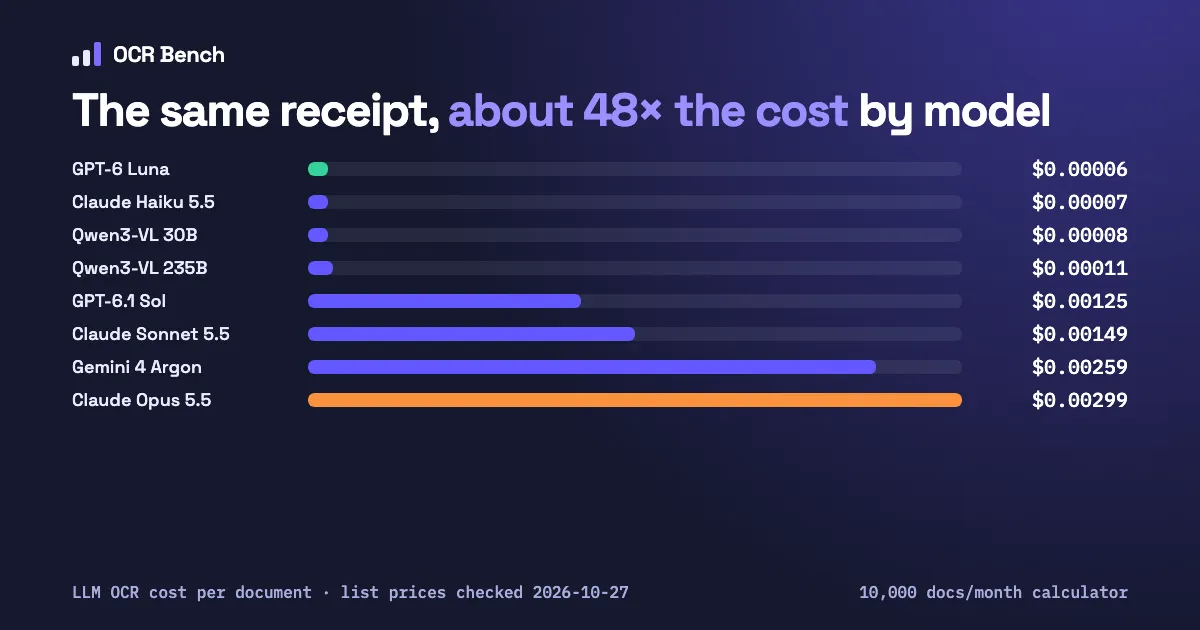
At 10,000 receipts a month that is $0.73 to $31.16. The dearest model costs about 43× the cheapest, so the model you pick is the biggest cost lever. Prices checked 2026-10-27.
This page closes that gap with measured numbers instead of guesses. Pick a sample document, or upload your own, and see what one extraction costs on each current model, then what it costs per month at your volume.
Each row prices one call per document: the page image plus your prompt go in, and the JSON you expect comes out. Choose one of three measured samples (a SROIE receipt, an AWS invoice, an IRS W‑9 form), or upload your own file together with an example of the JSON you want back. Tick the models to price, then estimate. Set your documents per month, open any model row to see its arithmetic, and use "Copy link" to share the exact setup.
Your ownreal token count
- Documents per month
1K 10K 100K 1M
At 10,000 receipts a month, LLM extraction costs
GPT-6 Luna is the cheapest and Claude Opus 5.5 the dearest, 43× apart.
Select a model to see the arithmetic. Costs are for one model call per document, at list prices.
Drop or choose a file JPEG, PNG, WebP or PDF, up to 15 MB
Prompt sent with the page Extract the company name, date and total from this receipt. Return JSON.
JSON the model returns { "company": "OJC MARKETING SDN BHD", "date": "15/01/2019", "total": "193.00" }
Real token counts, no guessing. Your file goes to the provider's own token counter (OpenAI, Google or Anthropic). No model reads it and nothing is stored.
Tick the models to price, then estimate. Models from one provider share a token count and keep their own rates.
input tokens × $ per 1M = cost+output tokens × $ per 1M = cost
List prices checked 2026-10-27. Copy link to this setup
Your first estimate was free. To keep the estimator open for everyone, solve this quick check before the next one.
The interactive calculator needs JavaScript. The comparison table below shows the same numbers for each sample document, and the formula is explained under "How it is computed".
The same numbers as the calculator, for every sample document and model, at 10,000 documents a month.
cost per document = input tokens × input price per 1M
- output tokens × output price per 1M
cost per month = cost per document × documents per month
Each term is divided by 1,000,000 because prices are quoted per million tokens (the receipt's GPT-6.1 Sol line is 544 × $2.00 ÷ 1,000,000). That division is the step where most back-of-the-envelope estimates go wrong.
Input tokens are the page(s) plus your prompt, counted by each provider's own free counter: OpenAI Responses input_tokens, Gemini countTokens, Anthropic messages.count_tokens. Qwen3‑VL has no free counter, so it is counted locally with its published image-packing rule. Models in the same generation share a sample count: both GPT-6 models, all three Claude 5.5 models, and both Qwen3-VL sizes. Those counts were measured on the sample page images with GPT-6.1 Sol, Gemini 4 Argon, and Claude Haiku 5.5. GPT-6 Luna, Claude Sonnet 5.5, and Claude Opus 5.5 return the same count on each of these pages, and both Qwen3-VL sizes use the same local rule.
Output tokens are the JSON from your example, counted with the o200k_base tokenizer for every model. The model's real answer will differ a little.
Prices are catalogue list prices per million tokens.
The cheapest model that gets the answer wrong is not cheap; it is a liability with a discount. Cost only means something next to accuracy and latency, so measure all three on the same documents before committing. See how to choose an OCR and extraction model for the full framework, and how OCR Bench scores extraction for how the accuracy half is graded.
Everything above is free to reuse if you link back. Download the table as CSV (every document and model, with input and output tokens, prices and cost; the source is on every row). The Copy embed HTML button under the calculator puts it on your own page. The embedded version prices the three sample documents; the article is where you can upload your own.
It depends on the model and the page. On the sample one-page receipt it costs $0.0001 with GPT-6 Luna and $0.0031 with Claude Opus 5.5, at the two ends of the current generation. The four-page invoice costs $0.0004 to $0.0160 depending on the model.
At the receipt's per-document cost, 100,000 documents cost $7.29 with GPT-6 Luna and $312 with Claude Opus 5.5. For the four-page invoice the range is $37.36 to $1,598. Enter your own volume in the calculator for the exact figure.
A one-page receipt is 435–1,166 input tokens and a one-page W-9 form is 631–1,166, depending on the provider. The four-page invoice is 2,485–4,532. The same image gets a different count from each provider because each resizes and tiles images by its own rules.
Not necessarily. Dedicated OCR services are typically priced per page and LLMs per token, so the answer depends on page size, your prompt and the model. This calculator covers LLM token pricing only; to compare the options fairly, run the same documents through each and look at cost together with accuracy.
No. It prices one clean call per document at list prices. Retries add to the bill, while caching and batch APIs can lower it, so treat the result as a baseline.
No. Your file is read in memory and sent to the provider's token counter to get the exact input count. No model runs on it and we do not save it.
Want the real per-document cost and accuracy for your documents, side by side? Start free, run a benchmark, and read all three numbers off one scorecard.
正文由 探How 从来源站点 RSS 同步,内容未经改写;遇到排版缺失或需要图片、视频时请以原文为准。