Rising Bond Rates and Their Risks
Alex, belikewater, Nuño Sempere, and 2 others
以下正文同步自 Hacker News 最新,版权归原站所有,已转换为易读排版。
+1
Alex, belikewater, Nuño Sempere, and 2 others
Oct 29, 2026
1
2
Share
Article voiceover
0:00
-39:41
Audio playback is not supported on your browser. Please upgrade.
Around the world, governments are paying more to borrow money. When interest rates on government debt rise, government borrowing may compete more with business investments, and growing interest payments can crowd out other government spending. Eventually, a country’s debt burden can become unsustainable. In this report, we will explore what is happening in bond markets worldwide, with a focus on the United States, why it’s happening, how countries might try to solve their debt problems, and what dangers might arise as a result.
Many governments borrow money by issuing bonds; the issuing government usually promises to make interest payments to an investor at regular intervals, and nearly always promises to repay the principal after a fixed term, on a date called the maturity date. Most government bonds can be bought and sold among investors.
Governments can offer bonds of any duration. The US Treasury offers short-term (up to one year), intermediate-term (2 to 10 years) and long-term securities (20, 30 years), and many other governments offer bonds of comparable maturities. The US 10-year Treasury yield is considered the benchmark yield, as it is a key indicator of long-term economic growth expectations, inflation expectations and market sentiment.
The 10-year Treasury yield has trended upwards since 2020. In contrast, the 2-year yield trended upwards after 2020 but fell between late 2023 and 2026. Short-term and long-term yields are not always coupled and are partly driven by different factors, but both have been rising this year.
10-year Treasury yield, via FRED https://fred.stlouisfed.org/series/dgs10#
2-year Treasury yield, via FRED https://fred.stlouisfed.org/series/dgs2
People loosely refer to yields on government bonds, particularly those issued by the US Treasury, as interest rates. Separately, however, central banks, such as the US Federal Reserve (“the Fed”), also set their own policy rates; the Fed steers its policy rate, a rate for overnight lending between banks, mainly by setting how much it pays banks and other institutions to keep money with it, and how much it charges banks to borrow from it.
The two sets of rates interact with each other, because investors attempt to optimize their returns, albeit sometimes in non-obvious ways. In general, however, very short-term yields fairly closely mirror central bank policy rates, and 1- to 2-year yields reflect where bond markets expect policy rates to go soon. By comparison, long-term yields reflect bond markets’ expectations for central bank policy rates, inflation, and growth, plus extra compensation for the risk of holding long-term debt.
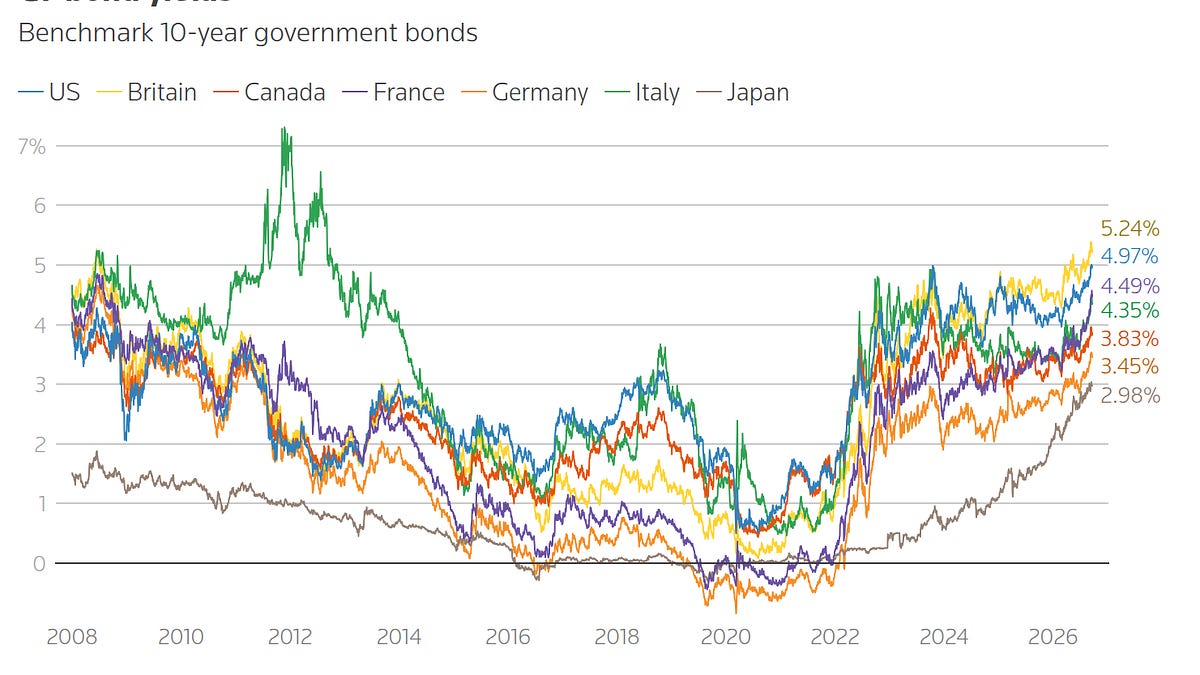
Beyond the US, bond yields have also been rising around the world, as we can see in the plot below. We can see that movements in longer-term bond yields tend to be correlated across countries, which makes sense because markets are global, money flows to the best returns, and countries often face shared global conditions.
G7 bond yields, via Reuters, https://www.reuters.com/business/finance/global-markets-treasuries-analysis-2026-09-23/
So, we are in a period of rising interest rates, on both short- and long-term government securities. To a first approximation, short-term rates are rising because central banks are convinced we are in a period of unacceptably high and rising inflation, and long-term rates are rising because of concerns about the credit-worthiness of many developed countries in conjunction with unusual demand for capital, driven by AI investment. Let’s examine short-term and long-term rates in turn.
Again, short-term yields on sovereign debt (in the US, yields on Treasury bills and short-dated notes) generally closely reflect a mix of current and expected central bank policy rates. The shorter the term, the more closely short-term rates reflect central bank policy rates; as the term approaches one or two years, rates primarily reflect expectations of central bank policy rates over the duration of the term. So, to understand yields on short-term government debt, we have to look at central bank policy rates.
Many major central banks voted to raise their policy and other rates in September. It is a central dogma of central banks that rising inflation requires this response. In the US, the Federal Reserve has stated that inflation has been a little higher than its 2% target for a long time now, so the Fed took corrective action by raising its policy rates in September. Moreover, it looks likely that the Fed will raise rates at least one or two more times over the next several months.
However, looking at the trend in inflation, i.e., in changes in monthly values of the consumer price index (CPI) compared to the previous year, inflation seems to be subsiding as a concern.
Median Consumer Price Index, via FRED https://fred.stlouisfed.org/graph/fredgraph.png?g=20grw&height=490
And yet, central banks are worried. In the case of the Federal Reserve, there is concern that rising fuel prices will feed into the costs of all goods and cause higher inflation than would be expected based on this past trend alone.
Brent crude price, via Trading Economics. https://tradingeconomics.com/commodity/brent-crude-oil
The concern is understandable. But there may be a behavioral bias at work here as well. President Trump has been applying considerable pressure on the Federal Reserve over the previous two years. He wants the Federal Reserve to lower rates because it stimulates the economy, in order to improve his popularity, whereas the Federal Reserve wants to drive inflation lower and uphold its independence in decision-making.
It is clear that Trump has taken actions to attempt to gain greater control over the Federal Reserve. Trump directly accused then-Chair Powell of unethical conduct in the restoration of the Fed headquarters building. He has also questioned Governor Barr’s competency as Vice Chair. And he has been relentless in attempting to fire Governor Cook for misrepresentations on her mortgage application. None of these actions have directly resulted in these governors leaving, and Powell even stayed on as a governor after being replaced as chair. That is already three out of seven governors that Trump has clashed with; additionally, Governor Jefferson, a Democratic appointee, might not be particularly inclined to go along with Trump. And current Fed Chair Warsh has weak standing among the other Fed board members, as they suspect he was appointed to do Trump’s bidding. Given this, Warsh is likely inclined to go against the President’s wishes for the time being, so as to gain credibility among his peers and in the financial community.
So, with Powell alienated, three other Democratic appointees, and Warsh having gone along with this recent hike, there is a balance of power in the board of seven that could potentially favor raising rates and asserting the Fed’s independence. Consensus opinion is that the Fed will continue to raise rates one or two more times, at the next Federal Open Market Committee (FOMC) meetings. And the decisions of the Federal Reserve tend to affect those of other central banks. In the case of Europe, there is also good reason to be concerned about the inflation rate. It was 3.8% in August 2026, after rising for several months, well above the ideal ECB inflation target of 2%.
Federal Reserve board of governors, via Wikipedia, https://en.wikipedia.org/wiki/Federal_Reserve_Board_of_Governors
Where is this going? If the current Federal Reserve rate-increase cycle is driven both by a concern about future inflation and also by a need to make a statement of independence, and if oil prices don’t increase much, then it seems likely that the Federal Reserve could stabilize rates after a couple of increases, or even start bringing them down. It is also possible that the desire to express independence will fall after the mid-term elections.
On the other hand, if the US war with Iran heats up and this raises oil prices further, we could see the concerns of the Fed realized, and the Fed could continue to raise rates. Further, if Trump continues to attack Federal Reserve governors, this may drive the Fed to continue raising rates as well.
All in all, conditional on oil prices falling under $100/barrel, our best guess is that the fundamentals do not indicate the need for a major increase in policy rates by the Fed. And in the end, the fundamentals are what drives the Fed’s decisions. So, if oil prices do fall, then after one or two more rate increases, we expect the Fed to hold rates steady. But if oil prices continue to rise, then all bets are off. And again, we expect yields on Treasury bills and short-dated notes to closely reflect the Fed’s current and expected policy rates.
But what about yields on longer-term bonds? Sovereign bond rates and yields on other longer-term debt have risen sharply in recent months, and this is driven by factors independent of those driving short-term rates. What is going on? Two trends are mutually driving longer-term rates higher: first, a persistent demand for debt to fund AI development, much of which has been fairly insensitive to rate pricing, and second, increasing concern about the debt levels and corresponding credit-worthiness of many developed countries.
Investment in AI in aggregate is projected to be the biggest “bet” in US history.
via the WSJ: https://www.wsj.com/economy/the-ai-build-out-is-becoming-the-biggest-economic-bet-in-u-s-history-c60716dd
Unlike the early days of web commerce leading up to the dot-com bubble, in which most investments were funded with equity, AI development is increasingly being financed with debt. One AI financing tracking source reports that global debt issuance for data centers is on track to be well over $500 billion in 2026, which is about double the 2025 figure. And really, capital expenditures in this area are just getting started. Private equity debt is a major driver of these borrowings. Exact data on interest rates for such financing is not easily obtained, given that much of it is private financing. But available information indicates that the rates tend to be higher than those for other commercial borrowings; for instance, this source estimates debt yield for a recent $5B datacenter deal to be 11%. This is not too surprising, given that investors expect spectacular rates of return on AI. Given these conditions, the volume of borrowings and borrowers’ willingness to pay higher rates, we should expect this competition for capital to put upward pressure on longer-term rates of all kinds, including on long-term government bonds. It is possible that this is all a bubble and that related borrowing demand could significantly reduce in a year or so. But unless this occurs, we should expect this demand for debt capital to persistently push up long-term interest rates over the next few years. And this is not particularly objectionable, as long as the assets financed produce positive economic returns.
In recent weeks, the market has aggressively reprised AI companies, particularly those that were very levered up with debt, like Oracle and CoreWeave, and started paying more attention to their projected return on capital, rather than assuming that they would all do well as AI continues to become more capable. This could be a sign that AI debt issuance will slow significantly. But unless it becomes apparent that AI will not deliver sufficient returns, we will probably continue to experience some upward pressure on interest rates from AI-related borrowings for some time.
The second and perhaps more worrying driver of long-term rate increases is increasing concern with the debt levels of many developed countries, and a perceived lack of resolve to address their budget deficits. Structur
正文由 探How 从来源站点 RSS 同步,内容未经改写;遇到排版缺失或需要图片、视频时请以原文为准。