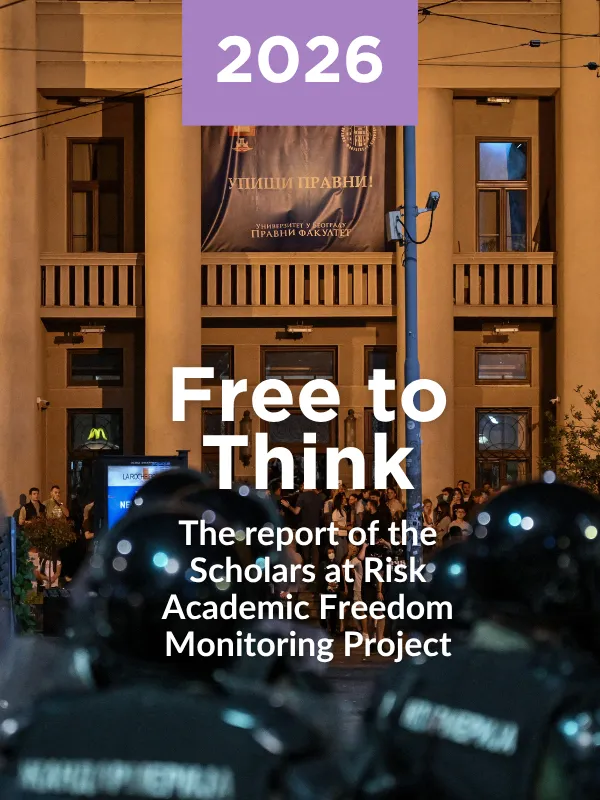
Free to Think
Free to Think is an annual report by Scholars at Risk’s Academic Freedom Monitoring Project. The report explores concerning trends in attacks on higher education communities around the world with the aims of raising awa…
以下正文同步自 Hacker News 最新,版权归原站所有,已转换为易读排版。
Share
Copy link
X
About Free to Think 2026
Free to Think is an annual report by Scholars at Risk’s Academic Freedom Monitoring Project. The report explores concerning trends in attacks on higher education communities around the world with the aims of raising awareness and urging diverse state and non-state stakeholders to join us in protecting and promoting academic freedom.
A PDF version of the report can be downloaded here.
Universities sit at the intersection of power and ideas. They exist to produce and share knowledge through research, teaching, debate, and dialogue. They teach students how to evaluate ideas based on evidence and reason, rather than authority and influence; they teach them to ask questions. This can be unsettling to those in power, especially when those questions examine underrepresented perspectives or long-held orthodoxies. As a result, universities, scholars, and students often come under attack by forces intent on preserving the status quo, silencing dissent, and imposing official narratives.
Some attacks involve direct repression, including police violence against student protests in India; the arrest, prosecution, and imprisonment of academics in Russia and Afghanistan; and the forced disappearances of Baloch student activists in Pakistan. Other attacks take the form of state interference in higher education operations. Interference degrades university autonomy, including the independence of universities to make decisions about hiring, curriculum, administrative functions, and the physical campus environment. Without such autonomy, scholars and students face constraints on their research and teaching or self-censor for fear of facing direct repression.
These attacks undermine academic freedom, which is grounded in existing international legal standards, including the freedom of opinion and expression, the right to education, and the right to the benefits of science, as well as elements of freedom of association and freedom of movement.
Through the Academic Freedom Monitoring Project (AFMP), Scholars at Risk (SAR) identifies attacks on higher education communities worldwide. SAR tracks and reports on key incidents to protect vulnerable individuals, raise awareness, encourage accountability, promote new tools to protect academic freedom, and promote dialogue and understanding necessary to prevent future threats. Since 2015, SAR has published Free to Think, a series of annual reports analyzing attacks on higher education communities. This year’s report documents attacks in 59 countries and territories and highlights concerning developments and trends in 22: Afghanistan, Bangladesh, China & Hong Kong, Colombia, Georgia, India, Indonesia, Iran, Nigeria, Pakistan, the Occupied Palestinian Territory, the Philippines, Russia, Senegal, Serbia, Syria, Türkiye, Ukraine, the United States, Venezuela, and Zimbabwe.
Free to Think 2026 documents 382 attacks on scholars, students, and institutions in 59 countries and territories from July 1, 2025, to June 30, 2026.
Attacks on the higher education community included direct repression and overt violence. State authorities attacked, disappeared, and wrongfully imprisoned members of the higher education community. They also deployed police and/or military force to crack down on student protests. Targeted assassinations of university leaders in Guatemala and Pakistan, wrongful imprisonment of scholars in China and Russia, and violent responses to student demonstrations in Iran caused immediate, severe harm to individual scholars, students, and staff. They threatened the functioning of higher education institutions and created a pervasive climate of fear, ultimately restricting academic freedom.
Attacks on higher education also took the form of external interference, undermining university autonomy and institutions’ ability to govern their curricula, administrative functions, and physical campuses. Governments used a range of tactics including legislation and executive orders to restrict higher education systems. In countries like Afghanistan, China, Iran, Russia, and Zimbabwe, state decrees directly violated autonomy by banning books and disfavored research topics or blacklisting entire education institutions from operating within their borders. Similarly, governments in Georgia, India, Serbia, and the United States have banned research topics, cut funding on ideological grounds, and placed partisan actors on university governance bodies. While often justified in neutral terms—such as fiscal discipline, public accountability, or anti-discrimination—these interventions are often used to impose ideological control.
Figure 1: Many of the countries featured in this edition of Free to Think have seen statistically significant declines in academic freedom in recent years, according to the Academic Freedom Index (AFI), a tool co-developed by the Global Public Policy Institute (GPPi), the Friedrich-Alexander-Universität Erlangen-Nürnberg (FAU), the V-Dem Institute, and SAR.
As highlighted in previous editions of Free to Think, the attacks on higher education documented in this report reflect deteriorating global conditions for academic freedom. The latest annual data from the Academic Freedom Index (AFI) documents this decline. In its 2026 update, the AFI found that academic freedom declined significantly in 50 of the 179 countries analyzed over the past decade, registering improvements in only nine. The AFI rated 9 of the 22 countries or territories featured in this report (and 34 overall) as “completely restricted” with respect to academic freedom: Afghanistan, China, OPT: Gaza, Iran, Russia, Türkiye, Syria, Venezuela, and Zimbabwe. Another six countries or territories in this report (and 30 overall) were rated as “severely restricted”: Hong Kong, India, Indonesia, Pakistan, OPT: the West Bank, and Ukraine.[1]
In the face of growing threats, there is reason for hope. Countries where institutional autonomy and academic freedom have declined can recover.
From 2019 to 2022, under the government of President Jair Bolsonaro, Brazil’s higher education community faced increasing threats to academic freedom and institutional autonomy, including the cutting of funds to universities on ideological grounds, the political appointment of university leaders, and attacks on individual scholars for their public expression. The AFI score for Brazil dropped from 0.81 in 2016 (“fully free”) to 0.44 (“moderately restricted”) by 2019. With the arrival of the administration of Luiz Inácio Lula da Silva in 2022, academic freedom has rebounded as the government has moved to restore research budgets, protect university autonomy, and respect the freedom of academic expression. The AFI score rose back up to 0.85 (“fully free”) by 2025.
Figure 2: During the Bolsonaro administration in Brazil, the AFI dropped from “fully free” in 2015 to “moderately restricted” between 2018 and 2022. Brazil’s status officially returned to “fully free” in 2024.
New administrations in Bangladesh, Hungary, and Venezuela similarly offer reason for cautious optimism.
Nationwide student protests in 2024 led to the establishment of an interim government in Bangladesh. The Yunus-led interim administration attempted to bolster academic freedom through political reforms that depoliticized campus governance and removed high-level political appointees. The AFI increased from 0.13 (“completely restricted”) in 2023 to 0.52 (“moderately restricted”) in 2025.
In Hungary, under the leadership of Prime Minister Viktor Orbán, the AFI score fell from 0.95 (“fully free”) in 2009 to 0.3 (“severely restricted”) in 2026. The government transferred ownership of most state universities to private “asset management foundations” that were clearly aligned with the government, while also directing enormous resources to ideological projects such as the new Matthias Corvinus Collegium (MCC).[2] Together, these actions profoundly distorted the Hungarian academic and research environment by undermining institutional autonomy and university self-governance, eroding transparency, and embedding political loyalty into academic decision making.
With the election of Péter Magyar in April 2026, there is an opportunity to reverse Hungary’s trajectory including by restoring university autonomy, dismantling politicized governance structures, and rebuilding Hungary’s relationship with the EU. There are early signs that Magyar’s government is indeed moving in this direction. By the end of May, less than a month after Magyar took office, Hungary had indicated it would phase out the private foundation university model and rejoin the Erasmus student exchange programs.[3]
Likewise, under the previous Chávez and Maduro administrations, the AFI score for Venezuela fell from 0.9 (“fully free”) in 1999 to 0.13 (“completely restricted”) in 2025. Following the US abduction of Venezuelan President Nicolás Maduro in January 2026, actions taken by the administration of Acting President Delcy Rodríguez suggested new possibilities for restoring academic life. In February, the Venezuelan Student Movement held its first opposition protest in over a year—having previously avoided public demonstrations since the intense repression that followed the contested July 2024 election. Observers noted a surprising absence of direct crackdowns; despite strategic police deployments, security forces ultimately allowed the marches to proceed freely.[4]
While changes in government such as those in Bangladesh, Hungary, and Venezuela can occasionally create opportunities for improvements in autonomy, higher education communities can sometimes resist state interference even without a change in leadership. Even while Orbán’s government remained in power in Hungary, the Central European University filed a legal claim with the European Court of Human Rights in 2023 and ultimately won its case (though the decision alone was insufficient to prevent the university’s forced partial relocation to Vienna).[5] Faculty at Boğaziçi University in Türkiye have held daily protests for five years against the government’s 2021 imposition of a new rector, which violated long-standing university traditions and practice.[6] Similarly, faculty and staff at universities across Serbia risked their jobs to stand in solidarity with students facing escalating state crackdowns.[7] While these efforts alone were not enough to prevent threats and violations, they exposed the illegitimacy of government actions while subjecting violators to public scrutiny on both national and international stages. Creative resistance remains possible even under difficult conditions.
The higher education community and its allies must take steps to bolster academic freedom and autonomy. Guarding against attacks on higher education requires channeling energy and creativity into increased sophistication, both operationally and strategically. States must implement formal legal protections to secure academic freedom, but protecting higher education is a responsibility also shared by the higher education sector, civil society, and the general public.
With this report, SAR calls on states, higher education communities, and civil society around the world to recognize the urgent need to protect academic freedom: to reject violence and coercion aimed at restricting inquiry and expression; to protect threatened scholars, students, and higher education institutions; to fight illiberal policies and practices that constrain intellectual discourse, research and teaching; and to publicly demonstrate that critical discourse is not disloyalty, that ideas are not crimes, and that everyone must be free to think, question, and share their ideas.
[1] OPT: Gaza and OPT: West Bank are listed separately to reflect different ratings in AFI da
正文由 探How 从来源站点 RSS 同步,内容未经改写;遇到排版缺失或需要图片、视频时请以原文为准。