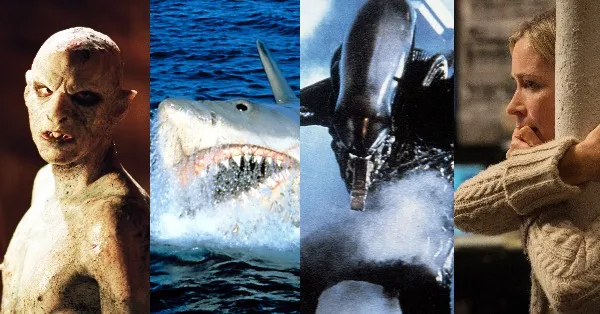
How Does Creature Screen Time Affect a Scary Movie's Tomatometer?
This year, the Kane Parsons-directed horror film Backrooms pulled in $394 million worldwide and introduced the world to “Pirate Clark,” a hulking Backrooms creation played by 7’7” actor Robert Bobroczkyi (who also playe…
以下正文同步自 Hacker News 最新,版权归原站所有,已转换为易读排版。
By
Mark Hofmeyer | Updated October 29, 2026
This year, the Kane Parsons-directed horror film Backrooms pulled in $394 million worldwide and introduced the world to “Pirate Clark,” a hulking Backrooms creation played by 7’7” actor Robert Bobroczkyi (who also played The Offspring in Alien: Romulus). With less than three minutes of screen time, the tall pirate shivered the timbers of audience members as he chased Oscar-nominee Renate Reinsve through dull yellow rooms and into the Ottoman Empire. During the chase, the monster blasts through doors, bites heads, and moves slower than a pirate ship anchored to a dock. It’s a good thing Parsons keeps its screen time to a minimum because the peg-legged plunderer needed to be feared, not over-analyzed.
In the tradition of some of the most celebrated monster movies in cinema, Backrooms keeps its creature cards close to its chest, only revealing what its mysterious threat actually is at about 86-minute mark. Even then, we rarely get a chance to ogle the tall pirate that terrorizes Reinsve and Chiwetel Ejiofor — marvelous though it is.
But is hiding your beasties always best for your movie?
With spooky season upon us and Kane Parsons reportedly traveling back to the Backrooms for an upcoming sequel, we’re looking at whether the screen time filmmakers give their creatures affects how well their movies are received by critics. Does following the Jaws rule of keeping your monster below the surface for an excruciatingly long stretch of your running time necessarily mean your movie will achieve Jaws-like levels of nail-biting tension and critical acclaim? Should movies show more or less when it comes to things that want to kill you? And should they reveal their killers straight out of the gate, or wait to the bitter and bloody end?
Filmmakers offer wildly different answers to those questions. Some unleash their beast(s) almost immediately (Bubba Ho-Tep) and are adored by critics and fans, while others choose to withhold the full reveal until minutes before the end (The Ritual). Some choose to feature their creations for only two minutes (Signs) while others let their monsters linger on screen a lot longer (Hello, King Kong). The impact these choices have on critical reception, as measured through the Tomatometer, is what we’re investigating below.
Specifically we’re diving into two questions:
We pulled together 75 creature features and analyzed their use of their central monsters in an effort to answer the questions. The movies were selected because they encapsulate key aspects of their genre, were created by Stan Winston (a given), or are trendsetters, cult-classics, or underappreciated gems. We understand these 75 films don’t come close to covering the entirety of the genre, but the data pulled from them does give us some understanding of over 90 years’ worth of cinematic monsters and how their creators used them. The full list is below, and more details about our criteria for choosing them can be found at the bottom of this feature.
(Photo by (c) 20th Century Fox Film Corp)
Creature features that show their monsters for more than four minutes have a higher Tomatometer average than those under four minutes — but just barely.
66.7% (four minutes or more) > 63.8% (less than four minutes)
Movies that feature their “This is me!” money shot in the first 30 minutes have a higher Tomatometer average than those that unleash their beasts earlier… or later.
65.1% (Monster revealed in first 30 minutes ) > 67.8% (Monster revealed in minute 30-60) > 64.5% (Monster revealed in minute 60-90).
While it’s always nice to have a flashy headline saying “More Monsters Equal a Fresher Tomatometer Average,” these results prove that it doesn’t really matter when monster movies unleash their beasts. There are cases to be made for showing beasts often and early, or sparingly and late. Which is refreshing, considering the template set by movies like Jaws, Alien, and Predator — which wait a long time to deliver their respective money shots.
Movie lore would have it that the best creature features are those that wait patiently to reveal their bad guys, then don’t show them much at all. Show a bit of leg, or fin, to tease your audience and keep them wanting more. There’s data to support this approach. Films like Jaws, Alien, Cloverfield, and Signs are all massive hits that waited an average of 67 minutes to fully reveal their creatures, and then only showed them on screen for a little over three minutes.
Steven Spielberg’s Jaws and Ridley Scott‘s Alien are classics of the less-is-more school, both with Tomatometer scores of 97%. However, when we combine those movies’ scores with the Tomameter scores for other movies that delay their monster reveals until after the 60-minute mark — Rotten flicks like Leviathan, Deep Rising, The Faculty, and The Relic — their exceptional individual numbers are weighed down by the stragglers. Combined, these late revealers have an average score of 64.5%, while the movies that fully introduce their monsters within the first 30 minutes average 65.1%. The latter set includes The Host (2006), It Follows, Pacific Rim, The Blob, Attack the Block, Bubba Ho-Tep, Creature from the Black Lagoon, Pandorum, and Trollhunter.
When you dig into that cream of the creature-feature crop — the 11 best-reviewed films in the data set — some interesting trends and moments in movie history emerge.
- Them! (1943) – 93%
- The Host (2006) – 93%
- Aliens (1986) – 93%
- Alien (1979) – 93% 7. Godzilla (1954) – 94% 6. Prey (2022) – 94% 5. It Follows (2015) – 95% 4. A Quiet Place (2018) – 96% 3. King Kong (1933) – 97%
- Jaws (1975) – 97%
- Godzilla Minus One (2023) – 99%
In this group of 11 (we had to account for ties), you can see something like an evolution of the creature feature.
King Kong (1933) | Them! (1954) | Godzilla (1954)
King Kong and Godzilla are arguably the most famous of all monster movies. Both of their central creatures have starred in numerous sequels and reboots, and they now share their own cinematic universe with Godzilla (2014), Kong: Skull Island (2017), Godzilla: King of the Monsters (2019), Godzilla vs. Kong (2021), and Godzilla x Kong: The New Empire (2024), with Godzilla x Kong: Supernova set to hit theaters in 2027. The first films that each character appeared in set up a successful template for how and when to introduce monsters.
Both giants get their first money shot at the 46-minute mark of their debut films, and then are given lots of screen time to destroy their respective countries’ largest metropolises. Kong was on screen for just over 18 minutes and Godzilla was featured for almost nine full minutes (8:56). At times when moviegoers were eager for spectacle and special effects, they were getting their money’s worth with these beasts.
We come to know and sympathize with them, and it is thus a tragedy when they die at the hands of humans. If you want your monster to be more of a character than simply a menace, we need time to get to know it. You might even win an Oscar for your efforts if you do, as Guillermo del Toro did with The Shape of Water.
When it comes to the 1954 “nuclear monster” film Them!, the irradiated ants get plenty of screen time (7+ minutes), but they exist to munch on soldiers, not provide pathos. Director Gordon Douglas used the giant ants to explore nuclear radiation, Cold War paranoia, and hidden armies lurking under the surface. The 12-foot mechanical ant puppets built by Dick Smith never get names (RIP Antie from Honey, I Shrunk the Kids); instead, they are treated like a nameless army of invaders who, if given the chance, would overtake the world in less than a year. Both Godzilla and Them! explore the fallout of dropping atomic bombs, and they helped monster movies enter a new world filled with destruction, real-world themes, and science.
Jaws and Alien are considered the most important creature features of the modern era — they helped create the summer blockbuster and, at the same time, brought the horror genre a prestigious allure (suddenly it was OK for A-list directors to tackle B-movie material). They also redefined the monster movie with their less-is-more approach.
Spielberg and Scott both wait until after the 60-minute mark to fully reveal their monsters, and it’s a very deliberate game of peak-a-boo that they’re playing. Scott’s delay allows audiences to witness the birth and evolution of a slick and juicy-looking beast (Facehugger, Chestburster, Xenomorph); Spielberg has us floating in fear of the unknown, unseen “thing” lurking below the surface (sure, we know that Bruce the mechanical shark was the reason behind that decision, but it’s effective nonetheless).
We’re not meant to empathize with these creatures — we’re supposed to run, swim, and scream for our lives.
Filmmakers ever since have emulated this approach, but it doesn’t always work. Four of the lowest-rated movies in the data set delayed the full reveal of the monsters until after the 80-minute mark and featured their creations for less than three minutes each. The Relic, DeepStar Six, Deep Rising, and Leviathan all kept their monsters from audiences for way too long and then didn’t show them enough. There needs to be a reason to withhold your monster from the audience, because if not, it feels like the movie is cheating. It also helps if there’s something interesting going on while we wait for the monster money shot. Some interesting human drama, say.
Aliens (1986) | Prey (2022) | Godzilla Minus One (2023)
For this section, we’re focusing on the three sequels in the top 11. All three films had the luxury of prior installments introducing their monsters (or familiarizing us with what they are), which means they didn’t need to dedicate screen time to world-building. Directors James Cameron (Aliens), Dan Techtenberg (Prey), and Takashi Yamazaki (Godzilla Minus One) “simply” had to add new ingredients to keep the franchise fresh and exciting. They knew what audiences wanted (death, explosions, atomic breath) and crafted stories and characters worth watching around the familiar elements. They also gave their monsters more screen time than the first installment, which backs up sequels going bigger and badder.
James Cameron took what Ridley Scott created (xenomorphs, chest bursters, facehuggers, eggs, evil companies), added space marines, a Queen Alien, and a likable kid, and crafted one of the best sequels ever. Cameron knew he couldn’t recreate the terror of the first Alien movie, so he directed a propulsive action film involving space marines battling deadly xenomorphs and a ticking clock. When a chestburster appears at the 60-minute mark, the film becomes a splatterfest, dedicating 992 seconds (versus the 210 seconds of the first film) to the xenomorphs and Alien Queen. A reason for the uptick in Xenomorph screen time is that Cameron didn’t have to reintroduce all the evolutionary steps, because by the time the infantry arrives on exomoon LV-426, the gooey Xenomorphs are already running wild.
For Prey, Trachtenberg went back in time to 1718 to match up a “Feral Predator” with a Comanche warrior named Naru (Amber Midthunder – Legion forever!). The lack of gigantic men shooting gigantic guns grounded the experience, as Naru wills herself to victory using her smarts, combat skills, and a mud pit. All the popular Predator trademarks are featured and respected (laser guns, heat vision, mud, slaughter), and we get more of the good stuff because Trachtenberg delivers the Yautja money shot 35 minutes in, whereas Predator (1987) waited until the 79th minute to unleash the beast. The Yautja in Prey gets more screen time (813 seconds vs. 530 seconds) as it battles fur trappers, bears, and Naru throughout the movie. In a smart move by Trachtenberg, the “Feral Predator” is young and overconfident, which makes it reckless during its hunt. Instead of hiding, it walks into chaos, which the veteran Y
正文由 探How 从来源站点 RSS 同步,内容未经改写;遇到排版缺失或需要图片、视频时请以原文为准。