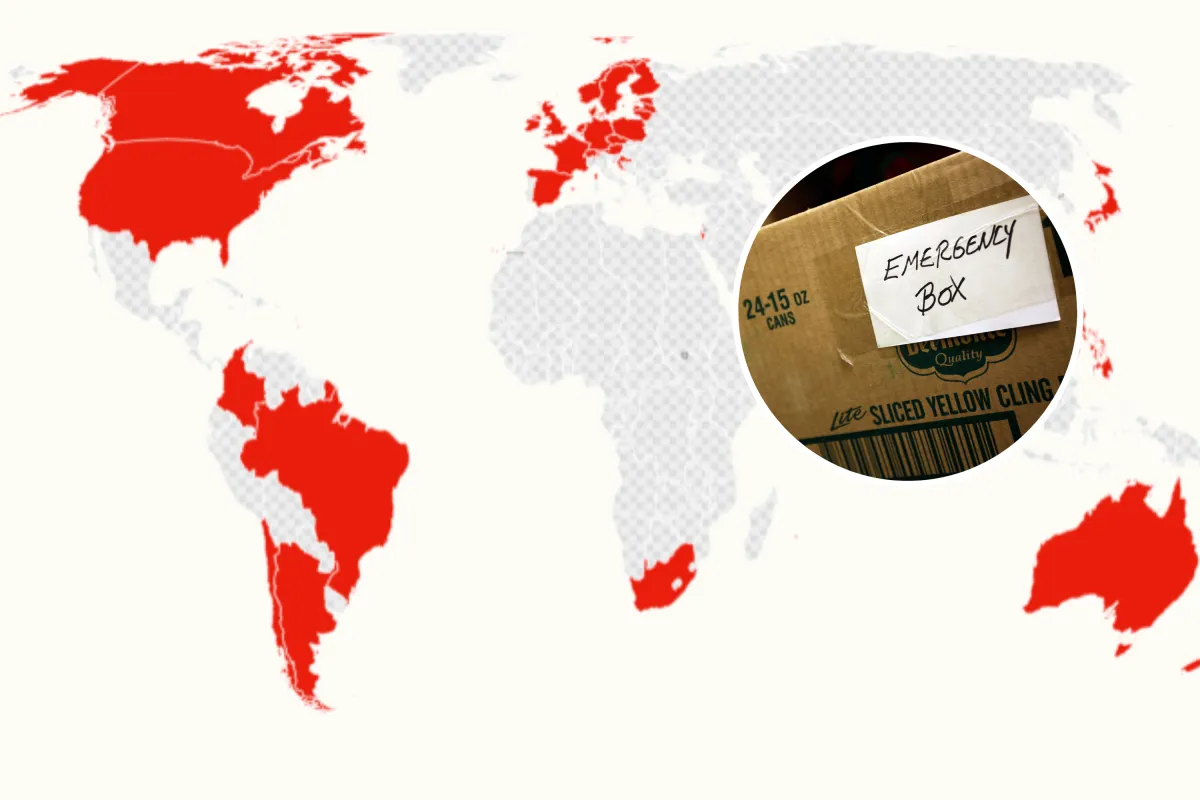
Map Shows Nations Urging People to Stockpile Food as France Issues Warning
See more of our trusted coverage when you search.Prefer Newsweek on Googleto see more of our trusted coverage when you search.
以下正文同步自 Hacker News 最新,版权归原站所有,已转换为易读排版。
10
Loading video...
By Marni Rose McFallReporter
Share
Newsweek is a Trust Project member
See more of our trusted coverage when you search.Prefer Newsweek on Googleto see more of our trusted coverage when you search.
Around the world, governments are increasingly advising their citizens to have provisions in the case of an emergency such as war, extreme weather and cybersecurity threats.
Different countries advise different levels of preparedness. Having emergency supplies for a three-day period is commonly advised. France and the U.K. recently advised people to have supplies for a period of 72 hours ready.
“Don't wait for the emergency: prepare now!” a government account for the French region of Normandy said in a social media statement on Tuesday.
Meanwhile, British Prime Minister Andy Burnham said during an interview on BBC Radio: “I do like my beans, so I have plenty of those in the cupboard, and soup. I think those are the kind of things that I would recommend people to have.”
Canada, Japan, Mexico and the Netherlands also advise an emergency kit for a 72-hour period. Other countries suggest a longer preparedness period, with Sweden and Norway advising having supplies for about one week, and Germany advising supplies for up to 10 days.
Some countries have less time specific guidelines. In the U.S., for example, advice published on Ready.gov, a website of the Department of Homeland Security, states: “Being prepared means having your own food, water and other supplies to last for several days.”
India’s National Disaster Management Authority advises households to have a disaster emergency kit but doesn’t stipulate a time frame.
In some cases, advice is given for general emergencies, while in others, it applies to specific hazards.
Some countries have region-specific advice. For example, in Western Australia has advised that residents in cyclone-prone areas prepare an emergency kit with food, water and medication. Similarly, the city of Cape Town in South Africa tells households to maintain enough supplies to last for at least three days.
There has been a specific focus on emergency preparedness in Europe over the past two years. The European Commission unveiled its Preparedness Union Strategy in March of 2025 and said that Europe faced growing geopolitical tensions and conflicts, as well as the threat of natural disasters owing to climate change.
While advice on the exact amount of time people should have provisions for varies, guidance on what the contents of an emergency kit should be is relatively consistent, with governments advising stocks of non-perishable food, water, medicine, batteries, a flashlight and a radio.
Newsweek has compiled a map of countries where governments are advising for emergency preparedness and recommending stockpiling of food.
Newsweek has contacted the White House for comment via email outside of regular business hours.
The United Kingdom, Ireland, France, Germany, Netherlands, Denmark, Norway, Sweden, Finland, Estonia, Latvia, Lithuania, Poland, Czech Republic, Austria, Switzerland and Croatia.
Japan, Taiwan, Israel, India, Philippines and Singapore
Dan Bongino, the American conservative podcaster and former deputy director of the FBI, recently spoke about emergency preparedness on The Dan Bongino Show.
He began by advising the importance of not panicking, before telling viewers: “The way to reduce anxiety and panic in tumultuous times is to be prepared.”
“Have yourself an emergency radio, have yourself some batteries. Get yourself some emergency food, get yourself a rain collection and water filtration tablets,” he said.
Assistant Director of the FBI Office of Public Affairs Benjamin Wilson told Newsweek over email in response to Bongino's comments: "Dan Bongino led the FBI as deputy director during one of the most successful periods of crime reduction in American history—including the historic Summer Heat violent crime surge, which arrested over 8,000 violent fugitives, identified or located over 1,000 children, and took thousands of deadly drugs off the streets."
"Any stories on his time at FBI should focus on that—and in the meantime he has every right to speak for himself as a now private citizen," Wison added.
The advice around emergency preparedness comes as Defense Secretary Pete Hegseth wrote in a recent memo that more U.S. military bases will need to be able to run independently for at least three months should they be cut off from external supplies in the event of a conflict.
On September 30, Hegseth unveiled the Federal Operations for Resilience, Troop Resources, Energy, Supply and Survivability (FORTRESS) initiative.
He dubbed it the “nation’s insurance policy” to ensure that the U.S. would still be able to obtain the materials it needs and carry out operations if traditional supply chains were to be cut off.
Newsweek’s reporters and editors used Martyn, our AI assistant, to produce this story. Learn more about Martyn here.
Contact Newsweek editors on this story: Edward Pearcey and Tony Phillips.
Update 10/29/26 07:50 a.m. ET: This article has been updated to include comment from Benjamin Wilson.
正文由 探How 从来源站点 RSS 同步,内容未经改写;遇到排版缺失或需要图片、视频时请以原文为准。