What happens when you analyze your favorite college football team like the CIA?
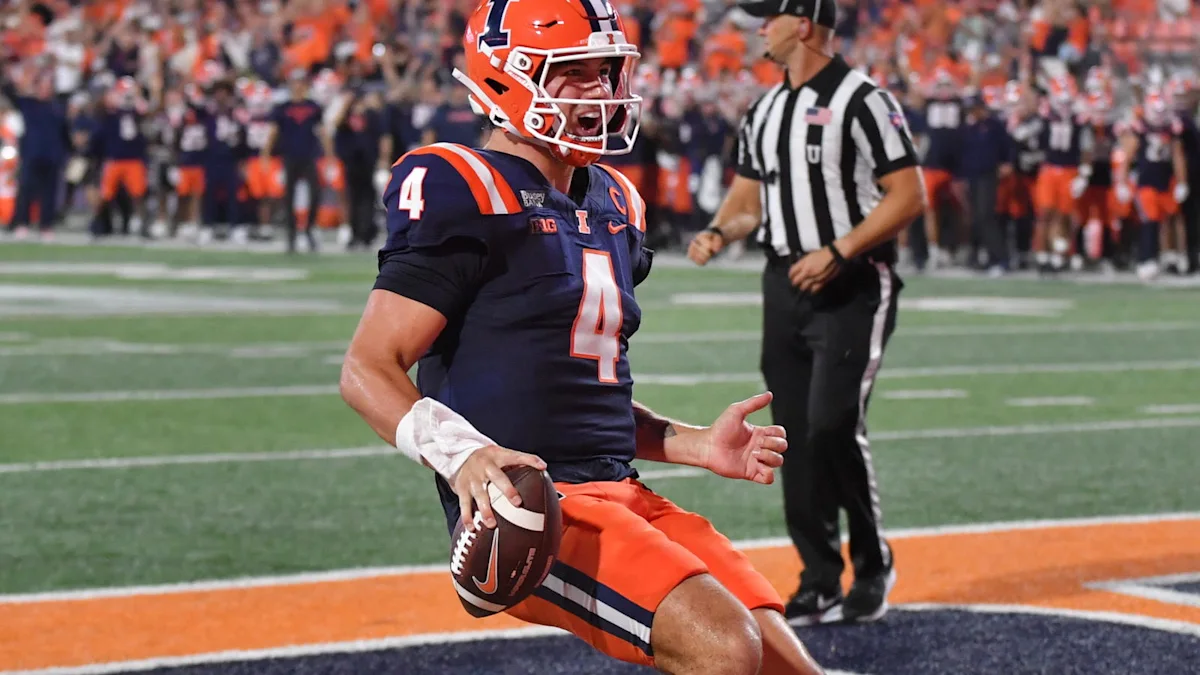
A couple weekends ago, the Illinois football team lost to Duke at home,
以下正文同步自 Hacker News,版权归原站所有,已转换为易读排版。
A couple weekends ago, the Illinois football team lost to Duke at home, 31–27. My Hinsley model immediately became much less optimistic about Illinois making the College Football Playoff.
But it became more optimistic about the offensive line and our new quarterback.
That sounds contradictory, but it's exactly what I wanted to happen.
For the past 15 years, we've worked with people whose job is to make judgments about uncertain futures: intelligence and government analysts, foreign-policy researchers, investors, and corporate strategists. This year I decided to try an experiment. I took the methodology we've developed for that kind of work and applied it to something considerably less consequential: assessing the fortunes of the University of Illinois football team.
To understand why, it helps to think about what an intelligence analyst actually does.
During the Cuban Missile Crisis, American intelligence analysts were trying to understand what the Soviet Union was doing in Cuba. They had a growing collection of evidence, but the difficult part was deciding what it meant. Analysts had to consider competing explanations, identify the observations that distinguished one from another, and revise their assessments as new evidence arrived. Eventually, U-2 photography provided much stronger evidence that the Soviets were installing nuclear missiles.
The stakes are obviously rather different, but the analytical problem is surprisingly general. Usually there isn't one fact that gives you the answer. There are several possible futures, a huge amount of imperfect information, and a smaller number of things that actually help distinguish among them. The analyst's job is to impose structure on all of this without becoming more certain than the evidence warrants.
You find versions of this problem everywhere. A foreign-policy analyst might be trying to understand whether a conflict will escalate. An investment analyst might be thinking about how geopolitics, regulation, or a new technology will affect an asset over the next decade. A government analyst might be assessing how another country will respond to a policy change. The useful question isn't simply, "What do I think will happen?" It's: What are the plausible ways this could turn out? What would have to be true for each of them? What should I be watching? And what new evidence would cause me to change my mind?
It's not broadly known, but for more than a decade, Cultivate ran a prediction market for the U.S. Intelligence Community, giving analysts a way to make and aggregate probabilistic forecasts about geopolitical and national-security events. More recently, our work has expanded beyond forecasting individual questions into the broader analytical process around them.
That's what led us to develop Continuous Probabilistic Foresight, or CPF, the methodology at the heart of Hinsley, our AI/human hybrid analysis platform. CPF starts with a strategic question and maps the range of plausible outcomes as scenarios. It decomposes the problem into the drivers and indicators that would make those scenarios more or less likely, makes assumptions explicit, and turns important uncertainties into resolvable forecasting questions. As new evidence arrives, those forecasts and the larger assessment can change with it.
The idea isn't to build a crystal ball. It's to maintain a structured, explicit view of an uncertain future, and to know why your view changes when the evidence does.
Which brings me back to Illinois football.
Having grown up in Champaign, I'm a lifelong Illinois fan, and college football turns out to be almost comically well suited to this kind of analysis. A season is an uncertain future surrounded by an enormous amount of information that is constantly evolving. We have preseason recruiting, game results, injuries, competitor performance, statistics, coaching changes, on-field performance, preseason models, beat reporting, podcasts, and endless amounts of informed and uninformed commentary. We know some things with reasonable confidence, have strong opinions about others, and are almost certainly wrong about a few things we currently regard as obvious.
So instead of just following the season the way I normally would, I asked Hinsley to follow Illinois the way an analyst might follow a country, company, market, or strategic issue.
I started a couple months ago with the question I think most Illinois fans are ultimately trying to answer before a season: What is the ceiling this season for the University of Illinois football team?
正文由 探How 从来源站点 RSS 同步,内容未经改写;遇到排版缺失或需要图片、视频时请以原文为准。