Canada to join EU network of supercomputers
The compute power team-up is a first step for middle-power cooperation on AI.
以下正文同步自 Hacker News 最新,版权归原站所有,已转换为易读排版。
The compute power team-up is a first step for middle-power cooperation on AI.
Listen
AI generated Text-to-speech
European Commission president Ursula von der Leyen said on Thursday Canada "will now become part of this network", confirming a POLITICO report from earlier this week that both sides were discussing the country's entry into the European supercomputing network.
Canada joining "enables Canadian industry, startups and researchers to access European supercomputing," von der Leyen said. "Paired with Canada's pioneering AI industry, this would allow us to develop highly competitive, innovative and safe AI systems."
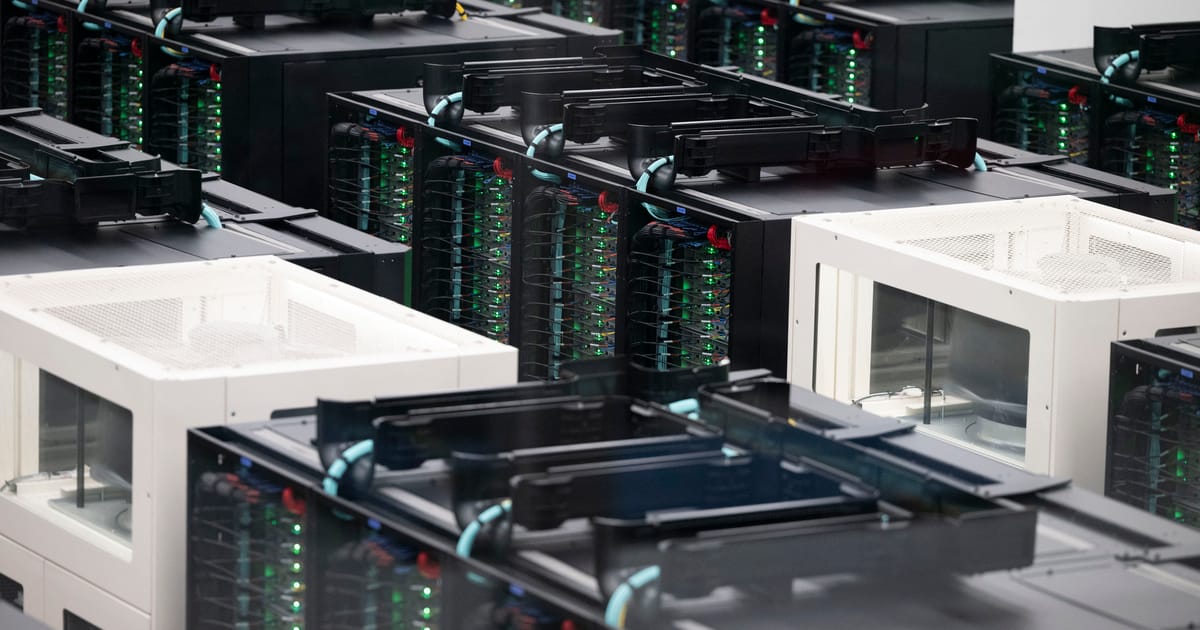
The EU's supercomputing network is run by the EuroHPC Joint Undertaking, an EU public-private vehicle with an €8.2 billion budget. The network consists of 14 supercomputers (some ranked in the global top 10), 19 AI-focused AI factories and 10 quantum computers.
The vehicle will also run seven massive AI data center hubs, known as AI gigafactories, set to be built next year with a total investment cost of €30 billion.
Experts praised a possible EU-Canadian compute power team-up, but warned it's only the start.
“Compute cooperation is one of the most obvious short-term ‘middle power’ cooperation plays in AI,” said Anton Leicht, technology and international affairs fellow at Carnegie Endowment for International Peace.
But he added that for now “it doesn’t put a dent into the actual dependence" on the U.S.
“As long as the U.S. builds gigawatt-scale clusters, no amount of cooperation that doesn’t result in massive buildouts will help,” he said.
Canada's engagement in the EU's supercomputer network builds further on Canada's previous partial involvement in the EU's flagship research and development program, Horizon Europe.
To date, 38 countries have participated in the EU's supercomputing network: 27 EU member countries plus non-EU countries including Norway, Switzerland, the United Kingdom, Israel and Turkey.
Related Tags
Artificial Intelligence
Budget
Cooperation
Data
Data Centers
Horizon Europe
Industry
Intelligence
Investment
Quantum
Startups
Supercomputers
Technology
Related Countries
Canada
Norway
Switzerland
United Kingdom
United States
Related People
Ursula von der Leyen
Related Organizations
European Commission
Our readers read next
Von der Leyen touts ‘associate member’ status for Canada over objections of EU capitals
1 HR ago
4 mins read
Belgium’s deputy PM wants to use ‘trade bazooka’ on US over pharma threats
5 HRS ago
3 mins read
UK social media ban likely to require photo ID checks
8 HRS ago
2 mins read
SPONSORED CONTENT FROM IIGCC
Don’t turn a methane pause into a retreat
13 HRS ago
5 mins read
More from Pieter Haeck
European CEOs warn against surrendering frontier AI to US and China
Leaving the AI race means Europe will be saddled with “leftovers,” says Arthur Mensch.
The European Parliament held a heated debate over how to handle AI, with the center-right doubling down on simplification to boost European business.
European Commission officials insist the 2023 law is strong enough to handle the security risks of the newest AI models.
The new mantra? Don’t panic about owning the models — put them to work instead.
正文由 探How 从来源站点 RSS 同步,内容未经改写;遇到排版缺失或需要图片、视频时请以原文为准。