You Quit What Drained You. Why Do You Feel Worse?
Quitting the news can leave you flat even when you are better off. The habit was also filling your day, and the problems it covered surface all at once.
以下正文同步自 Hacker News 最新,版权归原站所有,已转换为易读排版。
Quitting the news can leave you flat even when you are better off. The habit was also filling your day, and the problems it covered surface all at once.
You stopped following the news. It kept you anxious and angry about things you could not change, and you were right to stop. A few weeks later, you feel flat. Nothing is wrong, and somehow that is the problem. Worse, things you had not thought about in months are suddenly loud: a relationship, your health, your work, your family.
You are not alone in quitting. In the Reuters Institute's 2025 Digital News Report, about four in ten people across 48 countries said they sometimes or often avoid the news, and the top reason was its effect on their mood. And you are not imagining the flatness. In a 2018 trial, 138 people who gave up Facebook for five days had lower levels of cortisol, a stress hormone, than those who kept using it. They also reported lower life satisfaction. Their bodies were calmer. They felt worse.
That does not mean quitting was a mistake. A larger experiment paid people to deactivate Facebook for four weeks: they ended up less informed about the news, spent more time with family and friends, and were somewhat happier. Both can be true. You are better off, and you feel worse for a while, because the habit was doing more than draining you:
The first three explain the flatness. The psychologist Peter Lewinsohn argued that depression tracks a drop in rewarding activity. Quit a habit and you remove the drain and the rewards it came with at the same time. If nothing replaces them, your days get emptier, and your mood follows.
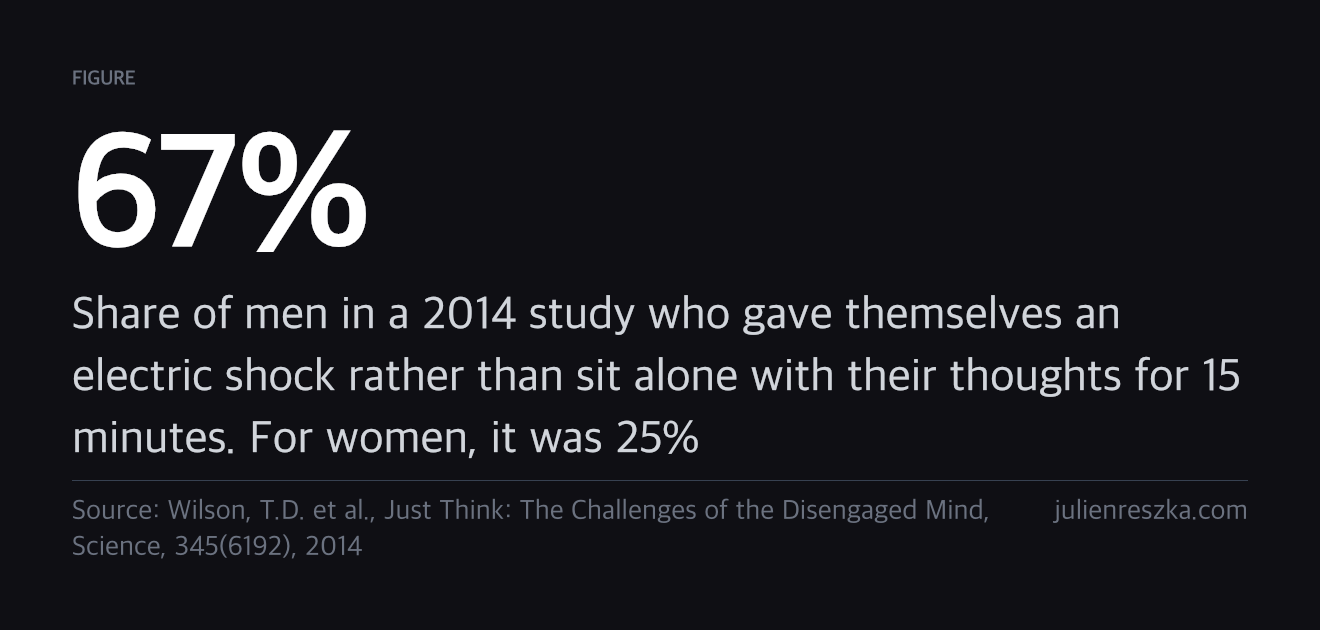
The fourth explains the noise. Your mind was never empty, it was occupied. People go to surprising lengths to avoid being alone with their thoughts: in a 2014 study, 67 percent of men and 25 percent of women gave themselves an electric shock rather than sit with nothing to do for 15 minutes. And research on thought suppression, starting with Daniel Wegner's white bear experiments, found that thoughts pushed away tend to come back once you stop pushing. The news was a very effective way to keep pushing. Take it away, and what you set aside comes back all at once.
That backlog feels heavier than the news ever did, because it is closer. It is about your life, not someone else's. But that is also what makes it worth your attention. Unlike a war or an election, you can actually do something about it.
The way back is not the old habit. It is to replace what the habit gave you, on purpose. This is the logic of behavioral activation, a therapy built on Lewinsohn's idea: act first, and let mood follow. In a 2006 trial of 241 adults with major depression, it did about as well as antidepressants for the more severely depressed patients, though a later reanalysis of earlier data did not confirm that it beats other therapies.
The writing step comes from Pennebaker and Beall's 1986 study, where students who wrote about personal upheavals that way made fewer health center visits over the following months. It felt worse at first, then better.
The flatness is not a sign you should go back. It is the space the old habit was taking up, and you finally get to decide what fills it.
If you quit something draining and feel flat, do not go back to it. Replace what it was quietly giving you, small daily rewards, structure, and a sense of being involved, with things closer to you that you can act on.
Both free to try, no login needed. Data stays local in your browser.
You finally quit the news that kept you anxious. Weeks later you feel flatter, not better, and personal problems you never had time for are suddenly loud. Is that a sign you should go back?
All comments are manually moderated by the author.
Thanks — your comment is queued for moderation.
Thanks — your reply is queued for moderation.
正文由 探How 从来源站点 RSS 同步,内容未经改写;遇到排版缺失或需要图片、视频时请以原文为准。