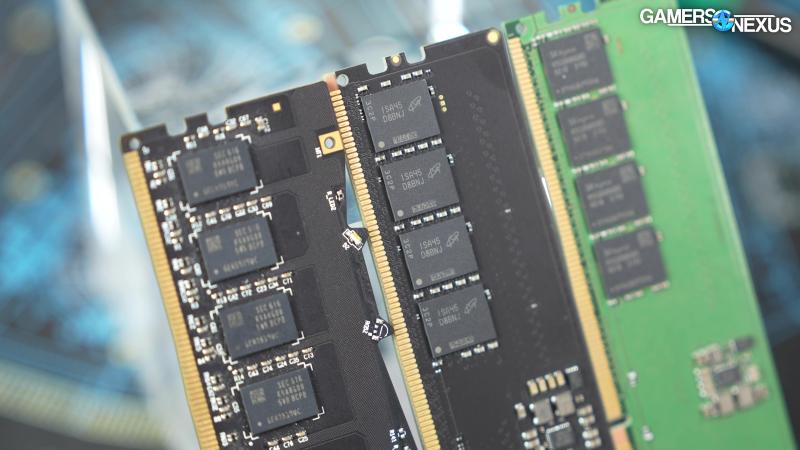
Memory Companies Have Destroyed the Consumer Market
The DRAM and NAND flash manufacturers at fault for the ongoing RAM, SSD, and GPU price increases have finally figured out how to suppress the market’s previously cyclical pricing nature, and it’s by committing to larger…
以下正文同步自 Hacker News,版权归原站所有,已转换为易读排版。
The DRAM and NAND flash manufacturers at fault for the ongoing RAM, SSD, and GPU price increases have finally figured out how to suppress the market’s previously cyclical pricing nature, and it’s by committing to larger, longer long-term agreements with fewer customers. This article deep dives into what these companies are saying out loud -- like Amazon’s interest in pushing more customers into cloud services from on-premises -- and also SSD and RAM pricing.
Editor's note: This was originally published on September 21, 2026 as a video. This content has been adapted to written format for this article and is unchanged from the original publication.
Since last September, the average price of SSDs and RAM have continued to climb: prices have increased by 137% for 2 TB NVMe SSDs on average, 183% for 2 TB SATA SSDs, 363% for 32GB DDR5 kits, and 294% for 32GB DDR4 kits, with AVG prices collected from the samples of product listings specified below the chart.
In some situations, it’s worse: DDR5-6000 64GB kits have climbed from $240 to $1,300-$1,400 on average, an increase of around 483%.
If you had dreams of a home server or a high-end engineering design or editing machine with 128GB of memory, that’s gone up even more.
We bought 128 GB of DDR5-6400 GSkill ECC Registered memory in 2024 for $1,060 to use in an editing machine.
If you bought similar RAM, you could get scalped by a third-party seller for some NEMIX 128GB of a similar spec for $6,800, or maybe you’d prefer 512GB -- something that used to cost $4,200 -- for $23,811.
In 2024, we also bought a 4 TB Samsung 990 Pro for $390. Today, that same drive is $1,100, or a 254% increase.
This is the K-shaped economy. From a single stick of 16 GB to a few sticks totaling 128 GB, everyone is getting ripped-off. People who want to play games for a hobby are robbed and people who want to start a business that needs a high-end computer might find it cheaper to rent a system or use cloud computing, which sort of seems like the endgame.
This massive diversion to data centers isn’t just affecting RAM and SSD prices for PC enthusiasts – it’s affecting the prices of all consumer electronics for literally everybody.
“Worldwide smartphone shipments will fall 16.7% in 2026, [...] The average selling price of a smartphone will reach $581 in 2026, up 27.6% in a single year.”
After Apple increased prices on its MacBook Neo, MacBook Air, MacBook Pro, Mac Studio, iPad, iPad Air, iPad Pro, iPad Mini, HomePod, HomePod Mini, Apple TV Box, and Vision Pro headset, Apple’s Tim Apple noted in his final earnings call as CEO, “We reluctantly raised prices I would say and we did it because we’re in what I would characterize as a 100-year flood on the memory pricing with exponential increases in memory prices.”
XBOX recently announced its latest round of price increases, stating, “Effective August 1, 2026, we will be updating prices worldwide. The price of XBOX consoles will increase by US$100 for 512 GB models and US$150 for 1 TB models. We will also be sunsetting our 2 TB model.” The company added, “Unfortunately, console storage and memory prices have increased by more than 2.5x and we expect another doubling by the fall of 2027.”
Amazon raised prices on its Echo Dot, Echo Show 11, Kindle, Kindle Paperwhite, Fire TV Stick HD, Fire TV Stick 4K Max, eero 7, and eero Pro 7.
Nintendo inflated its Switch 2 MSRP, and Sony’s already increased its PS5 prices twice within the last year.
TechInsights CSO, reported via the New York Times, added, “Yes, the prices of your iPhone are going up. But it’s also possible the prices of your M.R.I. machines may go up, or worse than that, that M.R.I. machine may not get made.”
Meanwhile, Chinese newcomers CXMT and YMTC have continued their rapid expansions, with YMTC breaking into the global top 3 NAND manufacturers by shipments, surpassing Kioxia, Micron, and SanDisk, and CXMT now holding 10% of the global DRAM market share by revenue, up 6 percentage points YoY, as reported by Counterpoint Research.
And yet being challenged by the United States Government for entrance, despite selling consumer-grade memory.
To us, the most concerning part of this is that the memory suppliers are trying to finally bust the cyclical nature of memory pricing, which would mean they want to eliminate the future low point for prices, especially for consumers.
Long-Term Agreements (LTAs) are made between memory manufacturers and large clients, often unnamed. These clients almost certainly include NVIDIA.
Shortages caused by AI demand could keep supply just tight enough to maintain the currently inflated RAM and SSD prices for years to come.
Throughout the past year, all major manufacturers altered their customer relationship strategies, now forming 3-5 year long-term agreements (or LTAs) with, and allocating 50 - 70% of their outputs to only their largest 5-16 customers.
Some form of agreements have been in place with major customers since, basically, the dawn of time -- but the capacity allocated to them and the duration are concerning.
“LTAs are transforming the industry from a 3–5-year boom-bust cycle into a long-term order-based model with pre-secured demand.”
In other words, the manufacturers went from prioritizing enterprises over consumers to now prioritizing their 10 largest companies over everybody.
In fact, thanks to all the major cloud service providers and hyperscalers buying up all the supply and sending prices skyrocketing, smaller businesses can no longer afford on-site server upgrades, forcing them to rent cloud infrastructure instead.
Fortunately for the hyperscalers, JP Morgan notes, “While LTAs may help keep costs manageable for hyperscalers, they dramatically decrease the flexibility of memory fabricators to address demand for memory chips in consumer goods.”
Starting with the long-term agreements, we can look to each of the manufacturers’ latest earnings reports:
Micron reported that its 16 LTAs currently represent 20% of its DRAM and a third of its NAND supply, noting, “When completed, we expect approximately half or more of our company revenue to be under these SCAs with customers across end markets.”
SanDisk, whose Datacenter and Edge revenue increased by 1,298% and 392% YoY while revenue for its consumer segment decreased by 5% YoY, reported that it’s allocating 50% of its bit output in 2027 and 67% of its bit output in 2028 to LTAs.
“We are on track toward our 50% LTA volume coverage for calendar year 28 with key customers.”
In an earnings call, Samsung stated, “We have already finalized agreements with the top five global data center customers, [and] are also in the final stages of talks with five additional major accounts to support their AI-related demand.” The company added, “We intend to maintain flexibility in supply allocation and plan to allocate approximately 60% to 70% of our total capacity to long-term supply contracts while preserving sufficient capacity to support customers without multi-year contracts.”
And Western Digital’s CEO affirmed, stating, “The last time we reported on LTAs, we talked about having one LTA of a large customer all the way up to calendar year '29. But we're very much in the throes of discussions with customers to establish LTAs for calendar '29, '30 and '31 as well. So visibility remains very strong, customer-driven demand for LTAs extending all the way out to '31 remains very strong.”
As for the effects: our understanding is that these long-term agreements will fundamentally alter the way the memory market works for consumers and everyone else. The Korea Herald explains this:
“The shift marks a departure from an industry long dominated by quarterly negotiations and short-term orders, potentially softening the boom-and-bust cycle that has defined the memory business for decades.”
Samsung reiterated this in its latest earnings call, stating, “Historically, the memory industry has experienced recurring cycles of upturns and downturns driven by demand fluctuations in consumer-oriented applications. However, by increasing the share of longer-term backlog-driven business, we hope to significantly enhance the stability and visibility of our business.”
And Samsung’s not alone – all manufacturers are echoing the same “enhanced visibility” phrase in some manner or another.
One industry analyst, reported via The Korea Herald, asserted:
"LTAs are unlikely to eliminate the memory cycle, but they could reduce earnings volatility by locking in demand for longer periods. How effective they are will depend on how the contracts hold up in the next downturn.”
Amidst the height of the shortage, demand from cloud providers continued to increase:
TrendForce anticipates CapEx for the world’s nine major CSPs to increase from $922 billion in 2026 to $1.383 trillion in 2027, explaining:
“The rapid increase will be driven in part by soaring memory contract prices and robust procurement demand. TrendForce estimates that DRAM and NAND Flash combined will account for 47% of CSPs’ total CapEx in 2026, with their share rising further to 68% in 2027.”
Based on TrendForce’s figures, that’d put the nine largest CSPs’ CapEx spending on only DRAM and NAND at an estimated $433 billion in 2026 and an estimated $940 billion in 2027.
Luckily for the CSPs, after driving up RAM and SSD prices, smaller businesses couldn’t afford on-site server upgrades, forcing them to rent cloud infrastructure from the CSPs instead.
Amazon’s CEO described the new dynamic in its 1Q ‘26 earnings report, explaining, "One of the interesting things that we see right now with the change in price and supply on things like memory is that it is a further impetus pushing companies who have on-premises infrastructure into the cloud.” He added, “We have seen a number of conversations we have been having with enterprises for many months [...] accelerate rapidly just because we have a lot more supply than what others have. It will be interesting to see how that evolves over time.”
That’s it. That’s the quiet part out loud, and the part we’ve all been saying: Amazon, the owners of one of the world’s cloud infrastructure providers via AWS, is saying that this is pushing companies into the cloud. That’s not going to stop at companies.
And the CSPs are already seeing the results. In their latest filings:
Google Cloud’s revenue increased 82% YoY, Microsoft’s “Azure and other cloud services revenue” increased 43% YoY, and AWS sales increased 36.7% YoY, which Amazon notes is its “fastest growth in 18 quarters.”
For further reference: In TrendForce’s “Forecast Breakdown of NAND Flash Bit Demand by End Application, 2026-2027” chart, the firm projects NAND bit demand for server applications to increase from 44.2% in 2026 to 51.1% in 2027 while % of total bit demand for PC, mobile, game console, and other applications will each moderately decrease.
In comparison, TrendForce expects DRAM’s bit demand from graphic and server applications to increase by 1.7 and 1.5 percentage points, reallocating % of total bit demand away from PC, mobile, and consumer applications.
While NAND is primarily only affected by increased server consumption, DRAM is heavily affected by increased graphic consumption in addition to increased server consumption, as manufacturers prioritize HBM.
Based on TrendForce’s projections, PC applications will account for 5.6% of DRAM bit demand and 11.5% of NAND bit demand in 2027.
Compared to TrendForce’s 2019 numbers, the % of total DRAM consumption for server applications is projected to increase by 13.2 percentage points, and projected to decrease by 7.1 percentage points for PC applications.
As for how this all affects the consumer market: I think we all know...
This chart compares AVG prices from September 2025 to AVG prices currently. We collected each entry’s AVG prices from a sample of individual product listings that we found complete price histories for on PC Part Picker, as specified below t
正文由 探How 从来源站点 RSS 同步,内容未经改写;遇到排版缺失或需要图片、视频时请以原文为准。