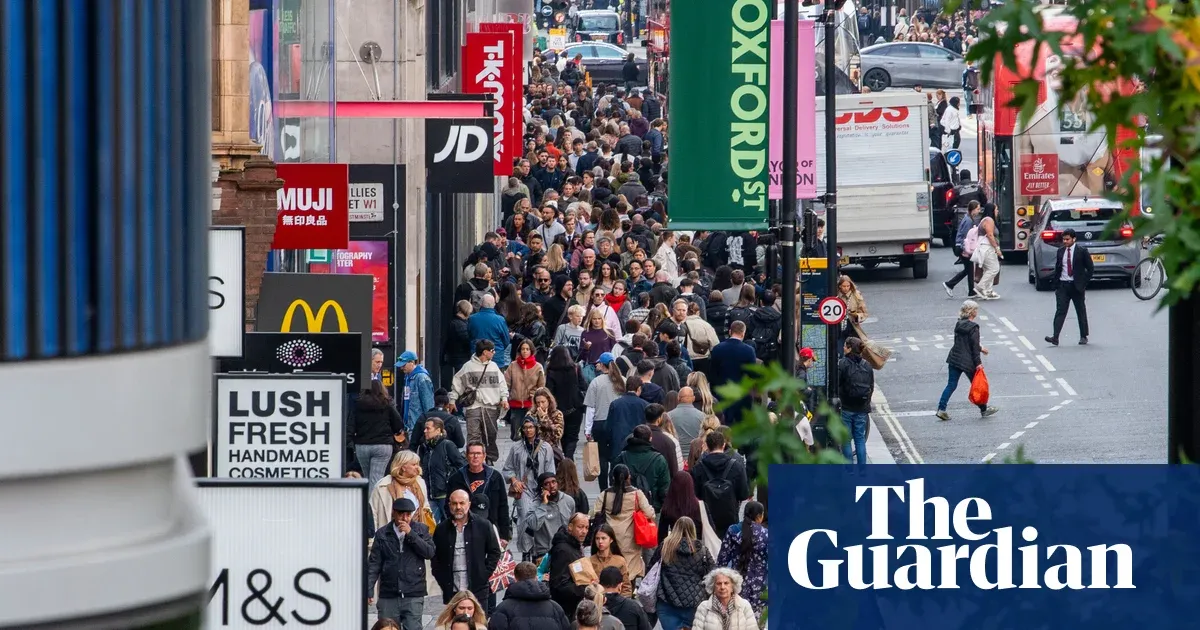
Everyone hates Oxford Street. Will pedestrianisation save it?
Oxford Street, London. Photograph: Jill Mead/The Guardian
以下正文同步自 Hacker News 最新,版权归原站所有,已转换为易读排版。
Oxford Street, London. Photograph: Jill Mead/The Guardian
In a few days the busiest shopping street in Europe will be closed to traffic. The hope is that an unloved and polluted thoroughfare will turn into somewhere that people actually want to spend time
Prefer the Guardian on Google
In February, the mayor of London, Sadiq Khan, announced that Britain’s best-known thoroughfare, Oxford Street, would be pedestrianised. To the surprise of every Londoner that I have spoken to in the past few months, it is actually happening. On Monday 26 October, the busiest shopping street in Europe – or, precisely, half of its 1.2-mile stretch – will be closed to traffic, putting an end to several decades of bitter arguments, obstructions and delays. Cars, lorries, vans, taxis, buses, bicycles, ebikes, scooters will be banned. Nothing but pedestrians (and emergency vehicles) will be allowed in.
This change will mark the most remarkable transformation to the streetscape of central London since at least 2003, when Trafalgar Square was turned from a glorified roundabout into one of London’s most recognisable public spaces. It will also form the most visible part of the mayor’s legacy, whether or not Khan runs for a fourth term in 2028. Three years ago, Khan published a memoir and manifesto, Breathe, attributing his asthma to growing up inhaling London’s polluted air. For the mayor, pedestrianising Oxford Street is the culmination of a mission to create a greener city that is oriented around public health, walking and cycling.
Pedestrianisation is one thing; making Oxford Street somewhere anyone actually wants to spend time is another. For weary Londoners and anxious visitors alike, it is a headache in the form of a high street. Its primary associations are crowds, stress, dirt, noise, the tackiest incarnations of consumer capitalism, and crime. At one point during my research I approached a harried police officer in the throng outside Tottenham Court Road tube station and asked if she thought pedestrianisation would be good for Oxford Street, or make her job harder. Both, she said.
This is not to say Oxford Street is an empty, dying high street. At the last count, it receives more than 500,000 visitors every day – equivalent to the population of Edinburgh. It seems reasonable to assume that most of London’s 22 million annual foreign visitors set foot on it at some point. The street generates 5% of the capital’s economic output, and lives in the national imagination the way few others do. “When I was 17, London meant Oxford Street,” sang Everything But the Girl, in their 1988 song of the same name: “It was a little world.” And yet, nobody loves Oxford Street. During the course of writing this article, I haven’t met anyone who will even admit to liking it.
Aerial view of the West End, with the pedestrianised area of Oxford Street
On a Sunday evening in September, I did something I had always carefully avoided doing before and cycled its full length. Even at the end of the weekend, it was overwhelming – with teenagers careening on rented ebikes and gaudy pedicabs parked in the middle of the pavement, blaring music. The pavements were thick with people, in part because the road was still thick with traffic. On another occasion, I watched a late-middle-aged woman perch awkwardly outside Ikea on a narrow black electricity box, in the absence of anywhere else to rest. For most Londoners, Oxford Street is a necessary evil, to be visited with surgical precision before fleeing the scene: a site of crime, grime and perhaps some Christmas shopping. “Who,” wondered the FT’s architecture critic in 2020, “lingers any longer than they have to in London’s worst thoroughfare?”
The grime itself is no joke. In the 1990s, when Oxford Street was known for its huge record shops such as HMV and Virgin Megastore, I remember returning to my south London home on the tube, blowing my nose and seeing a tissue full of jet-black snot. Its narrow streetway and tall buildings on either side create an “urban canyon”, trapping the heavy diesel fumes emanating from its buses and taxis (private car access has been restricted since 1972). In 2014, it was found to have the highest concentration of nitrogen dioxide pollution in the world. In the same year, the crime had become so bad that the United Arab Emirates warned its citizens to avoid the area for their own safety.
Since then it has become better known for its lawbreaking small businesses, where substantial raids have hauled in counterfeit goods and illegal vapes. This decade has seen the rise of mysterious US candy stores and empty souvenir shops that allegedly thrive thanks to tax evasion. Covid and internet shopping hit Oxford Street hard: vacancy levels soared from 4.5% in 2019 to 16.9% by early 2023, and it was often these businesses that filled the gaps. The current Google Street View images of its shopfronts, taken just two years ago, already look like a postcard from the past.
That Oxford Street has been struggling hurts the reputation of London as a whole. This is in tabloid parlance, “the nation’s high street”, home to the flagship branches of iconic department stores alongside global retail brands. Khan’s gamble is that the pedestrianisation can reverse what he conceded in 2024 was a case of “managed decline”, and will flood the street with life again.
In the offices of East, near London Fields, Julian Lewis and Archie Bashford were seated around a 4ft-long cardboard model of Oxford Street and talking animatedly about bollards. Lewis and his team are public realm architects, devoted not to buildings, but the world beyond them: signage, benches, perches, kerbs, paving, lighting, planters, trees and public art. East have carried out nearly 30 high street redesign projects in as many years, but this is the big one.
The first thing Lewis’s team did after being awarded the contract last year was to dive into the archives. The starting point was a little-known 1932 article in Good Housekeeping by Virginia Woolf. For Woolf, Oxford Street appeared as a “great rolling ribbon … the pebbly bed of a river … washed by a bright stream”. She saw it as gaudy, but also sparkling, thrilling and overwhelming, defined by the restless movement of its messy public. (Her essay also shows us how weird the street has long been – in 1932, it was apparently full of hawkers selling live tortoises.) It was these riverine characteristics that became the starting point for the thousands of material, small-scale design decisions that East are making. The “play of light on surfaces, the subtle reflectivity of a bench or a column” can all help bring out those tendencies, Bashford told me.
View image in fullscreen
Street trading outside Selfridges. Photograph: Jill Mead/The Guardian
The pedestrianisation happening next week will cover 0.6 miles, stretching westwards from close to the Oxford Circus crossing to Selfridges. (Sadiq Khan has expressed his commitment to eventually pedestrianise all 1.2 miles of the street.) The most noticeable transformation will be how much greener it is becoming. The architects’ plan is to experiment with introducing young trees in pots, alongside new places to sit. They will use the test phase – which will last from next week until spring 2027 – to learn about how people respond to the trees. Will they become meeting points? Rest stops? Landmarks for wayfinding? Ideally they will provide respite, Lewis said, “a refuge from the flow of people, which is the river analogy again – maybe that’s optimistic, but instilling some relative calm”.
The pedestrianised zone’s edges will be marked by bollards. Lewis has strong opinions on this subject, and speaks about bollards as if they were people. “Bollards are generally horrible things,” he told me. Too often they seem “apologetic”, he said. “A misaligned, plasticky reflective strip [on a bollard] sends the message: ‘Sorry, I didn’t really mean to be here, but I need to let you know there are some vehicles nearby.’ Instead, they should be saying: ‘I’m happy to be here, because I’m doing a job.’”
An abundance of considerations go into designing the right kind of bollard, including security, maintenance, aesthetics, accessibility, climate, foot traffic, crowd flow and civic pride. Oxford Street’s bollards have to be exactly 1.2 metres apart, for reasons of HVM – hostile vehicle mitigation – but they also need to be helpful and use “the existing language of the street”. They will be made of ductile iron, because it is more resilient than cast iron: it’s springy, and doesn’t crack when you hit it. They are also matt, because shiny bollards are too flashy, and detract from the ambience. “They’re very sophisticated,” Lewis said, and he meant it.
One of the project’s primary ambitions is to better integrate Oxford Street with its neighbours. It is surrounded by four areas with strikingly different identities: Soho, Fitzrovia, Mayfair and Marylebone. “There’s this slightly numb connection to Oxford Street itself, like: where the hell is Oxford Street? It might as well not be there, with regard to the relationship with these incredible centres,” Lewis said. “People want to go to Soho. They want to go to Marylebone. People live in Fitzrovia. Oxford Street does not have a place yet, it’s a non-spatial space, which is unbelievable given how famous it is.”
This is where landscape architecture and design comes in. The noun the architects use over and over is “invitation” – how do you encourage people to do the unthinkable, and linger in the newly pedestrianised space, and move freely in and out of it? The built environment has to invite them to do so. One innovation Lewis’s team wants to explore is outdoor public dining – not outdoor tables for restaurants, because there are barely any on Oxford Street, but continental-style tables to sit and eat whatever you want; takeaway food bought in Soho, or a packed lunch you made at home. “The idea of sitting there having sandwiches at a picnic bench, next to a shop in which you can buy a Prada handbag, is a fantastic kind of paradox,” Lewis said with a smile. “And it’s also very London.”
To understand where the idea of pedestrianising Oxford Street came from, you need to acquaint yourself with the work of a Danish urban planner called Jan Gehl. In 2003, when Ken Livingstone was mayor of London, Gehl was asked to spend 18 months researching the flaws in London’s streetscape, and in June 2004 he produced a 120-page report entitled Towards a Fine City for People. Gehl thought there was a huge amount of work to be done. “London comes only after Moscow in the contempt the city planners show for pedestrians,” he said that year. “You never see any children on London streets – what have you done with them all?” The answer is that they have been increasingly shut indoors: driven everywhere in cars or not trusted to play outside – compared both with earlier generations of Londoners, and with most other children across Europe.
Gehl wanted to transform the capital into one of the world’s most walking-friendly cities by 2015. But with the 2004 mayoral election taking place the same month, the radical edges of the final report that was published by Livingstone’s City Hall were sanded down. Gehl’s full recommendations were confined to a “secret document”, distributed to the capital’s decision-makers but never published. Among other things, it recommended the full pedestrianisation of Oxford Street. It has taken 22 years for that dream to be realised. “I see some signs of improvement in London,” Gehl told me recently on a video call from his home in Copenhagen, “but for God’s sake, the tempo and the amount of change have not been impressive.”
View image in fullscreen
Julian Lewis and Archie Bashford of East architects. Photograph: Jill Mead/The Guardian
Gehl, who is 90, has long sought to turn cities into places that put the people that live there first. His motto is “the city at eye lev
正文由 探How 从来源站点 RSS 同步,内容未经改写;遇到排版缺失或需要图片、视频时请以原文为准。