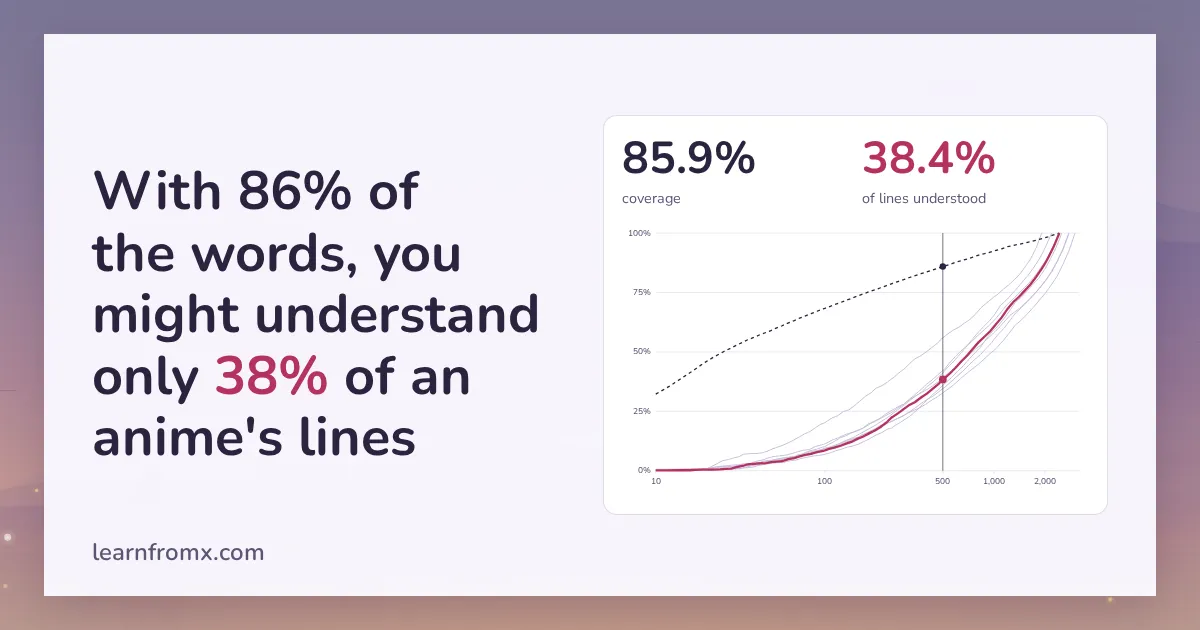
With 86% of the words, you might understand only 38% of an anime's lines
Coverage tells you the percentage of spoken words you know, not how many lines you can follow. Measured in Frieren and seven other anime.
以下正文同步自 Hacker News,版权归原站所有,已转换为易读排版。
Coverage tells you the percentage of spoken words you know, not how many lines you can follow. Measured in Frieren and seven other anime.
Say you want to watch Frieren, so you learn the 500 most common words in the show. A coverage calculator says that you now know 85.9% of the words spoken.
You make tea and press play. Here are three of the things you hear:
Blurred words fall outside the top 500. Hover or tap to reveal them.
By the third pause to look up a word, your tea has gone cold. With those 500 words, you know every word in 1,151 of the first 3,000 lines. That's 38.4% of them. The other 1,849 lines each contain at least one word you don't know.
Coverage is the number most learning sites quote. It's the percentage of spoken words that you know, so a particle spoken a thousand times counts a thousand times. The words at the very top of the Frieren list are all grammar pieces like の (of, 's) and は (topic marker), so the top 100 words alone give you 68.3% coverage. You'd follow only 8.5% of the lines.
Three figures describe the same 500 words:
manga-kotoba builds its coverage tables this way. jpdb and jiten show a coverage figure too, though their help pages don't give the exact formula.
The gap between coverage and lines comes from line length. A Frieren line has 7 words on average. You need to know all seven to follow it. At 85.9% coverage, your chance of knowing a whole line is about 35%. That's 0.859 multiplied by itself seven times. It's close to the 38.4% of lines we measured.
Thick line: lines understood in the chosen show. Dashed: coverage in that show. Pale lines: lines understood in the other seven. For each curve, we assumed you learn that show's most common words first.
All eight shows have this gap. Serial Experiments Lain reaches 95% coverage with the fewest words, 1,191. Even then, you'd follow only 77.5% of the lines.
Serial Experiments Lain needs the fewest words of the eight: about 400 gets you half the lines. Jujutsu Kaisen needs 980.
We capped every show at 3,000 lines so that a long show doesn't look harder for having more episodes. If a show gets harder later on, it looks easier here than it is.
Back to Frieren. You missed 1,849 lines. Of those, 1,042 are missing a single word, which is 56.4%. Across all the shows, that figure runs from 50.2% to 63.9%.
Going from 500 to 1,000 words helps you far more than coverage suggests. Coverage only gains 6.5 points, because these new words don't come up often. Lines understood gain 22.1 points, because one new word is often the last one you needed to follow a line.
You can't fill these one-word gaps with a handful of words. Those 1,042 lines are missing 804 different words between them. The most you get from one word is 4 lines, from words like 後悔 (regret), 約束 (promise) and 収集 (collecting).
As a rough comparison, we tried the 2,000 most common words of general Japanese, from the wordfreq list. Those got you 23.4% to 37.6% of lines. We then tried each show's own top 2,000 words. They got 74.3% to 93.3% of lines. Serial Experiments Lain has fewer than 2,000 different words, so it isn't in that second range.
A show's top words can be unusual. Number 304 on the Frieren list is 生臭坊主, a monk who doesn't keep his vows, which is what the characters keep calling Heiter. Number 21 is 魔法 (magic), four places ahead of 私 (I).
Say you learn a show's top words from one season, then carry on to the next. We tested something close to this on the four shows with enough lines. We built each list from the first 3,000 lines, then tested it on the next 3,000. On Frieren's next 3,000 lines, the old list gets 22.3%, while a list built from those lines themselves gets 33.0%. The word 試験 (exam) appears only once in those first lines and 51 times after them, because the characters take a mage exam later on. Across those shows, the drop is 5.5 to 14.0 points.
Many words have several meanings, which linguists call polysemy. We counted a word as known whichever meaning a line uses. At 500 words, both of these Frieren lines count as understood: 手が震えています (my hands are shaking) and 手に取るように分かる (I can read it like a book). You could know 手 (hand) perfectly from the first line and still be lost in the second. Word for word, it says "as if taking it in your hand." We didn't measure how many lines have this problem. On this count alone, the lines-understood figures are too high.
pip install sudachipy sudachidict_core
lines.txt: one subtitle line per row, in episode order, songs and repeats removed
fillers.txt: your own list of sounds not to count, one per row
from collections import Counter from sudachipy import Dictionary, SplitMode import re
tok = Dictionary().create() fillers = set(open("fillers.txt", encoding="utf-8").read().split())
def words(line): out = [] for m in tok.tokenize(line, SplitMode.C): pos = m.part_of_speech() if pos[0] in ("補助記号", "空白", "記号"): continue # punctuation if pos[1] in ("固有名詞", "数詞"): continue # names, numbers if not re.search(r"[0-9A-Za-zぁ-ヿ一-鿿々]", m.surface()): continue if m.surface() in fillers and pos[0] in ("感動詞", "副詞", "名詞"): continue out.append(m.dictionary_form()) return out
lines = [words(l.strip()) for l in open("lines.txt", encoding="utf-8")] lines = [l for l in lines if l][:3000] # the first 3,000 lines with a real word count = Counter(w for line in lines for w in line) known = {w for w, _ in sorted(count.items(), key=lambda x: (-x[1], x[0]))[:500]}
coverage = sum(n for w, n in count.items() if w in known) / sum(count.values()) understood = sum(all(w in known for w in line) for line in lines) / len(lines) print(f"coverage: {coverage:.1%} lines understood: {understood:.1%}")
Run on our Frieren lines, this prints 85.9% and 38.4%. We don't store the unprocessed subtitle files. Your own subtitles and filler list will give you slightly different numbers.
Each cell shows coverage, then lines understood, at that many known words.
Known words needed to reach a given percentage of lines understood:
learnfromx is a flashcard app that teaches Japanese from anime. Each card uses a line where you know everything except the one new word, which is why we started counting lines. The figures above count each word once, however many meanings it has. That wouldn't work in the app: knowing あれ as "that" doesn't help when someone says あれ? (huh?). These are two separate cards. It doesn't catch every such word yet, we're working on it. During early access it offers one show, Hunter x Hunter.
正文由 探How 从来源站点 RSS 同步,内容未经改写;遇到排版缺失或需要图片、视频时请以原文为准。