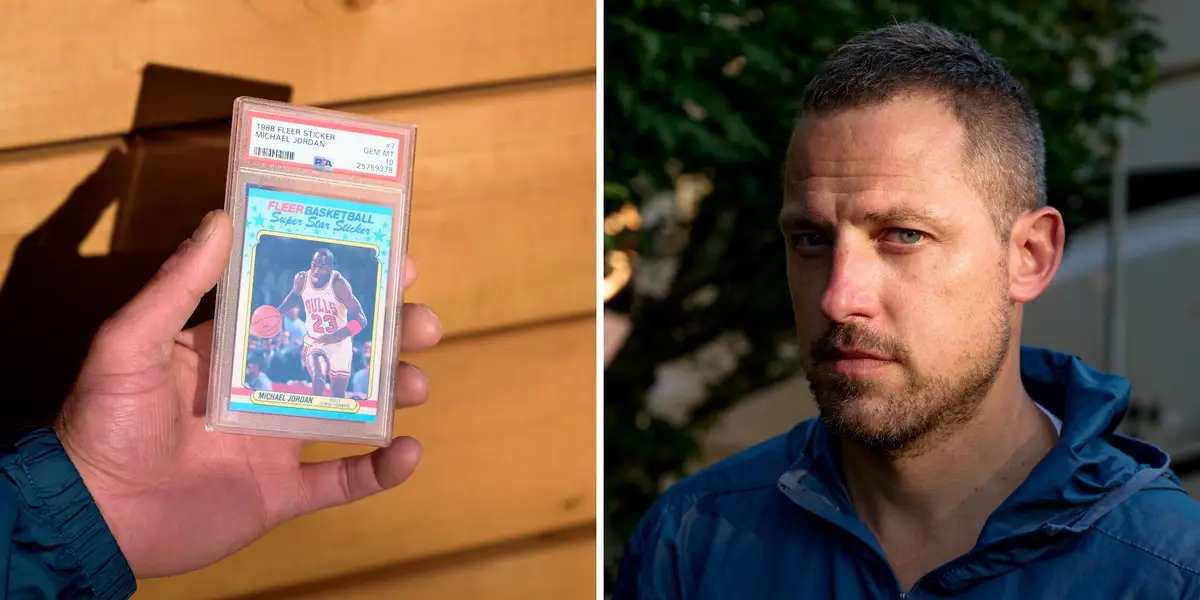
A $168,000 Michael Jordan rookie card rocked the $15B card industry
Seventeen years after becoming the most legendary bank robber of the internet age, Anthony Curcio was again inside a federal courtroom facing prison. It was January 17, 2026. Dressed in a casual blue suit and loose tie,…
以下正文同步自 Hacker News 最新,版权归原站所有,已转换为易读排版。
Seventeen years after becoming the most legendary bank robber of the internet age, Anthony Curcio was again inside a federal courtroom facing prison. It was January 17, 2026. Dressed in a casual blue suit and loose tie, the 45-year-old still possessed the handsome bad-boy charm that long had Hollywood producers after him. Once the high school football hero of tiny Monroe, Washington, a college injury left him with a Vicodin addiction he couldn't shake. Then, when the housing crash hit, the desperate father of two made an outlandish play: an armored-truck heist of $400,000 in cash and a getaway down the Skykomish River on an inner tube. In 2013, after serving five years in federal prison, Curcio began his redemption arc: TED talks, TV appearances, and a line of best-selling children's books. Now, prosecutors alleged, he had been running an elaborate new scheme: defrauding buyers in the booming $15 billion trading card industry. After a two-year FBI investigation called Operation Heist and Holder, Curcio was charged with wire fraud and conspiracy, charges that carry a maximum sentence of 40 years in prison. The evidence, prosecutors said, would include texts and recordings of Curcio lying to card buyers, faking his identity, and doctoring labels of rare cards, as well as forgery tools found in his home workshop. Curcio's defense told a different story: The case wasn't about fraud; it was retribution. The real villain, his attorneys argued, was Professional Sports Authenticator, the card industry's dominant grading company. PSA is the Moody's of the sports card world. A PSA label can mean the difference between a card worth $50 and one worth $500,000. PSA's parent company, Collectors Holdings — which is backed, in large part, by billionaire hedge fund manager and New York Mets owner Steve Cohen — controls roughly 80% of the card grading market. By the time of Curcio's trial this winter, a New York congressman had demanded a Federal Trade Commission antitrust investigation, writing that Collectors had "effectively dismantled market competition." PSA soon faced a boycott by aggrieved customers over fee hikes and allegations of grade manipulation. Over several months of exclusive interviews, Curcio shared his version of events for the first time. "I don't have nothing to hide," he says. "Those motherfuckers got a lot to hide." Collectors Holdings and PSA "basically have a horizontally and vertically integrated monopoly," says Remington Ewald, a veteran card dealer who had a fateful encounter with Curcio at an expo in Chicago. "It just sucks that the guy who's bringing it to everybody's attention is a criminal himself." Long before he was a famous outlaw, Anthony Curcio was just another one of America's 94 million card collectors. Growing up in the tiny logging town of Monroe, he'd bike over to the Red Barn gas station and spend his allowance on the latest packs of Topps cards. As the town's star high school athlete, he was determined to one day have his face featured on his own card. A nimble wide receiver, Curcio went to the University of Idaho on a full scholarship. Then he tore his ACL, and became addicted to painkillers. To support his habit, he faked prescriptions and ran a side hustle buying and selling trading cards online. He quickly learned there was one company at the heart of the trade. Founded in 1991 by card dealer David Hall, PSA offered a simple premise: that a card examined by an expert and graded a number was worth more than a card pulled from a shoebox. Collectors would mail their cards to the company, and trained graders would evaluate each one across four criteria — centering, edges, corners, and surface — and assign it a numerical grade from 1 (Poor) to 10 (Gem Mint). The card was then sealed in a clear, tamper-evident plastic case called a slab, with a label bearing the grade and a unique certification number tied to PSA's database. The company charged per submission, and the model was self-reinforcing. "Once the buyers insisted on it," Hall said in 2019, "the dealers had no choice." In a statement to Business Insider, a PSA spokesperson wrote, "For more than thirty years, PSA has served collectors by authenticating, grading, and protecting items so that collectors can trade with confidence. In our view, that trusted role is precisely why people try to counterfeit our labels and holders." The spokesperson added that "last year alone, our systems intercepted roughly $200 million in potential counterfeit value before it reached the market." In the trading card community's burgeoning online forums, Curcio made a name for himself — as an alleged fraudster. In 2005, participants on the Trading & Memorabilia discussion thread began warning of the "Seattle boy" attempting to sell a fake 1953 Mickey Mantle. "Anyone on this board get ripped off by this guy??" one user wrote. Curcio denied everything. But in his 2013 memoir, "Heist and High," Curcio wrote about his early card-dealing days in ways that would come back to haunt him. He shared how, after being defrauded out of $12,000 by a con man who reversed a PayPal payment, he got his money back by listing a counterfeit Mantle of his own and pocketing $20,000 from buyers who never got the card. He also detailed learning to trim cards for better centering, yellow them with coffee grounds to fake aging, and crack open sealed PSA cases to swap in higher-grade cards. After college, Curcio returned to Monroe to marry his high school sweetheart, Emily, and found success flipping houses. When the real estate bubble burst in 2007, he burned through his life savings, and his house went into foreclosure. He found painkillers again. He couldn't support his habit or his family. One day, while eating a hamburger in his car outside a Jack in the Box, he watched an armored truck pull into the Bank of America. It was just another bank, he thought, that had robbed him and millions of Americans. So he felt justified when he decided to rob it. Curcio spent months planning the heist, testing on himself the bear spray he'd mist the security guard with, and gaming out escape plans of varying risk — a getaway car (too conspicuous), a jet ski down the river (too shallow) — before settling on the seemingly most outlandish, yet practical, option: a black-and-yellow inner tube festooned with a decal of a hornet. For added cover, he took out a Craigslist help-wanted ad, telling prospective workers to show up in the park across from the bank dressed in matching landscaper vests. It worked. He fled with $400,000, and then spent weeks blowing cash on cars and gambling. But a homeless man in Monroe had witnessed Curcio on a dry run of the heist, and gave the local cops Curcio's license plate number. After pleading guilty, he was sentenced to six years in federal prison in Big Spring, Texas. That's where I first met with Curcio in 2009, for a GQ story about the heist. He told me then that the robbery wasn't about money, it was about feeling like he needed to be the big man on campus once again. Getting locked up was the first time he'd felt free of that lie. He echoed this sentiment to me in October 2025, when we sat in a Jersey City hotel café the day before his trading card fraud hearing began. Wearing a zipped-up blue windbreaker and a backward cap, he looked more like a suburban little-league coach than a wizened bank robber. "I was concerned with materialistic shit because I didn't feel good about who I was," he told me about what led to the heist. "I wish I could have calmed down and realized, 'Yes, I got bills, but none of this really is that big a deal.'" After he was released in 2013, Curcio threw himself into a great American comeback. Back with his family, he became an active youth basketball, baseball, and softball coach. He was "the happiest and most content I've been ever," he tells me. While in prison, he'd written and illustrated "My Daddy's In Jail," trying to explain incarceration to young children, including his own. Then he wrote another book about Steph Curry, which the NCAA selected for a nationwide reading program. Suddenly, Curcio went from making $200 a month to $16,000. Some months, he says, he made more than $100,000. He bought a local gym, but after tiring of the business, he decided to sell it. The buyer happened to be a card collector, who threw in boxes of valuable cards as part of the gym-sale deal — including a 1986 Fleer Michael Jordan rookie card graded PSA 10, Gem Mint. "I ended up taking tons of cards in on, like, a credit," Curcio tells me, "to keep the fucking tax amount down." It was a fortuitous time to come into a card collection. During COVID, the sports trading card business exploded in value, joining a pandemic gold rush in other collectibles like Lego sets, rare whiskey, and luxury watches. With collectors stuck at home, and cryptocurrency fattening their bank accounts, they began pouring their money into cards — which swelled as much as 10 times in worth. Curcio's Gem Mint '86 Jordan was worth about $39,000 when he received it in January 2020. In January 2021, two sold for $720,000 each. As the first widely distributed licensed NBA card to feature Jordan, it became, as PSA described it in its CardFacts database, "the most important modern card from any sport in the entire hobby." That same year, a group of private equity investors — which included hedge fund magnates Daniel Sundheim and Steven Cohen — took Collectors private in a deal worth roughly $853 million. Flush with money, the company rapidly expanded. It acquired Goldin Auctions, where the cards were sold. It struck a partnership with eBay, handling authentication for the platform's high-value transactions. It acquired rival card grader SGC. It bought the Long Beach Expo, the primary venue where the deals were made, and where every card that passed through it needed PSA's blessing to be worth anything at all. PSA's practices had already been under scrutiny. In 2019, one of the biggest scandals in the trading card hobby's history broke open. Collectors accused a buyer of purchasing cards already graded by PSA, then secretly trimming their edges and resubmitting them to PSA for a higher grade — evidence, they said, that PSA's own process had failed. Trimming a card's edges by a fraction of a millimeter could transform a PSA 7 into a PSA 9, multiplying its value. The buyer was accused of making hundreds of thousands of dollars this way through an Oregon-based marketplace called PWCC. The FBI subpoenaed PWCC. No charges were filed. In June 2019, Collectors Universe CEO Joe Orlando wrote in a letter to customers that expecting perfection from "human-based opinion services is simply unattainable." The stress of COVID, parenting, and battling a lifetime of addiction was taking a toll on Curcio. He began spending hours a day in his basement, building an elaborate Lego city. Long suffering from OCD, he found that the bricks soothed him. His obsessions also soon turned to the card market. Given the rarity and value of the Gem Mint '86 Jordan, Curcio decided to take a shot at selling it on the highest-end market he knew: Sotheby's. To be accepted, he had to clear an elaborate verification process. This included ownership records and approximately two dozen photographs of the card taken to precise specifications, several of them under black lights. On September 12 2021, Eric Hirsch, a Sotheby's specialist in its Modern Collectibles division, emailed Curcio the good news: The Jordan had been verified and approved for an upcoming auction. Though prices had fallen from their early COVID peak, Hirsch estimated a listing between $150,000 and $200,000. "We certainly believe the sale price could go higher depending on the market," he wrote. Hirsch did not return requests to comment. The auction was still seven months away, and Curcio feared the card's value would keep falling. To hedge, he listed it on eBay for $175,000, and decided to "just see what happens,"
正文由 探How 从来源站点 RSS 同步,内容未经改写;遇到排版缺失或需要图片、视频时请以原文为准。