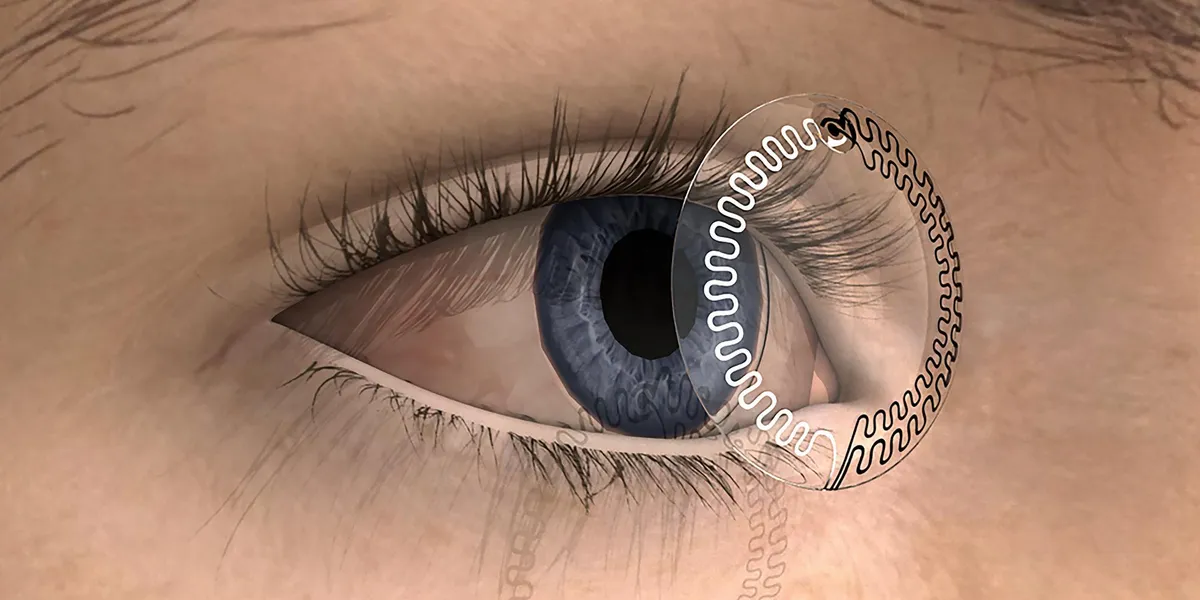
Lab on a Contact Lens Can Measure Stress Through Serotonin
The researchers tested these smart contact lenses in lab dishes with commercially available artificial tears that they laced with serotonin. The lenses could detect as little as 72-trillionths of a mole per liter of ser…
以下正文同步自 Hacker News,版权归原站所有,已转换为易读排版。
The researchers tested these smart contact lenses in lab dishes with commercially available artificial tears that they laced with serotonin. The lenses could detect as little as 72-trillionths of a mole per liter of serotonin, well below the average serotonin concentration in human tears of roughly 15-billionths of a mole per liter. Experiments also showed the lenses could withstand more than 28 days of repeated flipping, folding, stretching, and twisting while staying functional.
The scientists also tested the lenses in lab dishes on tears collected from 10 volunteers five minutes before, immediately after, and roughly 30 minutes after they each performed a pair of stressful tasks—public speaking and math challenges. As expected, serotonin levels in tears fell with increased stress.
In addition, the researchers placed one of their lenses on the eye of an anesthetized live pig for about five minutes. The lens could detect serotonin when the eye was given artificial tears containing 50 and 100 nanomolar levels of the hormone. In addition, the lens caused no sign of infection or irritation.
“We were able to detect very low concentrations of serotonin in tears using a soft contact-lens platform while preserving the transparency, flexibility, and comfort-related properties of the lens,” Zhu says.
When the lenses were used to detect serotonin in the lab and with the pig, the scientists connected the lenses to readout equipment using soft flexible nickel wires. Zhu and his colleagues have developed a proof-of-concept wireless version of their lens incorporating a miniaturized near-field communications (NFC) chip and stretchable antenna for battery-free sensing and smartphone-based data transmission. However, they say further optimization, safety testing, and validation are needed. (Corrective versions of these lenses could also be made, Zhu says.)
All in all, “I think the work highlights an exciting direction in wearable biosensing—moving beyond physical signals such as heart rate and temperature toward continuous monitoring of molecular information,” says Wei Gao, a professor of medical engineering at the California Institute of Technology who did not take part in this research. “The eye and tear fluid provide an interesting interface for this because they may enable repeated biochemical measurements without blood sampling.”
In tests where the scientists limited the movements of mice for a few hours per day in order to increase their stress, the researchers found that serotonin levels dropped in both the rodents’ blood and tears to a similar degree. These findings suggest that tears may provide a noninvasive window into blood serotonin levels, but more testing is needed before doctors might use these lenses in medicine, Zhu says.
正文由 探How 从来源站点 RSS 同步,内容未经改写;遇到排版缺失或需要图片、视频时请以原文为准。