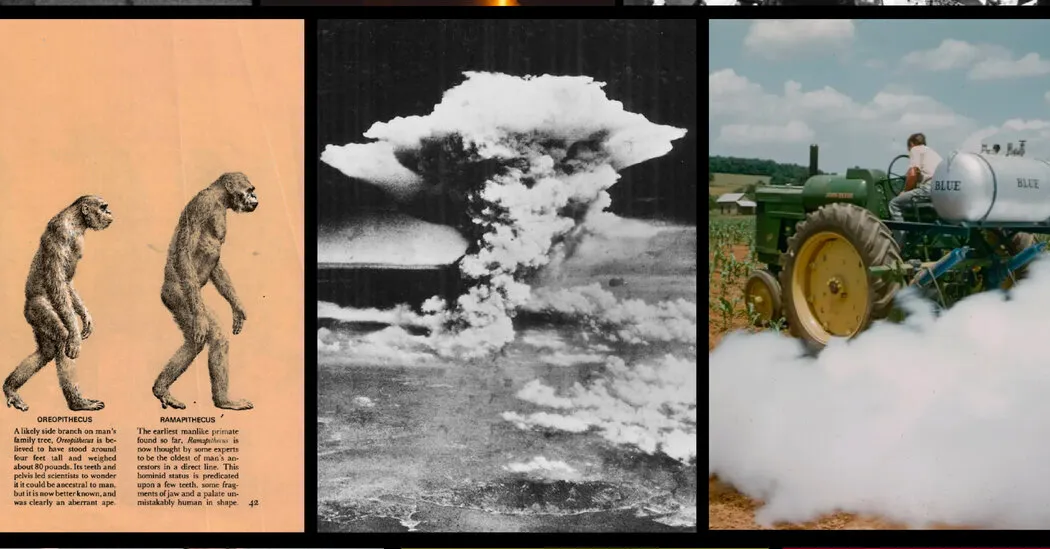
Ten Days That Changed the World
There have been 63,978 days since The New York Times began publishing. We chose the most important ones.
以下正文同步自 Hacker News 最新,版权归原站所有,已转换为易读排版。
There have been 63,978 days since The New York Times began publishing. We chose the most important ones.
Share full article
343
Introduction
To commemorate The New York Times’s 175th anniversary, The New York Times Magazine set for itself an impossible project: to select the 10 most consequential days since the paper began publishing. The Times, especially in its predigital period, was built on days: one paper per day (in several editions) offering, in the famous phrase, its “first draft of history.”
Last summer, we invited a jury of 13 historians and scholars to debate this question across a series of meetings. You can see a roster of their names below. They were generous, illuminating in their reflections and remarkably game, with several describing the process as the best sort of dorm-room debate. To force decisions, we pitted days against each other as if we were game-show hosts: If absolutely pressed, would you choose the invention of the plane or the automobile? (Of course, the panelists sometimes found the exercise exasperating — at one point the writer John Ganz threw up his hands and exclaimed, “This is totally arbitrary!”) To which we could only say, Yes, but. Assigning importance retrospectively is what historians do. Eventually, after much haggling, a final list emerged.
You’ll notice that each of the days illustrates a theme the panel deemed crucial to understanding our present. That was what the historians, being historians, noticed as well. It wasn’t intentional, but as the deliberations proceeded, they found they were organizing their own thinking by identifying significant contemporary strands and working backward. In part, that’s because we asked them to be “presentist,” to think about history through the lens of how it formed our current moment. (If we were doing this 10 years ago, or 10 years in the future, their choices might have been different, as what looks significant today can seem a little less significant tomorrow.)
We also asked them to take the whole world into account, though that world through an American perspective came to dominate their considerations — which made sense, because these 175 years were a period of America’s rising (and perhaps falling) global dominance. The selected days are also, of course, shaped by the composition of the jury itself, with its zones of expertise and biases. One admitted bias of our historians was that they, being historians, were reluctant to grant too much emphasis to recent events, not being certain how they would play out. They were more inclined to search for the roots of the major events of the recent past than to award those events themselves a place on the list. The election of Donald Trump, the screen in our pocket that took over our lives: These phenomena paled in their minds compared with the forces that made them seem, in retrospect, inevitable.
Once we had our list, we set out to tell the story of each day — what happened and how it reverberated through the years. Our tool was The Times’s own archive. One pleasure of The Times’s 175th birthday project, published throughout the paper over the past few months, has been the riches of its vault, some of which now looks prescient, some oblivious, but which is nearly always riveting in its contemporaneous accounting of what was known at the time.
In addition, we’ve assembled a list of the Almosts: days that our historians made a strong case for — but didn’t make the final cut. The panelists’ discussion reveals both how history works and how difficult the assignment really was.
History is rarely made in a day. It is progressive, though never linear. One world war makes the next world war possible, perhaps even inevitable. Other events complicate the progression: a depression, say, which plays out over many pivotal days, creates the conditions for that war.
So dig in, and argue with the panel’s choices. History isn’t science. It’s judgment — and judgment is personal.
Marie Arana is the author of “Bolivar: American Liberator,” “Latinoland” and several other books of history.
Christopher Caldwell is the author of “Reflections on the Revolution in Europe: Immigration, Islam and the West” and “The Age of Entitlement: America Since the Sixties.”
Henry Farrell is a professor of democracy and international affairs at Johns Hopkins School of Advanced International Studies.
Beverly Gage is a professor of history at Yale University and the Pulitzer Prize-winning author of “G-Man: J. Edgar Hoover and the Making of the American Century.”
John Ganz is the author of “When the Clock Broke: Con Men, Conspiracists and the Origins of Trumpism.”
Henry Louis Gates Jr. is the Alphonse Fletcher University Professor and the director of the Hutchins Center for African and African American Research at Harvard University.
Claudia Goldin is a Nobel Prize-winning professor of economics at Harvard University.
Siddhartha Mukherjee is a physician and a biologist and the author of the Pulitzer Prize-winning “The Emperor of All Maladies.”
Nell Irvin Painter is a professor emerita of American history at Princeton University.
Rick Perlstein is the author of “Before the Storm,” “Nixonland” and “Reaganland.”
Fred Turner is a professor of communication at Stanford University.
Dan Wang is the author of “Breakneck: China’s Quest to Engineer the Future.” He is a contributing New York Times Opinion writer and a research fellow at Stanford’s Hoover Institution.
Nov. 24, 1859:
Charles Darwin publishes ‘On the Origin of Species.’
“Above all, Darwin’s theory is an extratheological conception of what people are and what their place is in the universe. Nothing gets bigger than that when it comes to our own existential sense of ourselves.” Read the Article
Feb. 3, 1870:
The 15th Amendment is ratified.
“People all around the world today, when they try to manage minority rights, do it with these ideas. There’s something about the American way of doing this. It has created a template for rights. ” Read the Article
Sept. 4, 1882:
America’s first electrical grid activates.
“Electricity opens up the night. It makes possible 24/7 labor. It does all kinds of strange and wonderful things.” Read the Article
Sept. 9, 1913:
The Haber-Bosch process is invented, enabling chemical fertilizer.
“Haber-Bosch created a worldwide boom in agriculture, averted mass starvation and became arguably the most significant scientific contribution in human history to the species’ survival.” Read the Article
Nov. 7, 1917:
The Bolsheviks take over in Petrograd.
“It was a radical attempt to create a different framework for a modern industrialized society. That was the revolution — and you were either for it or against it for the next 75 years.” Read the Article
Jan. 20, 1942:
At the Wannsee Conference, Nazi leadership plans a genocide.
“It was the systematic, planned nature of the Holocaust that makes it so unusual. The Wannsee Conference was: Here’s the blueprint for murder.” Read the Article
Aug. 6, 1945:
The United States bombs Hiroshima.
“It’s the moment when we understand man to be the kind of creature who produces the atom bomb, who can destroy himself.” Read the Article
May 9, 1960:
The F.D.A. approves the birth control pill.
“When childbearing no longer rules, women can become powerful politically, economically and socially, which threatens a society where only men are in charge.” Read the Article
Oct. 29, 1969:
The first message is sent on the Arpanet network.
“The internet eventually transforms individuals into broadcasters. Anything you do can go global instantaneously. And the fact that this can happen with millions of people leads to all kinds of chaotic effects.” Read the Article
Dec. 18, 1978:
Deng Xiaoping announces economic reforms in China.
“The moment at which America’s likely slide from dominance began, even if it wasn’t visible then.” Read the Article
Photograph and video credits Charles Darwin: Time Image, via Getty Images; Bettmann, via Getty Images; Gringer, Paramount, Pathe Newsreels, via Getty Images. Fifteenth Amendment: John Sotomayor/The New York Times; Gene Herrick/Associated Press; Bruce Davidson/Magnum; Archive Films, via Getty Images; Joe Raedle/Getty Images; Gabe Dinsmoor/Getty Images. Electrical grid: Kristina Kokhanova/Creatas Video+/Getty Images; Archive Films/Getty Images; Creatas Video+/Getty Images. Haber-Bosch: Paulo Fridman/Bloomberg, via Getty Images; BBC Universal, via Getty Images; Film Audio Services, via Getty Images; Prelinger Archives, via Getty Images. Bolshevik Revolution: Christopher Morris/VII, via Redux. Halcyon Days, via Getty Images; British Film Institute, via Getty Images; Archive Films, via Getty Images. Wannsee Conference: Discovery Access, via Getty Images; John Milli/GPO, via Getty Images; Bettmann/Getty Images; DPA/Picture Alliance, via Reuters Connect. Hiroshima: Hearst Newsreel/Getty Images; Smith Collection/Gado/Getty Images; Science Photo Library/Getty Images; Underwood Archives/Getty Images. The Pill: Don Hogan Charles/The New York Times; BBC Archive, via Getty Images; Hearst Newsreel, via Getty Images; BBC Archive, via Getty Images. Arpanet: Jeffry W. Myers/Corbis, via Getty Images; BBC/Getty Images; Apic/Getty Images; Image Bank Film/Getty Images. Deng Xiaoping: Brent Frerck/Getty Images; Farming: Marc Riboud/Magnum Photos; Automobile factory video: Getty Images. Homepage video: Image Bank Film/Getty Images; Science Photo Library/Getty Images; Heritage Images, via Getty Images; Rudolph Zallinger; BBC Universal, via Getty Images; BBC Archive, via Getty Images; British Film Institute, via Getty Images; Time Image, via Getty Images; ITN, via Getty Images.
正文由 探How 从来源站点 RSS 同步,内容未经改写;遇到排版缺失或需要图片、视频时请以原文为准。