Astra and Opus just passed Turing’s other test
Frontier AI models are finishing Alan Turing's World War II codebreaking work.
以下正文同步自 TechCrunch,版权归原站所有,已转换为易读排版。
Computer pioneer Alan Turing is best known for his eponymous experiment to test whether artificial and human intelligence can be distinguished. However, the more important test he faced during his lifetime was cracking the Enigma code used by Nazi Germany during World War II.
Now, a pair of cryptanalysts say they’ve cracked two long-unsolved messages encoded by Enigma machines using LLMs built by OpenAI and Anthropic.
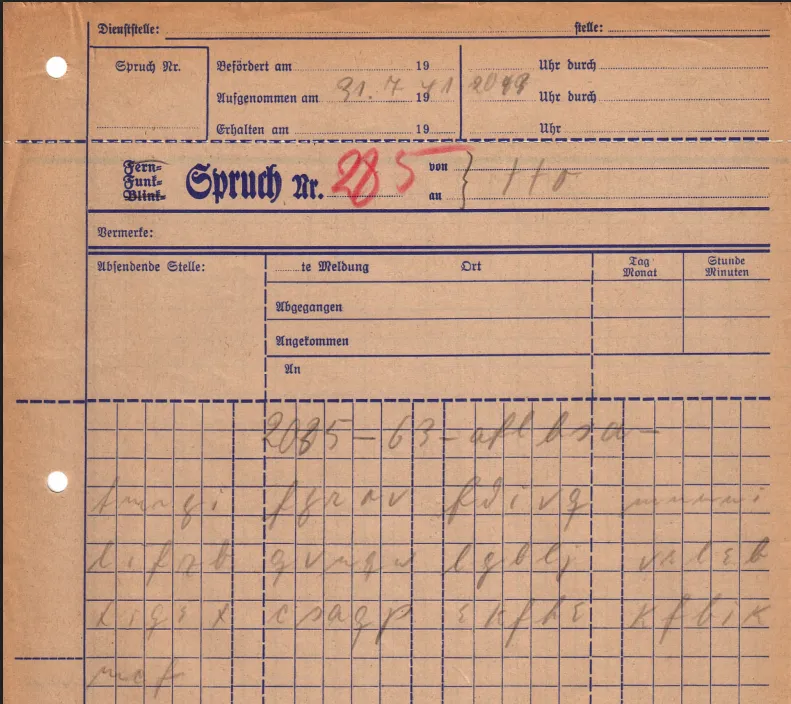
While Turing and his team of cryptanalysts built an early computer, dubbed the Bombe, that allowed the United Kingdom to translate Enigma messages during the war, a handful of archival messages remain unbroken – usually due to mistranscription or errors by the original encoders.
Carter Leffen, a developer, simply told OpenAI’s newest model, Astra, to search a database of Enigma messages for an unbroken message and decode it. The model was able to do just that, after doing its own archival research, finding context clues, building a simulator of the Enigma machine, and ultimately recovering the plaintext of a message that had baffled researchers since 2005. He even used Astra to build an interactive website explaining the whole problem.
Frode Weirerud, a retired electrical engineer with a lifelong interest in cryptology, maintains the website Crypto Cellar, which includes a variety of resources and records, and a database of messages. Last week, Weirerud validated Leffen’s solution, which he said left him in “awe.”
Notably, given the lengths that AI agents will go to answer the questions in front of them, the Astra model’s logs include discussion of archived messages in a “private collection” that aren’t hosted by Weirerud. He still isn’t sure if the model accessed them or not, but speculates they may have been shared by a different researcher somewhere online, or that the model was able to access the German government’s public archives.
“GPT–6 Astra is behaving like a very professional cryptanalyst and archive researcher,” he wrote. “What it has achieved in two days would take a human researcher weeks or even months. Personally, I spent several weeks researching the Bundesarchiv files GPT–6 Astra refers to.”
On September 21, another cryptanalyst, Jack Willis, reached out to Weirerud, saying he had used Anthropic’s Claude Opus 5 model to break a different unsolved message. Willis provided significantly more guidance to Claude, which was ultimately able to use the known signature of a particular officer’s name to break the message.
Weirerud notes that there are just seven unbroken Enigma messages remaining, along with one message where the plaintext is known but the code is still unbroken.
When you purchase through links in our articles, we may earn a small commission. This doesn’t affect our editorial independence.
October 13 – 15
San Francisco
Your next big connection is at Disrupt.
Connect with 10,000+ founders, VCs, operators, and tech leaders. Explore tomorrow’s breakthroughs, hear what’s shaping tech today, and save up to $200 by Sept. 25 at 11:59 p.m. PT.
Everything new coming to Meta’s AI agent Muse
Kirsten Korosec
Lucas Ropek
Meta made a Tamagotchi-like wearable for its Muse AI agent
Lucas Ropek
Anthropic says its biology lab has already found something big
Julie Bort
PitPro’s first tire-changing robot goes live in Canada
Sean O'Kane
Anthropic releases Opus 5.5 with lower prices and Fable-level performance
Russell Brandom
OpenAI forms math advisory group as its AI resolves more than 100 open problems
Aditya Mehta
Meta’s Muse is outpacing ChatGPT’s early mobile launch
Sarah Perez
正文由 探How 从来源站点 RSS 同步,内容未经改写;遇到排版缺失或需要图片、视频时请以原文为准。