Racism and Redlining Are Fueling a Flock Camera Backlash
Police in Hampton Roads saturated Black and low-income neighborhoods with Flock-style cameras, a study found.
以下正文同步自 Hacker News 最新,版权归原站所有,已转换为易读排版。
Police in Hampton Roads saturated Black and low-income neighborhoods with Flock-style cameras, a study found.
Copy Link
Bluesky
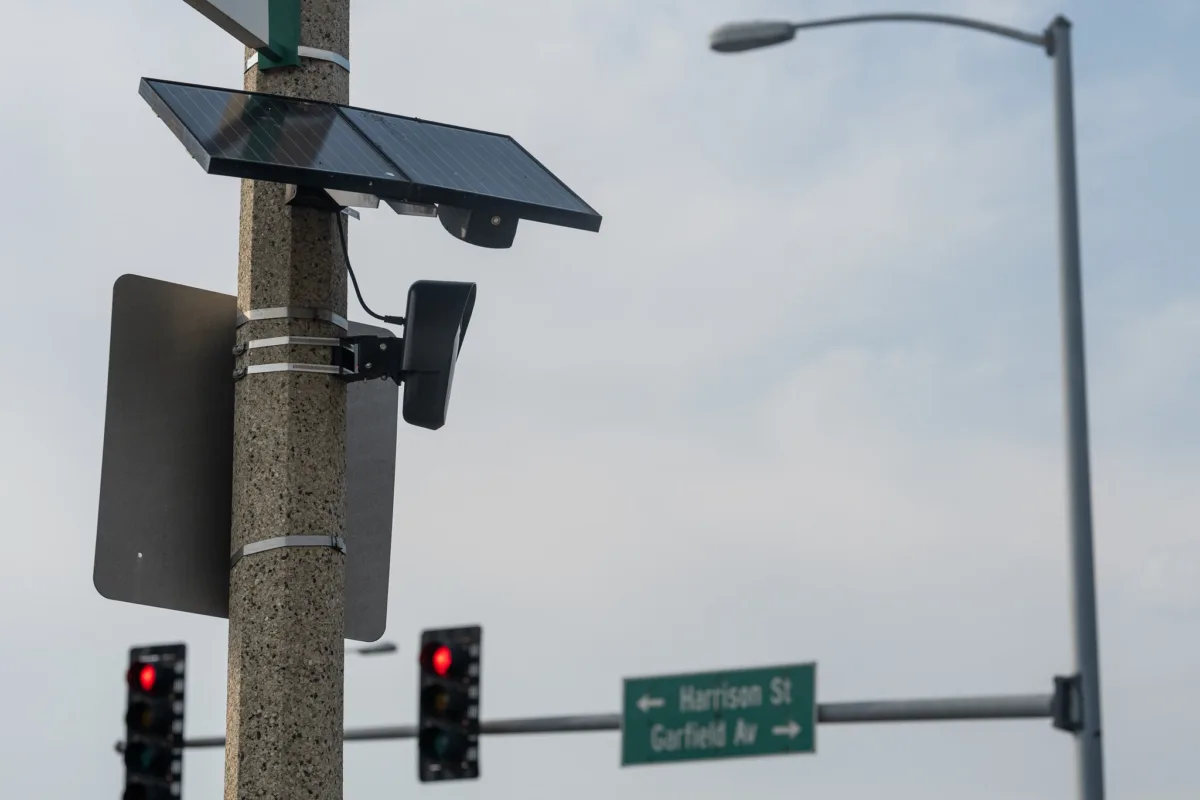
Photo by Paul Goyette via Flickr. This story was co-published with Truthout.
Local governments in Virginia are under mounting pressure to cancel contracts for surveillance cameras known as automated license plate readers (ALPRs). On October 6, the Henrico County Police Division announced that it would terminate its contract for such cameras after residents shared “legitimate concerns about Flock Safety.” In nearby Richmond, Mayor Danny Avula said on October 13 that the city would cancel its contract with Flock Safety, the most famous purveyor of the cameras, but did not rule out using ALPRs from a different company.
“It is a good first step, but we do need to keep the pressure on the city to not automatically switch to another ALPR vendor,” Richmond Democratic Socialists of America (DSA) member Victoria McCullough told Truthout.
DSA activists and residents in Richmond pushing police to ditch the contract have powerful research to point to from elsewhere in the state. In the neighboring Hampton Roads region of Virginia, race and class are the primary predictors of locations where police installed ALPRs, a groundbreaking study found earlier this year.
The study found police were more likely to install ALPRs in majority Black census tracts in each of the nine cities across the Hampton Roads region, an East Coast metroplex with 1.8 million residents and multiple cities, including Norfolk and Virginia Beach. About 80 percent of majority Black neighborhoods contain at least one camera compared to fewer than 40 percent of majority white tracts. ALPR surveillance is also more intense in majority Black neighborhoods, where on average there are four times as many cameras than in white neighborhoods when weighted for population share.
In Virginia Beach, police deployed ALPRs in only five of 76 majority white census tracts (6.6 percent), compared to one of two Black census tracts (50 percent). Black residents of the locality are 7.6 times more likely than white residents to live in a census tract with at least one ALPR. When weighted for the number of cameras deployed in each area, Black drivers in Virginia Beach were roughly eight times more likely than white drivers to be regularly surveilled by Flock-style cameras.
Published in January 2026, the study found a “similarly consistent pattern of disproportionate camera coverage” in low-income areas and concluded that ALPR deployment in Hampton Roads follows historical patterns of housing discrimination, racist segregation, and disinvestment. In other words, police have deployed the cameras so Black and lower-income people are more likely to live under high-tech, AI-powered traffic surveillance than whiter, wealthier people.
Dr. Steven Keener is a co-author of the study and director of the Center for Crime, Equity and Justice Research at Christopher Newport University. He pointed to Norfolk State University in Norfolk, one of only five historically Black colleges and universities (HBCUs) in Virginia, as an example of the increased surveillance presence. The area in and around the university is heavily saturated with Flock brand ALPR cameras, compared to whiter and higher-income areas of Norfolk, the study found.
“The census tract with the most ALPR cameras surrounds Norfolk State, which is the only public HBCU in the region,” Keener told Truthout in an interview. “The cameras completely encircle the campus, so you can’t enter or exit in a vehicle without being surveilled.”
Of the census tracts with the highest number of ALPRs, nine are located in Norfolk, where the cameras are concentrated in historically Black neighborhoods and near public housing. The ALPR data used in the study was only available because a federal judge ordered police to release the records in November 2025 as part of a privacy rights lawsuit filed by two residents of Norfolk. Keener’s team used the data to map out ALPR locations across Hampton Roads and compare the results to Census data on race and income.
“Economic and social policy failures have led to your life being constantly surveilled,” Keener said of lower-income and Black communities. “They’re still doing racialized surveillance and policing, but instead of having an officer on the corner, they are watching you to criminalize your behavior based on where you live.”
Across east Virginia, police deployed ALPRs near public housing projects where many lower-income Black residents live, reflecting Virginia’s history of redlining and other racist policies, according to Keener. Some housing projects are also surrounded by AI-powered “tsunami cameras” that analyze data on people as well as vehicles by recording “360-degree video in ULTRA-high definition 24/7,” according to one manufacturer. The cameras are operated by the public housing authority but often accessed by police, according to reports.
That type of surveillance reaches beyond the region for which the study had data, Keener mentioned. “A journalist, Samuel Parker, in Richmond found that police were watching people enter and exit their homes, using tsunami cameras to investigate social media posts,” he said.
Keener and his team expect similar results to their study in other parts of the country if transparency advocates are successful in pushing police to release such data. Police typically fight to keep such data under wraps — Richmond has refused to release its data despite public outcry over the technology, citing the potential for vandalism — and Keener knows of no other example of police releasing ALPR location data in the United States.
Modern ALPR systems go far beyond recording license plates at a specific time and location. By capturing images of each passing vehicle and using AI-powered software to turn identifiers such as make, model, dents, and bumper stickers into searchable data points, networks of ALPRs allow police to easily build detailed profiles of an individual driver’s movements or daily routine. The data is often fed into centralized, “real-time” surveillance centers where police use AI and “predictive policing” software.
“Predictive policing is this modern idea that, because we have all this data on where arrests have happened … we can predict where crime will happen and prevent it by focusing resources there,” Keener said. “But there are a ton of false positives where police misidentify places and people.” Other critics say predictive policing technology has proven to be both ineffective and a form of social control that reinforces existing patterns of racist and classist policing.
“We are putting our tools up in a racialized manner, so the data is going to be racialized,” Keener said, in reference to his research on ALPR locations. “It looks clean and without bias, but that is just not the case.”
Predictive policing technology also allows police to launder or “tech-wash” racist policing strategies to appear as if they are based on objective data, when in reality already highly policed communities are oversampled in the data that determines which communities are targeted. The report describes a “self-fufilling prophecy” in which highly policed communities produce the data used to identify targets for heavy surveillance in turn producing more data instructing police to consider these communities as threats.
“These cameras could be very useful tools for doling out fines and fees for expired tags and expired registrations that are in high poverty neighborhoods,” Keener said. “We are constantly taxing the poor in this system, and this is a clear way that the poor are going to be taxed.”
Flush with pandemic-era funding and federal grants, police departments across the country have aggressively invested in other high-tech surveillance technology in addition to ALPRs, including advanced AI-powered drones, without consulting the public. The integration of facial recognition technology with these surveillance tools in New Orleans and other localities has sparked outrage, leading a handful of cities to ban or limit its use by police with exceptions for investigations into violent crimes.
The study cites reams of research on the racial biases inherent to surveillance tech algorithms, as well as the negative economic and mental health impacts people experience when living under racialized segregation and high-tech police surveillance. In interviews with Parker, residents of Richmond housing projects described anxiety about being constantly on camera.
“I think it’s terrifying … it wasn’t by accident that these ALPR cameras got put up without public input,” Keener said.
The surveillance isn’t limited to local police, either. Keener warns that federal agencies, including Immigration and Customs Enforcement (ICE), are increasingly accessing local ALPR surveillance data through “side doors” despite guardrails established by state and local policymakers.
“Essentially, a side door access is like the federal government, in this case, ICE, getting access [to ALPR data] from friendly [police] departments,” Keener said during a recent press conference. “And that’s the most common way that it’s happening.” Investigative journalists found last year that about 50 immigration-related searches were performed across five Virginia counties between June 2024 and April 2025, despite local governments barring the use of ALPRs for immigration enforcement.
While the federal government could subpoena Flock Safety for the same data, since the company also stores ALPR data for training AI models, using these “side doors” is much easier, Keener said.
As the anti-surveillance fight heats up in Virginia, law enforcement has gone on the defensive in an attempt to continue using controversial ALPR tech. Ramin Fatehi is the commonwealth attorney for Norfolk and came into office promising to reduce mass incarceration. He suggested people are misdirecting their frustration with Big Tech toward Flock-style cameras because ALPRS are far more visible than data brokers working behind the scenes to hoover up and sell personal information online, for example.
“That is what has drawn people’s ire; they can see the [ALPR camera], and that is where they are directing anxieties that are perfectly reasonable in the age of AI,” Fatehi told Truthout. “They are right, but they picked the wrong target.”
Like others in law enforcement, Fatehi claims ALPRs are a “precision tool” for solving car thefts, missing persons cases, homicides, and other felony crimes. He said ALPRs can improve the “clearance rate” for homicide cases, or the percentage of cases considered resolved by an arrest or “exceptional means” such as the death of a suspect, for example.
However, journalists recently used FBI data to determine that the installation of Flock cameras and other surveillance devices in Atlanta, Georgia, did not markedly improve the city’s clearance rates from 2021 to 2025. Last month, CBS News also debunked repeated claims by Flock Safety CEO Garrett Langley that the company’s ALPRs helped police solve “1 million crimes” in 2025, which is not supported by available evidence. Asked about the scandals surrounding ALPRs in other communities, including dozens of cases where cops used the cameras to stalk women, Fatehi pointed to a new Virginia law that took effect on July 1 and restricts how police can access, use, and share ALPR data.
The law limits storage of ALPR data to 21 days — unless police have “reasonable suspicion” that a crime has been committed, a lower legal bar than the “probable cause” needed to make arrests. Vehicles placed on so-called “hot lists” can be closely surveilled for longer than three weeks by networks that can extend far beyond where the driver lives. “The fact that ALPRs are subject to abuse is a different way of
正文由 探How 从来源站点 RSS 同步,内容未经改写;遇到排版缺失或需要图片、视频时请以原文为准。