Time to rethink Shift Left accessibility with agentic AI
Remember back in May when we shared all our website accessibility indicators were up year-over-year? That’s held up well since. The average accessibility scores of Wagtail websites went up 5 points since May. Here’s a g…
以下正文同步自 Hacker News 最新,版权归原站所有,已转换为易读排版。
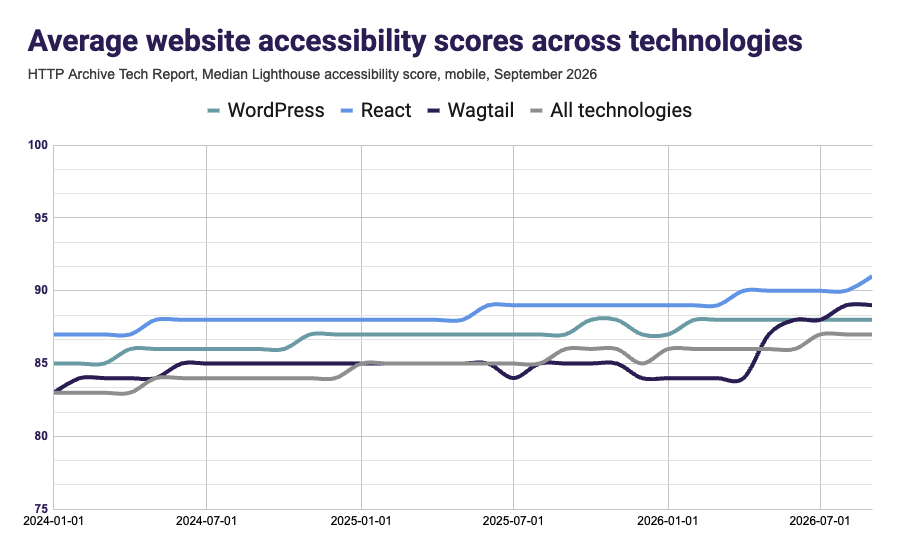
Remember back in May when we shared all our website accessibility indicators were up year-over-year? That’s held up well since. The average accessibility scores of Wagtail websites went up 5 points since May. Here’s a graph of the underlying HTTPArchive data, with Wagtail in indigo:
It’s obviously great to see our accessibility efforts paying off like that, particularly in the more disappointing context that web-wide reports like 2026 WebAIM Million show a 10% increase in detected issues year-over-year (different dataset, the chart above is HTTPArchive data, but still). It doesn’t have to be like that.
From this, my hunch is we can probably take this data-driven approach further: convert issues systematically present on existing sites into product changes to Wagtail, like to our built-in accessibility checker. Do that all the way until there are no issues remaining, going as far upstream as possible (design goals / R&D / product decisions). This has been called the "Shift left" approach to accessibility for a while, and with agentic AI it’s only become more relevant.
It’s hard to express how dramatic of a shift we’re going through for accessibility. Users of assistive tech are using more advanced tools than ever, with LLMs or otherwise. AI agents of all sorts are making much more extensive use of content semantics that we’ve been refining for humans for decades. And for accessibility knowledge workers, unsurprisingly the work is changing dramatically with AI adoption. It’s a challenging shift, as a lot of the craft is driven out of care for people first and foremost, and AI adoption comes with big ethical and societal issues. It’s nonetheless crucial we adapt to that shift if we want to keep making the web better for people.
This calls for a new strategy, but with things changing so fast for now we’ll just focus on adaptation tactics.
Getting this one out of the way quick, we need to stop spending so much time on one-off audits and instead redirect auditors’ precious time and expertise towards making upstream changes. Some will be remediation in code or design, some will be even farther upstream (project specs, best practice docs, web standards). WCAG 2.2 AA audits that don’t involve assistive tech can be 90% automated with LLMs today. And every form of testing that only auditors can do now, will be automated within the next year if not earlier. There’s no AI breakthrough needed here, just more time for people to adapt their work to new AI capabilities. Just take a look at computer use work from folks like H Company, or how the Jev decision model plays through the whole Pokémon Red video game. 30 hours worth of UI testing for $2.
The 10% of audit work that remains is all about trust, legal compliance, connecting the audit to the wider business context. Important aspects of the work where technology isn’t as much of a factor.
Having automated QA and monitoring of production systems is now so simple to set up, that the only reason teams aren’t adopting this is sheer inertia or lack of any capacity whatsoever for fundamental QA investments. Everyone should do it, and once they do, QA automation experts’ time can now be spent on AI R&D that benefits from deep automation skills, with tasks like:
And also more fundamental data engineering tasks like:
Paraphrasing No Man Is an Island, we underrate intellectual community. Whether it’s internal communities of practice, W3C community groups like the ATAG CG, or meetups, we need those spaces and connections to thrive. There’s a dearth of expertise on the ethics of our work specifically, and how to work ethically on the job within competitive pressures. This is crucial to navigate:
Our AI guiding principles are super helpful here, but they need practicing day to day, collectively. We underrate how much we can learn from one-another as peers and mentors / mentees, and addressing that is one of the simplest ways to better adapt to the paradigm shift.
Last but certainly not least, talking directly to your users is evergreen. They’re well placed to understand and express which of the fundamentals still matter and warrant the investment, and what’s coming up ahead that is worth looking at sooner than later.
With Wagtail Space 2026 right around the corner, it’s a great time for us to rethink what "Shift-Left" means in our decision making. There is a lot of Shift-Left type thinking on the talks agenda across all things content and code. The separate community day (TBA!) will be an excellent opportunity to relaunch our accessibility team. For accessibility specifically, I expect we’ll want to discuss:
正文由 探How 从来源站点 RSS 同步,内容未经改写;遇到排版缺失或需要图片、视频时请以原文为准。