Autumn (YC W26), and Why Unprotected Second/Third Order Agent Inferences Fail
Most companies are still figuring out how to get real value out of AI agents. Autumn (YC W26) is an interesting example of building a company around the assumption that agents can do much more of the work themselves if …
以下正文同步自 Hacker News 最新,版权归原站所有,已转换为易读排版。
Henry Michaelson
Oct 20, 2026
1
Share
Most companies are still figuring out how to get real value out of AI agents. Autumn (YC W26) is an interesting example of building a company around the assumption that agents can do much more of the work themselves if given enough specific broken-down tasks and instructions.
Autumn is a research platform for people and companies. You give it a name, a company, or a description of a cohort (“25 Series A AI dev-tool startups that raised in the last 12 months”). Agents work through filings, LinkedIn, X, GitHub, event pages, and the open web, then return a profile or a table where every cell links to its source. Autumn says its index covers more than 1 billion people and 109 million companies.
It’s a notable pivot. Autumn launched through YC as a real-time “stalk your prospects at scale” signal feed for sales teams. The current positioning is “everything on anyone,” with the signal feed as one workflow inside a research agent. Its public pitch has also touched on long-context models for enterprise data. Three framings in under a year suggests a team still finding its center, which is normal for a company this young with two college-aged co-founders at the helm.
Founders: Vishnu Sampathkumar (CEO) and Shiv Kampani (CTO). They met on the first day of orientation at Columbia where they graduated in 2025.
YC: Winter 2026 batch, San Francisco, with Ankit Gupta as primary partner.
Funding: Crunchbase lists a seed round with Rebel Fund and Haystack as investors alongside YC, but the amount isn’t easily sourceable, so I’m not quoting a number.
Customers and partners: Brex (the featured case study) plus big names Corgi and Mintlify on the homepage. Their first customers were reportedly fintechs and deep-tech companies. They also ship an API, Slack bot, CRM integration, and an MCP server for Claude Code and other agents. Teams features (shared billing, shared chats) arrived in early October.
Autumn’s own comparison is against ZoomInfo, Clay, and Apollo. Those are databases and workflow tools where you get the rows they already have. Autumn runs live research at request time, the way an analyst would, then assembles the answer. The pitch is that it finds what no database has indexed yet, like new Delaware incorporations, event pages, and launch pages.
The Brex case study shows this best. Brex wants to reach startups the week they come into existence, often before they have a website. Autumn watches Delaware filings, resolves each raw entity (a name and a registered agent) to founders, domains, and products, and attaches the evidence. A manual sweep of filings becomes a standing, cited pipeline. Brex has been a partner since February 2026.
The interface is a chat with a task list. You ask for research, a list, or an analysis, and the agent saves rows, validates them against your rules, and reports back.
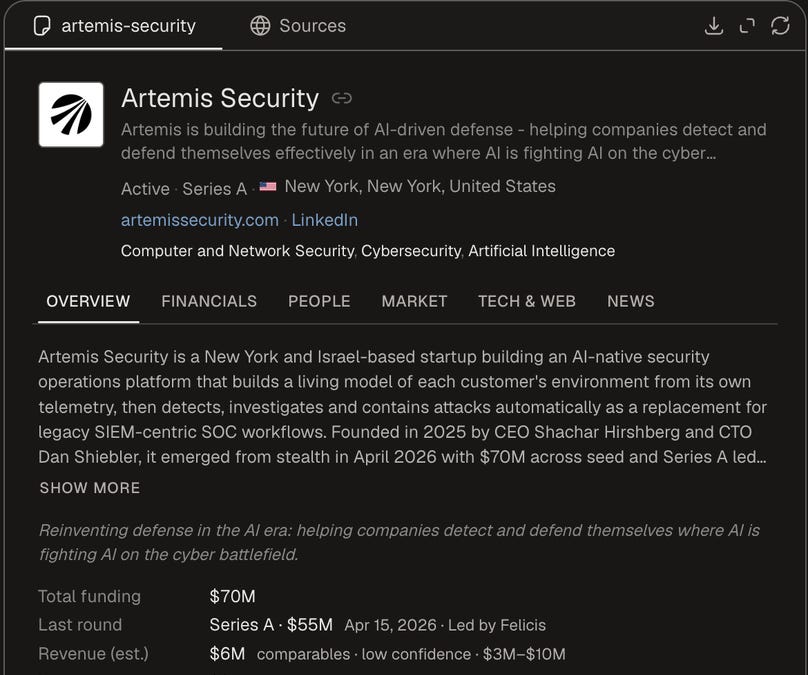
I spent some time trying it out, and I was overall impressed with the product. It surfaced a ton of information, especially when it came to identifying employees associated with the company and their posts. Here was an example from Artemis Security:
Generally speaking, I think it surfaces interesting insights. However, one negative thing I noticed is that some of the numbers cited look really shaky. In particular for earlier-stage companies, the revenue estimates seem very questionable and to me look made without clear citation as to why. For example, I even looked it up for my own past startup, and the number was wildly off of reality. That is a particularly revealing failure mode, and a somewhat expected one. Without extremely clear guardrails, agents can assemble a convincing profile from real sources while still producing second and third-order conclusions that are unsbustantiated.
Autumn charges in credits, and what I saw was roughly 50–100 credits per company. At list price that’s about 50 cents to $1 per run.
At under a dollar, a company profile that would take an analyst a meaningful chunk of an hour is cheap to run. You can research a list of 100 targets without anyone approving a budget. The flip side is that Hobby only covers 20–40 companies a month, so anyone doing this as a real workflow lands on Growth or Scale quickly. Volume discounts are modest (about 12% off per credit at the top self-serve tier), so the pricing is built around usage rather than seats. Generally speaking I think the cost is so freeing that any GTM or sales lead should try it out to see if their workflow would benefit.
For a company like this, the test of PMF is whether that experience translates into repeat usage. Can it reliably handle work that people would otherwise do themselves? Does it save enough time to justify the cost? And how quickly does it improve as users put it to work on more tasks?
Usage-based pricing at under a dollar per run is easy to try and easy to expand. The “cited cell” design makes agent output checkable, which is the thing that lets you stop supervising every step.
Apollo, ZoomInfo, 6sense, and Clay are well-funded and moving toward agents themselves. The data comes from the open web, so the moat has to come from resolution quality and freshness, not access. There’s also a privacy and compliance question that comes with indexing a billion people.
An early signal to examine would be whether Brex-style customers expand from one workflow to several, and whether a two-person team can support enterprise buyers.
The opportunity in this space isn’t simply to build another AI wrapper. In fact, I think this is the danger of the product. The product necessarily has to NOT be purely a one-shot AI wrapper for it to be worth it. Autumn needs to figure out which parts of a workflow can be handed off to software, and make that handoff reliable enough that people stop thinking about the underlying technology.
The companies that get this right could end up owning much more of the workflow than the tools they replace.
正文由 探How 从来源站点 RSS 同步,内容未经改写;遇到排版缺失或需要图片、视频时请以原文为准。