Book Review: The Ghost in My Brain
[This is one of the finalists in the 2026 book review contest, written by an ACX reader who will remain anonymous until after voting is done. I’ll be posting about one of these a week for several months. When you’ve rea…
以下正文同步自 Hacker News 最新,版权归原站所有,已转换为易读排版。
Scott Alexander
Oct 23, 2026
73
43
1
Share
[This is one of the finalists in the 2026 book review contest, written by an ACX reader who will remain anonymous until after voting is done. I’ll be posting about one of these a week for several months. When you’ve read them all, I’ll ask you to vote for a favorite, so remember which ones you liked]
In 1999, Professor Clark Elliott is rear-ended by a stranger at a stoplight. He’s shaken but figures he’s fine, and drives to work. Spoiler: Clark Elliott is not fine.
Elliott is severely concussed, and this fact will dictate the next ten years of his life. Elliott’s memoir is based on notes he took while concussed. Reading it is like watching someone try to troubleshoot their broken laptop using the broken laptop.
In the opening chapter, Elliott describes walking from his office to his car after a long winter workday:
“At this point my world had collapsed inward on itself… I looked down at my feet and shouted at myself to walk, but I knew it was hopeless. I had lost the mysterious initiative that impels us all forward when we walk, and I knew that without brain rest I wouldn’t be getting it back. I considered lying down in the snow.”
Over an hour later, Elliott finally manages to cross the parking lot and begins the second phase of his trial: getting into the car.
“I’d lost the concept of center. I had no internal representation, or visual understanding of circle, target, middle, inside. Without these concepts I couldn’t get my hand to move toward the lock, or put the key in the slot.” So he just stands next to the door for another hour and a half.
Around 2 a.m., a suspicious police officer asks why Elliott is loitering in the parking lot, but the officer is too cold to get out of his car and drives away. At 3:30 a.m., four and a half hours after he left his office, Elliott finally arrives home.
Somehow, Elliott lives like this for a decade.
The book’s first mystery is how a person can remain conscious, verbal, employed, and yet so damaged that he can’t get into a car or recognize his own house. The second mystery is: why did he apparently recover through treatments that sound, at first pass, like boutique neuro-quackery?
A disclosure is in order before we continue. I am pretty personally invested in the answers here. About a year and a half ago, I got seriously concussed. Milder than Elliott’s, but bad enough to substantially rearrange my life. On some level, I read this book in hope of a cheap fix, or at least an obvious one. Instead I found myself in the weird borderlands of modern medicine.
What’s it like to be a human with severe brain damage? Elliott offers a metaphor:
To simulate concussion damage to a human brain then, we’ll need to gather together […] 50 million desktop computers, a 500,000-mile-high stack of paper, and the almost inconceivable amount of information it takes to construct a human mind, then loose a hurricane on the system, ripping out network lines, laying waste to vast sections of memory, and sending landslides to smash hundreds of thousands of computers.
A bit sensational, but you get the picture. One classic model of what’s happening during severe concussions is “diffuse axonal injury”: rapid acceleration and deceleration stretch axons, the neuron projections that send electrical signals, causing micro-tears and disrupting cellular metabolism.
Standard CT and MRI imaging usually fail to detect these microscopic or functional disruptions, and there isn’t really a cure, so patients are told to go home, rest up, and wait to find out whether they’ll be back to work the next day or out of commission for the next decade.
U.S. concussion incidence is commonly cited around 1.6-3.8 million a year, and many go unreported1 . About 15-30% of adults report post-concussion symptoms (PCS) 3-6 months later. Even on conservative estimates, that’s hundreds of thousands of cases a year in the US alone. A much smaller number of those cases will result in something like Elliott’s experience.
After the initial fender-bender, Elliott hands his driver’s license to the other driver. Then, a few minutes later, he hands it over again. He has no memory of having done so the first time, and can’t figure out why people are looking at him funny. This is a recurring theme—Elliott can’t even notice the problem, because the cognition that’s supposed to monitor the behavior has gone offline.
He writes: “when cognitive capabilities go missing they are often so fully gone that the concussive does not miss them in the way a normal person would, or indeed sometimes even realize they’ve gone absent.”
But Clark Elliott is no pushover. He’s a Professor of Artificial Intelligence at DePaul University, a consummate musician, is single-handedly renovating his family home, and runs marathons on the side. The biographical lists serve a purpose: Elliott wants to assure the reader that he hasn’t become less intelligent. His cognitive capacities have just come apart in a way that doesn’t track any nameable cognitive disorder.
He can write, but he cannot read. He can climb stairs but not descend them. He can teach a graduate seminar and then, walking home afterward, fail to recognize his own house. Moving through doorways or down halls poses a significant challenge.
More than once, he describes his state as “alien.” He writes, “we still walk and talk and act as though we are part of the human race, but it doesn’t feel that way inside… Instead, there is a strange feeling of nostalgia, a longing for who we used to be.” He notes that this feeling of disconnection is likely a significant contributor to the rate of suicide among concussives2 : “we have, in many ways, already lost that which makes us human.”
One of the most striking passages in the book is when Elliott, hungry, decides to make himself a snack. He heads to the kitchen to eat a piece of salami and an apple, but finds he can’t. As though trapped in an old Tom and Jerry cartoon, he finds himself literally unable to choose which of the two to eat first. He can’t initiate action selection. He goes to the living room, returns to the kitchen, fails again. He repeats this loop ten times, like “a rat repeatedly traversing a dead-end maze.” Two days pass before he eats.
Elliott calls this “getting stuck.” The bridge between knowing what he wants to do and doing it has broken. In desperation, he finally calls his bemused friend Jake, who tells him: “Okay, go eat the salami first, then eat the apple,” ending the forty-eight hours of struggle.
Somehow, he cobbles together enough coping mechanisms to keep limping along for years. Until he can’t anymore.
“This is it,” Elliott reflected. “I am never going to have another normal day, or hour, or ten-minute period again. I am never going to be a real human being again. I won’t be publishing my research, and at some point I am going to lose my job.”
Ten years after the crash, Elliott is approaching a complete breakdown. Or rather, while broken, he adds a small child to the equation. As it turns out, the normal prattle of his two-year-old daughter is concussion kryptonite:
“It was this simple combination—my inability to filter out or process spoken dialogue in real time, and Erin’s continual need to talk—that almost led to a final, catastrophic meltdown.” He calls it “partial death.”
Unfortunately, there are no parenting sabbaticals. In a last-ditch effort, Elliott pulls out his emergency savings and reaches out to a “cognitive restructuring specialist” named Donalee Markus.
Wait a minute, you might be thinking. Elliott hasn’t seen a specialist before??
He has, sort of. It didn’t help. A brief detour through medical history: Elliott hit his head in 1999. The CDC didn’t publish its first major report on mild traumatic brain injury (TBI) until 2003. The NFL concussion crisis broke into public awareness in 2005. Until 2013, the only mention of persistent post-concussive symptoms in the DSM-IV was in the appendix under “proposed criteria set”. After the crash, an ER doctor checks his pupils and sends him home; a neurologist runs a 30-minute test and declares him fine, and shouts at him when he pushes back.
It’s unclear whether Elliott was just unlucky in encountering a cast of extremely unsympathetic medical professionals, or whether this was really the general state of neurology in the 90s. Whatever the case, Elliott quickly writes the whole system off and goes back to calling his friend Jake whenever he gets stuck in doorways.
For ten years, Elliott can’t make himself a sandwich. Then, over the course of a year, he substantially recovers. Enter idiosyncratic concussion specialists Donalee Markus and Deborah Zelinsky.
This is the first time we have a third-person perspective on Elliott. Markus writes:
“Clark Elliott was a mystery to me when we first met. Observing him through my glass front door, I saw that it took him two minutes just to find the doorknob with his hand. When I gave him the simplest of my assessment tests—copying a geometric line drawing—his body went into bizarre contortions as he struggled to complete it.” Markus takes him on as a patient anyway.
Her intervention is simple: she gives him geometric puzzles to solve, specifically trapezoids and three-dimensional dot exercises that escalate in complexity. He has to apply rules to shapes, generate equations from them, and eventually do the whole thing in his head.
(Source): Elliot includes a bunch of these geometric puzzle examples in the book. Sadly, they didn’t alleviate my symptoms.
Markus also refers Elliott to her colleague Deborah Zelinsky, a neuro-optometrist.
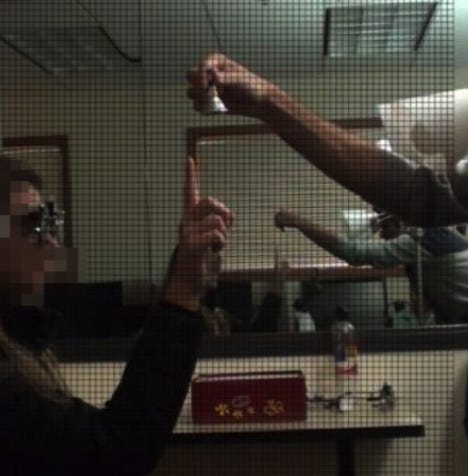
Zelinsky’s diagnostic method is a little more involved. The patient closes their eyes, and the examiner rings a small bell at various positions in space. The patient must reach out to touch the bell. The patient will often fail this test, revealing a “visual-auditory mismatch.” Zelinsky will then try different prism lens combinations while the patient’s eyes are closed and ask them to do the bell test again. I repeat, the patient’s eyes remain fully closed. The entire time. She then prescribes the lenses that improve the patient’s performance.
(Source). The only image I could find of the Z-bell test; fittingly grainy and hard to evaluate.
This is called the Z-bell test (presumably after “Zelinsky,” who has a patent on it). While I wasn’t particularly surprised that adjusting someone’s vision when their eyes are open can change how accurately they localize sound when their eyes are closed, I remain deeply confused about how prism lenses could alter accuracy if the patient’s eyes remain closed the entire time.
The claim is that low-level light still passes through the closed eyelids, stimulates retinal activity, and that this stimulation is what’s being modulated by the different lenses.
“By placing various types of lenses across a patient’s closed eyes, we can change the way light spreads over the retina, thus modifying the dynamic relationship between the mind’s visual inputs and the body’s internal responses.”
Depending on wavelength, eyelids transmit somewhere from well under 1% of blue/green light to around 5–6% of red light. But, as anyone with eyelids knows, this is still mostly diffuse reddish illumination—not sufficient to update your visual field, or to localize a bell.
But within a year of meeting Markus and Zelinsky, Elliott has experienced massive improvements and is on the road to recovery. He writes a heartfelt note to Markus thanking her for “giving him his life back.” So I guess the treatments worked?
Let’s take a look at the evidence, starting with Markus. Markus belongs to a fairly large tradition of “cognitive training interventions” for PCS for which there’s some evidence. A 2016 meta-analysis looking at 14 studies on cognitive training in post-acute TBI found a small effect on overall improvement in cognitive function (Hallock et al., 2016).
Unfortunately, “cognitive r
正文由 探How 从来源站点 RSS 同步,内容未经改写;遇到排版缺失或需要图片、视频时请以原文为准。