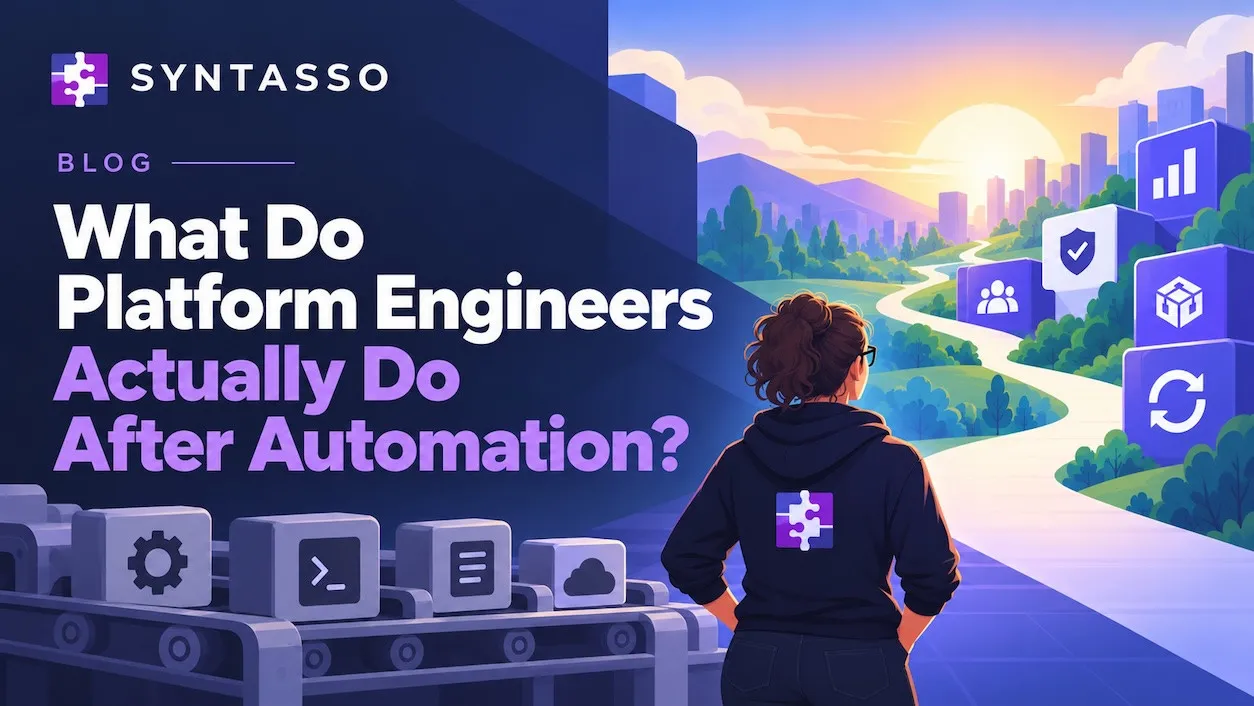
What Do Platform Engineers Do After Automation?
Platform engineering teams spend years automating infrastructure provisioning, eliminating tickets, and making self-service a reality. But once they succeed, an awkward question emerges: what do platform engineers actua…
以下正文同步自 Hacker News 最新,版权归原站所有,已转换为易读排版。
Platform engineering teams spend years automating infrastructure provisioning, eliminating tickets, and making self-service a reality. But once they succeed, an awkward question emerges: what do platform engineers actually do next?
The answer can't simply be "more strategic work." That's too vague for engineers who want meaningful technical challenges, and equally unconvincing for engineering leaders justifying their platform investment.
At Syntasso, we've built Kratix around a different idea: automation doesn't eliminate the need for platform engineers. It changes where their expertise creates the most value. Instead of provisioning individual resources, they design, evolve, and govern the capabilities that allow everyone else to move faster.
Here's what that work actually looks like.
Platform engineering has always had the tension that every bit of automation which removes toil also removes a job description someone used to have. Nobody mourns the disappearance of manually cabling up a server rack. Writing bespoke Terraform for the fortieth database request won't be missed either. But the value platform engineers provide was never really the cabling or the Terraform itself. It was their ability to support colleagues building software reliably and at scale, and that ability doesn't go away just because the ticket queue does.
Provisioning or templating once was always the easy part of the job. The harder, more valuable work is redefining the line between consumer and producer, so consumers are genuinely unleashed from platform-level concerns rather than just handed a different queue to wait in or a pile of running services they don't know how to maintain. The Platform as a Product discipline shifts platform engineering toward ensuring hundreds or thousands of requests behave like the first one, and that the dependencies underneath them not only keep working but stay compliant.
This changes platform engineering responsibilities across three activities: producing reusable capabilities, making them easy for developers to consume, and maintaining those capabilities safely over time. Kratix provides the orchestration framework for all three, but the platform team still makes the engineering decisions about what to expose, who can contribute, and how capabilities evolve.
The work doesn’t disappear. It moves up a layer.
Making capability creation safe enough to hand to someone else
If you're building a marketplace architecture, the value is in removing the constraint that the platform team is the only team trusted or able to write capabilities. That's the whole point of the model, yet it isn't as simple as wishing it were true. Handing the producer job to other engineers only works if they can work confidently in the tool stack to both produce and maintain their capabilities. Encouraging and supporting high-impact composition also makes it even more important that a capability can't quietly break everything downstream, so this is where the centralised platform design work needs to go.
The real value of a platform marketplace isn't simply providing a catalogue of services. It's enabling teams across the organisation to create, share, and maintain capabilities without introducing inconsistent standards or operational risk. Whether you're using Kratix with Promises or another abstraction, you'll need the ability to design independent, testable, and composable capabilities, which demands a socio-technical approach.
Technically, you need to design shared platform expectations that enable cohesive naming, operational support, and audit trails across capabilities. The centralised orchestration team should trust but verify adherence to those expectations, and keep maturing the platform by encouraging effective capability versioning, cross-dependency upgrades (including progressive rollouts), and active deprecation once a capability stops earning its keep. Some of the tools teams are using include validations on Promise creation/update, AI agents scanning Promises for issues or common patterns to extract, and improvements to platform metrics and alerting for both centralised and per-capability learning.
Handing over Promise creation is a design problem.
The tech can support both carrot-and-stick enforcement, but which one gets used is an organisational question, not a technical one: who gets to contribute a Promise, with what review, and at what level of access. Experienced platform engineers are exactly the right people to design and iterate on those rules, because they've seen both failure modes up close: too strict, and you've rebuilt the centralised ops bottleneck you were trying to remove; too loose, and you get the unmaintainable sprawl that DevOps at scale always threatened to become.
Platform engineers can also define maturity levels for Promises, automate feedback on implementation quality, and help new contributors create their first capability. Making it easier to produce a well-designed Promise isn't just about improving the contributor experience. It directly influences how effectively the platform can scale.
Define what a mature Promise looks like.
AI makes this shift even more important. As agents become capable of generating infrastructure configurations, proposing platform capabilities, and requesting changes, the challenge isn't simply making those actions possible. It's ensuring they happen through the same governed interfaces and lifecycle processes as human-driven changes. Platform engineers become responsible for designing the boundaries within which both humans and agents can safely operate.
None of this asks platform engineers to learn wildly different skills. It asks them to apply the ones they already have with higher impact. The job becomes building the thing that lets someone else safely change what used to be theirs alone.
One thing to call out: platform engineers don't have to offload all the fun to the capability producers.
Once an organisation really captures the paradigm shift provided by a platform orchestration framework, they can see that developer-facing APIs for common capabilities like webapps, infrastructure, or environments are just the start. Not every capability needs a front door, and platform teams should be looking for the ones that don't.
Not every capability needs a front door.
Fleet-wide resource reconciliation is just as valuable for baseline cluster configuration and shared tooling as it is for a self-service API. A common example for Syntasso Kratix Enterprise (SKE) users is scheduling the health agent that needs to exist in every Kubernetes cluster and report its health back. That kind of one-off installation used to get shipped as a new manifest in a Helm chart, applied only when CI/CD happened to run, or worse, as a manual change someone had to remember to make. The same principle applies to security policies, observability tooling, and shared platform components that need to remain consistent across an entire fleet.
Self-service capabilities get most of the attention in platform engineering conversations, understandably, because they're the visible part. But orchestration doesn't need a tenant asking for an instance to be worth building. If a capability should simply always be true across the estate, design it that way rather than waiting for someone to request it. The platform team often designs and delivers these features, making them producers on the platform just as much as any other capability providers.
Organisations have different shapes and sizes of rules, and someone needs to decide where and how to apply them. For platforms built on Kubernetes, some things belong as Kubernetes-level guardrails, enforced no matter what's asking, while others fit better as per-instance or per-capability checks. You can implement these as a stage inside a Kratix Promise workflow to apply them consistently across every instance of a similar capability, keeping them true over time instead of bolting them on per request and only applying them on creation or change.
The result is a shift from compliance as a one-time checkpoint to governance as an ongoing platform responsibility. Instead of relying on individual teams to remember every requirement, platform engineers can embed policy checks, validation, and reconciliation into the capabilities developers use. Without this continuous governance, broader platform adoption will turn into either a queue of manual approvals or a pile of rules nobody remembers exist.
One important thing to realise is that you shouldn't expect any of this to feel finished. There is a reason the top level of the CNCF Platform Engineering Maturity Model is "optimizing" not "optimized". There will still be IaC to tidy up, adoption that is moving slower across parts of the organisation than you'd choose, and ordinary friction to work through with the teams producing and consuming Promises.
As Team Topologies reminds us, platform teams need to balance providing capabilities as a service with collaborating directly with the teams that use them. Self-service doesn't eliminate collaboration. It changes when and where collaboration delivers the most value.
Understanding where friction exists, and deciding whether the platform should absorb it or expose it to consumers, is ongoing platform-as-a-product work. It's not a phase you complete and move past.
Automating infrastructure provisioning doesn't make platform engineers redundant. It gives them a bigger challenge.
Instead of managing individual requests, they can focus on designing reusable capabilities, enabling contributions from across the organisation, and ensuring everything remains secure, compliant, and maintainable as the platform scales.
And as AI accelerates the creation and consumption of infrastructure, this work becomes more important, not less.
That's what we built Kratix to enable. Syntasso Kratix Enterprise (SKE) helps platform teams move beyond one-off automation to produce, orchestrate, and maintain reusable capabilities across their entire technology estate. Instead of becoming the bottleneck for every infrastructure request, platform engineers can build the foundations that allow the whole organisation to move faster, safely.
Ready to move beyond infrastructure provisioning? Explore Syntasso Kratix Enterprise.
正文由 探How 从来源站点 RSS 同步,内容未经改写;遇到排版缺失或需要图片、视频时请以原文为准。