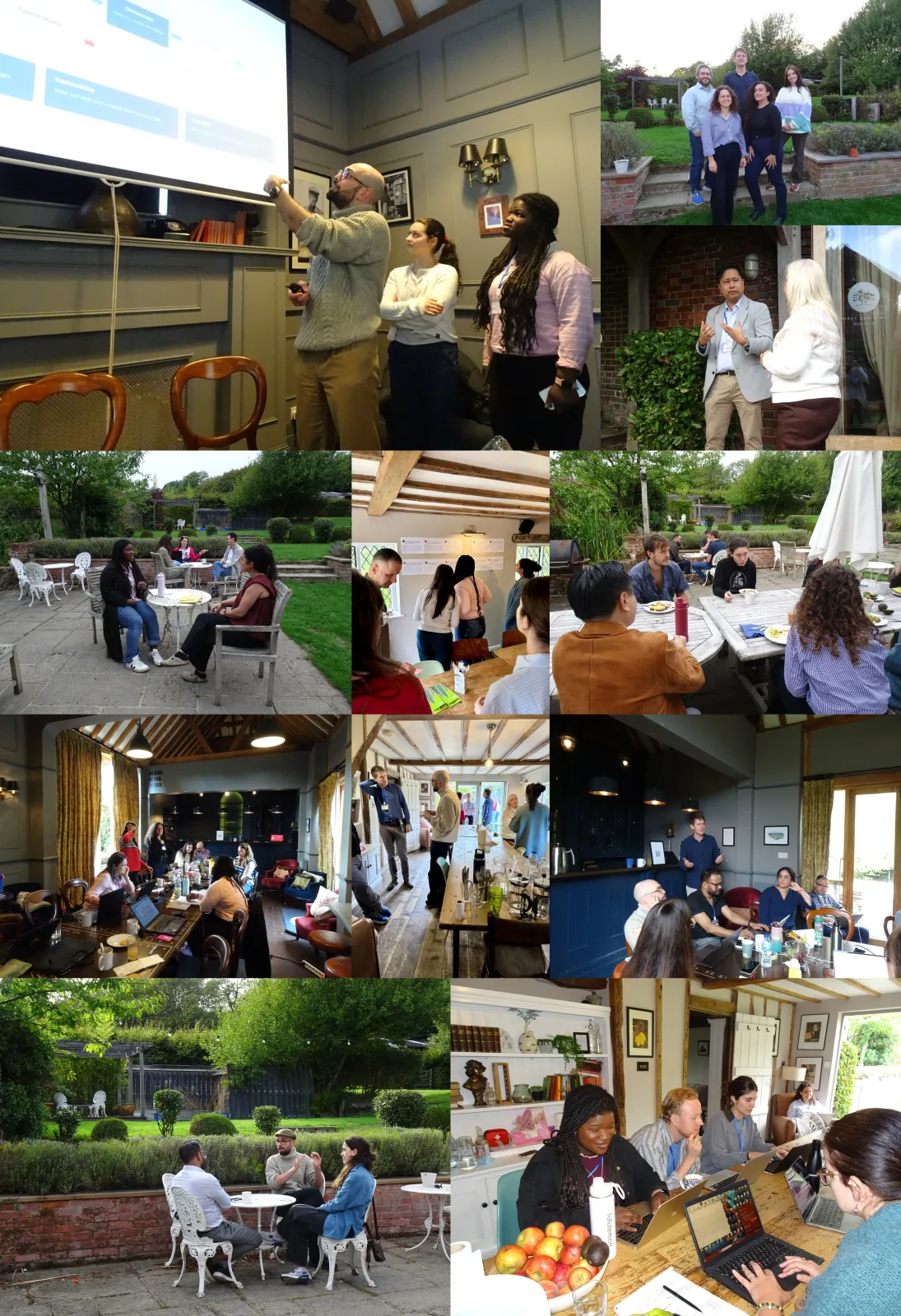
What I learnt co-leading an AI Safety bootcamp for legal and governance practit
Click to highlight new comments since: Today at 5:21 PM
以下正文同步自 Hacker News,版权归原站所有,已转换为易读排版。
4Comments
4
AIFrontpage
47
New Comment
Submit
4 comments, sorted by top scoring
Click to highlight new comments since: Today at 5:21 PM
[-]Katalina Hernandez1d10
0
Giving @Martin Radzaj a big shoutout, who wrote What lawyers can do for AI safety and is starting a Community for Lawyers in AI Safety. Martin is one of the participants in the pictures, he had been working on LegalxAIS issues for a year before the Seminar and continues to bring legal professionals into AI safety!
[-]wonder20h*7
0
Sounds like pretty cool events! I was a research engineer in the LLM Responsible AI/Trust and Safety team and worked a lot with lawyers; and also found our lawyers learn very fast and often understand our technical parts eventually pretty well! I can also echo that we (researchers in the team) were often encouraged to think from the perspective of threat models, and refining that threat model from the technical perspective was both helpful for me as a researcher and for the lawyers.
[-]Cameron D.4h3
0
Seems like important work; thanks for doing it! Question: was there any discussion/inclusion of illegible problems (list of examples) in this event? And, if the answer is no, may I suggest that something of that sort is included in any events that are run like this in the future? While the ML frame of AI Safety and alignment is easier to communicate in a short amount of time, it's not the full picture, and touching on some of the harder theoretical problems could help legal and governance folks appreciate the full scale of the alignment challenge. Illegible problems are, by their nature, more difficult to communicate, so this would not necessarily be an easy task, but I think it would be a worthwhile one.
Leaving off with a relevant quote from Wei Dei:
...a potentially more impactful approach (compared to trying to make illegible problems more legible), is to make key decisionmakers realize that important safety problems illegible to themselves (and even to their advisors) probably exist, therefore it's very risky to make highly consequential decisions (such as about AI development or deployment) based only on the status of legible safety problems.
[-]Katalina Hernandez3h2
0
Thank you for this comment! I love that Wei Dai post. That said, the majority of people who attended the seminar lacked fairly basic AI safety literacy, including things like what AI labs currently do to mitigate the most obvious safety problems with current-level AI systems: safeguards, evaluations, benchmarks, how these work in practice, etc.
For that audience, I think going into something like decision theory would have been way too high-level. We did talk about things that are closer to the practical interface between AI safety and law, though. For example, we discussed how small decisions in deployment can accumulate into gradual disempowerment. We actually did a role-playing exercise based on the AI Minister in Albania case, which @Raymond Douglas included in Gradual Disempowerment Monthly Roundup last year, as an example of events that might contribute to gradual disempowerment.
We also discussed value alignment, law alignment, and the broader difficulty of the alignment problem. I'm just not sure whether those would count as ilegible problems in this context.
If you have ideas, or specific problems you'd like to see discussed, I'm very open to suggestions. In particular, I'd be interested in hearing what you think people with practical legal expertise could actually contribute to addressing.
正文由 探How 从来源站点 RSS 同步,内容未经改写;遇到排版缺失或需要图片、视频时请以原文为准。