Meaning After an AI Eucatastrophe
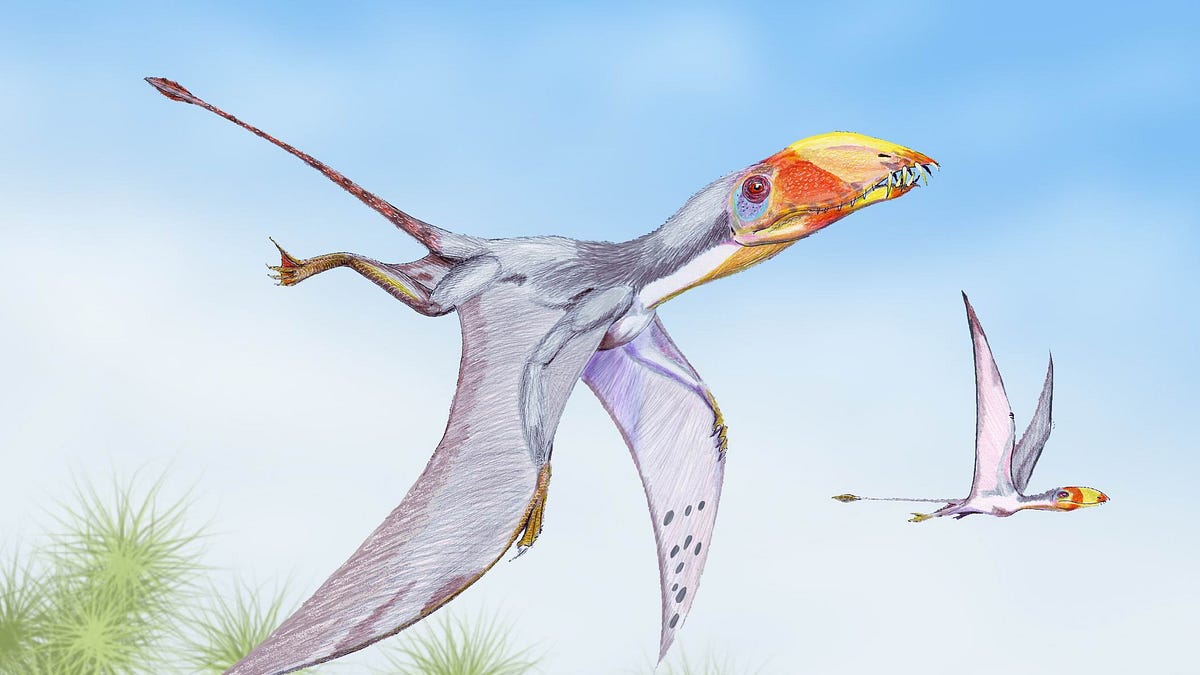
Pterosaur drawing (CC-BY-3.0) Dmitry Bogdanov
以下正文同步自 Hacker News 最新,版权归原站所有,已转换为易读排版。
David Chapman
Oct 26, 2026
24
5
7
Share
Pterosaur drawing (CC-BY-3.0) Dmitry Bogdanov
A eucatastrophe is “a sudden turn of events that averts an impending Doom.”
Superintelligent AI may well cause Doom. Or, precipitate a eucatastrophe that solves all our problems, so we live happily ever after. Or, maybe it won’t happen. I have no idea, and neither does anyone else.
Each of these is at least possible, so I think it’s important to think about futures we might like. If we can’t even imagine a good future, we’re less likely to get one.
In 1993, Vernor Vinge predicted that computers vastly more intelligent than humans would create a Singularity. He called that “an opaque wall across the future,” beyond which science fiction writers cannot see. By definition, we cannot imagine what superintelligence might do.
We can still imagine what we might do, though. The whole wide world may become incomprehensible, but—if we survive, and remain human—we won’t be all that different.
So I’m more interested in the meanings we may find in the post-Singularity world than in the astounding technologies that fascinate futurists. What will be meaningful or meaningless in a eucatastrophic AI future in which things go surprisingly well?
The pre-Singularity world is all we’ve got, for now. So I’m even more interested in ways imagining future meanings can cast light on the ones we find in this world. Thinking through how meaning would work there reveals several misunderstandings of how it works here, and ways to do meaningness better.
Photo courtesy Ahmed
Lite nihilism is the sense nothing is meaningful enough, or that only the wrong sorts of meanings are available. The proper and adequate sort of meaning would be absolute, transcendent, eternal, objective, ultimate, or cosmic. Unfortunately, you will not find those in the cupboard.
This motivates searching for meaning somewhere else. Commonly people imagine real meaning lives in some alternative, metaphysical world. The apparently inadequate meanings we get are mere shadows of those, intermittently seeping from that domain into ours.
Then it is tempting to discount actual, this-world meanings, and to try to live in another dimension—emotionally, mentally, or spiritually. Then you may fear that abandoning that project would result in nihilistic depression. In fact, though, giving up on it is an antidote to nihilism.
We can only live in the actual world. “This is it!” Our immediate experience constantly contradicts imaginary sorts of meanings. At some level, we know they’re just made up, invented as emotional support fantasies.
Meaning is only ever right here and right now. Searching for meaning is self-defeating. When you stop, you see actual meanings increasingly clearly.
“The classic tribute to hope.”
The future is one of the alternative worlds we may imagine meaning comes from. Then, in imagination, we try to live in it. What is meaningful, we suppose, is not what is actually happening, but what may happen someday.
Some worry that if AI can satisfy all our desires, there will be nothing to look forward to, and no motivation to do anything at all. Even in the best possible outcome for superintelligence, humans would be reduced to listless consumers, as in the movie WALL-E. The future will have ceased to exist. Hope will become impossible.
Hope is a dysfunctional ploy, because it devalues and blinds us to the actual world. If superintelligence takes away the future, this strategy for avoiding the present—the right now, right here—will no longer work.
On balance, this may be good! Because it never did work. And, fortunately, “here, now” will not go away after a Singularity (if we survive it).
If AI can do everything better than we can, catastrophic loss of meaning might result. Or, so some people worry! I suggest it need not.
What we find meaningful would change. But I don’t think all meaning, or even most, or even much, is likely to disappear, or even diminish. We might find the eucatastrophic world far more meaningful.
In a different world, what is meaningful, in what ways, will be different. But that is happening all the time! Constantly, particular meanings fade, and some eventually die altogether. Some personal life events that once seemed highly significant may no longer. (I’ve used an extramarital affair as an extended example, in “The puzzle of meaningness.”) Many huge cultural brouhahas that everyone was worked up about a few years ago are mostly forgotten. New meanings always spring up to replace the lost.
A common concern is that work is a main source of meaning for many people, and if AI does all of it, we’ll lose that. But work is meaningful only for a minority. More people live in the circumrational shantytown, where the work itself often seems tiresome and meaningless.
Many people enjoy some social aspects of working, but not its substance. I’ve suggested that, after an AI eucatastrophe, we can recreate the meaningful pleasure without the meaningless tedium. That might be a greatly improved version of village life, a natural human way of being. That might seem like heaven for many.
But, you may object, village life seems constricted and repetitive. Some people might like it, but it seems meaningless to you. Heaven is a place where nothing ever happens. There are bigger, more important things than socializing with friends and community!
I agree, for myself. Yet I would be willing to trade away meaning for me in exchange for better lives for most people. Fortunately, I don’t think we’d need to make that painful bargain.
According to the photographer, “Using AI guidance, she corrects her technique as the app flags uneven sections in the fabric.”
More serious than losing particular meanings is the possibility that whole types of meaning may cease. The meaning of accomplishing any project goal, for example?
On the other hand, you may knit sweaters because you enjoy doing it. You could probably buy a much nicer sweater than you can knit. It would cost much less than the economic value of your time. That’s not the point. Knitting is something you do for its own sake, not for the future product.
When you’re finished, you love it and wear it because you made it yourself, not because it’s intrinsically wonderful. AI being able to give you a fantastic sweater, exactly how you would like it, wouldn’t change that.
An AI eucatastrophe might force us to switch from a goal orientation to a process orientation. If machines can instantly accomplish any goal for you, then that orientation just won’t work anymore.
Goal pursuit is natural, and seems inevitable. However, it tends to be a grind, sometimes miserable, and when you get to the end it is often disappointing, or only transiently satisfactory. It can be an addictive, false promise; soon after achieving something, you start chasing the next one. Process enjoyment, in contrast, can be continuously satisfying.
People vary on this axis; it seems to be an aspect of personality. Perhaps it’s even innate. So a negation of accomplishment would be harder on some1 than others. However, everyone can, and does, find meaning in process as well.
Science fiction writer Ada Palmer recently suggested:
What if the future is the Etsy economy, where we all make beautiful handcrafted bespoke things and buy them from each other? Maybe you enjoy drawing pterodactyls, maybe crochet. Everybody enjoys making and doing things. A future where we all make and do things and purchase them from each other is a beautiful future.
But maybe it seems inadequately meaningful to you? Maybe you don’t find the prospect of an eternity of knitting sweaters attractive. I do not either…
Many of us find problem-solving highly meaningful. If AI can solve all problems better than we can, that annihilates some sorts of meaning.
For instance, it may no longer be possible to gain status by winning the contest to be first to solve some problem. Right now, some mathematicians are extremely upset about this.2 I find status-climbing unattractive, so personally I don’t think losing this particular opportunity is something we should regret. However, I can understand how others would disagree. (And I might have in the past; “Love letters to Liota” is about that.)
There are nobler ways to find problem-solving meaningful. Making the world better for others by solving a practical problem feels good, and is good, even if no one notices, or someone else takes the credit.
If AI solves all problems, then we’ll lose that opportunity too, and I will be a bit sad about it. (Not as sad as I would be glad to have no problems, though!)
Still, I think difficult, creative intellectual work is valuable. In a follow-up post, “Meaning for thinky people in a world with superintelligence,” I’ll explain how that value may survive in a future in which computers are much better at it than we can be.
The word “eucatastrophe” was invented by J.R.R. Tolkien. He first used it in “On Fairy-Stories.” Despite the title, that is not about twee tales for toddlers. It explains creative imagination as a process, and the transformative power of serious myths. It’s a peek behind the scenes of The Lord of the Rings, to learn how and why he constructed it.
While knitting a sweater, you probably look forward to finishing it. You imagine what it will look like, and imagine the satisfaction of having finished it.
Imagination is good! Visiting mythic realms in imagination is meaningful and satisfying! You can still do that after the Singularity!
Earlier, I suggested imagining that meaning lives in the future is a mistake. This is not a contradiction. Imagining possible future meanings can be valuable. (It’s what we’re doing in this post, even!)
The problem is not imagining, it’s confusing the imaginary with the actual. Imagination is an activity you engage in here and now. That process is where the meaning is, not in the future.
There are specific practices for increasing one’s perception of meaning in actuality: in the here-and-now. These widen the class of things you find meaningful, and intensify how meaningful given particulars are. These also enhance enjoyment of process for its own sake, because they draw attention toward what is actually happening.
Making these practices known and available may be greatly beneficial if we’re heading toward an AI eucatastrophe. And also if we aren’t!
In “Romancing the shadow,” I quoted Robert Bly’s Little Book:
In daily life one might suggest making the sense of smell, taste, touch, and hearing more acute, making holes in our habits, visiting primitive tribes, playing music, creating frightening figures in clay, being alone for a month, regarding yourself as a genial criminal. A woman might try being a patriarch at odd times of the day, to see how she likes it, but it has to be playful. A man might try being a witch at odd times of the day, but it has to be done playfully. He might develop a witch laugh and tell fairy stories, as the woman might develop a giant laugh and tell fairy stories.
Some meditation methods can dramatically broaden and deepen one’s perception of meaning. (Others have the opposite effect.) Quoting my spouse Charlie Awbery’s book Opening Awareness: A guide to finding vividness in spacious clarity:
Opening awareness frees you from domination by your own mental contents: your thoughts, emotions, interpretations, habits, beliefs, desires, intentions, identities, and all of that other stuff. These mostly concern matters elsewhere and elsewhen. They are much less relevant to what is happening now than they try to claim.
Spontaneous action arises naturally from spacious involvement. Spaciousness frees you to act instead from fresh, panoramic perception of what is happening and what is becoming possible.
Charlie and Andrew Conner recently collaborated to create an online course, Spacious Clarity, that teaches Opening Awareness meditation. They describe spacious clarity as “continu
正文由 探How 从来源站点 RSS 同步,内容未经改写;遇到排版缺失或需要图片、视频时请以原文为准。