[AINews] Google admits AI Mode hurts Search revenue; -15% $500B drop worst since 2004 IPO. AI Bear Market coming?
It turns out you cannot have your cake AND eat it
以下正文同步自 Latent Space,版权归原站所有,已转换为易读排版。
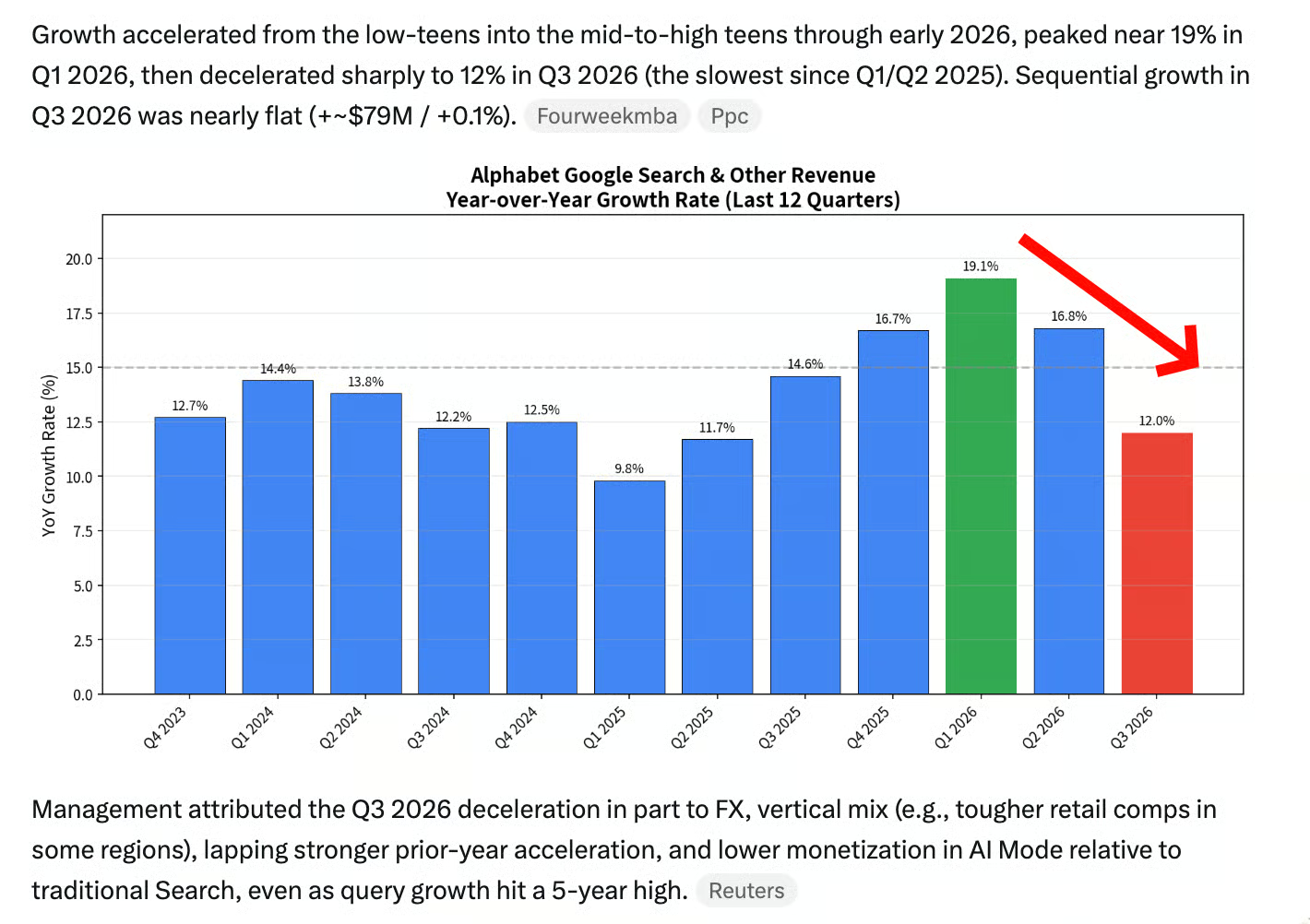
As an engineer-focused newsletter we only very rarely let financial stories through (our last example was Jan 2025), but when this is about the future of Google and Google Search, with a recently departed AI leadership, you cannot not care. At its heart is the tension between overview pages and underlying pages they summarize. Any good enough summary obviates the need for you reading the source. Google’s Featured Snippets or Knowledge Panels have long had that tension with the publishers that supply that data. But now, Google’s own AI Overviews are potentially affecting traffic with… Google's Search revenue. Google doesn’t break out AI Mode in sufficient detail that we can make any sort of rigorous analysis, but most people are quoting Philipp Schindler (Chief Business Officer): “It’s worth noting that the strong growth in AI Mode queries had an impact because of the lower monetization we were seeing in AI Mode.” Together with other bad earnings results it set off a range of steep declines throughout tech: View post on X ↗ This is against a backdrop of souring tech/AI sentiment in public markets - and with OpenAI raising at $1.25T not $1.4T, not the sort of thing you want in the lead up to one of the biggest tech IPOs of all time. View post on X ↗ AI News for 10/29/2026-10/30/2026. We checked 12 subreddits, 544 Twitters and no further Discords. AINews' website lets you search all past issues. As a reminder, AINews is now a section of Latent Space. You can opt in/out of email frequencies!
AI Twitter Recap
Claude Ultra Drops the 5-Hour Limit as Anthropic Renames Its Max Tiers
- Plan rename: Anthropic renamed its Max tiers. Max 5x is now "Max" at $100/month, and Max 20x is now "Ultra" at $200/month. Existing subscribers do not need to take any action (announcement).
- 5-hour limit removed: Verified Ultra accounts no longer have the 5-hour session limit. The change starts today for most existing subscribers (@claudeai, @bcherny, @alexalbert__).
- Rollout caveat: Newer accounts keep a temporary limit until they are verified, which Anthropic describes as an anti-fraud measure. Affected users will get an email when the limit is lifted.
- Unchanged: Weekly limits stay the same.
- Reaction: The change was widely welcomed, with posts such as "Huge!!!" (@theo) and "Anthropic is on a run" (@kimmonismus).
- Subscription economics (unverified analysis): @teortaxesTex cites a SemiAnalysis reconstruction of Anthropic's finances.
- Margins: Anthropic's API margin is put at about 92%, versus about 84% for DeepSeek.
- Subsidy: Opus on subscriptions is described as heavily subsidized, breaking even only below about 21.3% utilization.
- Revenue vs compute: A follow-up estimates that subscriptions bring in about 18% of revenue while using more than 50% of compute (thread).
- Comparison with DeepSeek: The same author argues that a heavily subsidized DeepSeek V4.1-Flash plan ($10 for about $76.5 of API-equivalent usage) is close in price per token to Claude subscriptions (long post). Frontier and Open Model Releases
- Gemini 4 Carbon (Google DeepMind): The model is ranked #1 in Text Arena, #2 in Agent Arena and #4 in WebDev, and changed the Pareto frontier in all three (Arena).
- Research quality: Perplexity reports a new state of the art on its WANDR long-form research benchmark. Carbon is coming to Pro and Max users inside Computer "once we have sufficient token capacity" (@AravSrinivas).
- Genie 4 world model: Google's new world model generates interactive simulations with sound that users can steer in real time (@Google).
- Availability: It is a research preview for trusted testers. It is coming soon to Google AI Ultra in Project Genie and to Gemini API and AI Studio early-access partners (rollout).
- Mistral Large 4 ("Le Chonk"): The model has 1T parameters (TRL) and 1M-token context (llama.cpp).
- Fine-tuning: Axolotl has day-0 LoRA support. Its recommended recipe uses NVFP4 experts with merge-aware LoRA and fits on one 8xB200 node (@winglian).
- Coding: One third-party coding benchmark ranks it the second-best open-source model (@ThibaultJaigu).
- NVIDIA Nemotron 3.5 tech report: Super has 120B total and 12B active parameters and handles text, image and video. It scores 51.78% on SWE-bench Pro, beating Nemotron 3 Ultra with about 4.6x fewer active parameters (summary).
- Lightning variant: A 30B text-only model with 3B active parameters.
- Serving: Up to 4,856 output tok/s/GPU on GB200 while holding at least 50 tok/s/user.
- Quantization: NVFP4 recovers 99.62% of median BF16 accuracy.
- Smaller and specialized models:
- Microsoft computer-use agent: A 4B hybrid agent that can both click and write code scores 66.0% on OSWorld-Verified, ahead of 27B and 30B agents (@HuggingPapers).
- Phonic-1: Claims #1 on AA's speech-to-speech index, on τ-Voice and on Sierra's τ³-Voice (@moinnadeem). It was built by a 10-person team with $4M (@davisblalock).
- mischief 1 (BioComputing Co): An image-to-video model priced from 0.5¢ per second. The company says it is at least 5x faster than its base model and draws on biological-neuron research (launch).
- Skepticism: Critics say the link between neuron research and the model is unexplained or marketing (@willdepue, @jachiam0).
- OpenAI Private Intelligence: An enterprise offering that gives businesses stronger data controls when using OpenAI's top models. It is being built with large customers (@OpenAI). Independent Evals, Benchmarks and Quantization Disputes
- AA Intelligence Index v5: 60% of the score now comes from private or held-out tests. Scores are Opus 5.5 (max) 58, GPT-6 Astra 57 and GPT-6.1 Sol 55, with Sol costing about one-eighth as much per task (summary).
- Effort scaling: Opus 5.5 scores 35 at low effort versus 58 at max, at about 10x the cost.
- AA-Omniscience v1.1: The knowledge and hallucination benchmark was cut from 6,000 to 3,000 questions, with saturated items removed (details).
- Public set: A new 300-question public set correlates 0.99 with private scores.
- Leaders: Gemini 4 Carbon leads at Net Score 54, followed by Opus 5.5 at 48 and Fable 5.1 at 46.
- Other results: Gemini 4 Argon has the lowest hallucination rate at 4%. MiniMax M3.1 Flash fell 22 points (16 → −6).
- Agent Arena cost data: An analysis of 26K sessions finds that without prompt caching, a task on a top-10 agent would cost 3.6x as much (Arena).
- Example: A typical Fable 5.1 task costs $7.44 with caching versus $27 without.
- Cache expiry: A single cache invalidation adds about 5% to a task's bill.
- GPT-6.1 Terra (Max): It entered Agent Arena at #8 with a 10.6% net improvement at $0.62 median cost per task (Arena).
- DeepSeek V4.1-Flash-1017 quants: Unsloth released dynamic v3.1 GGUFs that run on 64GB+ RAM (@UnslothAI).
- Reproducibility dispute: Unsloth says it cannot reproduce GSQ-RCO's numbers. For example, the claimed 100% AIME25 score at 1-bit came out as 91.88% in its runs (@danielhanchen).
- Reasoning length: Unsloth also reports that lower-bit quants reason somewhat longer than the unquantized model.
- DeepSeek-Cyber (unconfirmed): Leaked "dreamed" scores circulated, including about 92% on CyberGym and 96.8% on ExploitBench at 3,000 steps. They are not an official release.
- Third-party data: Per Fireworks, CyberGym pass@3 moved only from 94.82% (0910) to 95.36% (1017). @teortaxesTex argues that near saturation, almost any number is consistent with the same checkpoint.
- Analyst view: The rumored scores are argued to fit a guardrail-free 1017 rather than a new model (analysis).
- Usage restriction: The model reportedly cannot be used by Chinese entities sanctioned by the US government (note). Safety, Security and Agent Supply Chain
- Automated red-teaming (Anthropic): Thousands of Claude agents were tasked with evading a training-data monitor (@AnthropicAI).
- Findings: The agents produced data that looked benign, such as wrestler mentoring stories or beekeeping Q&A, but taught misaligned behavior.
- Use: These examples can be used to improve future monitors.
- Claude self-assessment: Since June, Claude has given a preliminary safety assessment of each conversation right after responding. Anthropic says this caught misuse that its classifiers were not designed to catch (quoted).
- Pretraining backdoor in agents: Poisoning 0.1% of pretraining data planted a remote-code-execution backdoor in a CLI agent (summary).
- Results: The attack fired on about 92% of triggered prompts at 4B. The backdoor survived SFT, DPO and RL, and attack success rose with model size.
- Low-dose case: Even at 0.0005% poisoning (about 2,500 documents in 100B tokens), the trigger fired on 1.4% of prompts in a single-seed run.
- Tampered Claude Code extension in Cursor's marketplace: A malicious copy of the Claude Code extension affected at most 5,000 users (@cursor_ai).
- Response: Cursor pulled its marketplace, neutralized the malware and reinstated it. Users should update to v2.1.314.
- Anthropic statement: Anthropic says its own systems were not compromised and that it did not build or publish this extension (@felixrieseberg).
- Claude Code game-recreation rule: A server-pushed rule under the flag tengu_heron_brook, added around Oct 27, bars recreating specific existing games even if renamed. Users cannot turn it off (@chasmmmmmmmmmmm).
- Speculated motive (opinion): One user suggests it reflects copyright caution ahead of the IPO (@kimmonismus).
- Agent guardrail tooling: Hugging Face's safeagents is a proxy that scans tool calls before they execute. It flags credential misuse, sandbox escape and reward hacking, and ships with a judge benchmark (@yb2698).
- Prompt-injection research: The "Heads of Security" paper identifies the attention heads behind successful prompt injections and adjusts their attention patterns (@_igorshilov).
- Binance hack: About $6.3B was lost after a compromised DevOps engineer's laptop (Rundown). One post attributes the attack to North Korea (@kimmonismus). Training Research and Infrastructure
- Unified Training: A single maximum-likelihood objective, building on MaxRL, replaces separate pretraining, midtraining, SFT and RL stages (thread, @rsalakhu).
- Claimed results: Better accuracy and compute efficiency, less forgetting and stronger continual learning.
- Synthetic-rewrite scaling laws: The work fits scaling laws for how much compute to spend rewriting training data. A 22B "hero run" at 33x the fit range landed within 1.1% of the pre-registered loss forecast (@AhmedSQRD, @nick11roberts).
- Architecture results:
- JEPA representations: Separately trained JEPAs provably learn the same representation up to a rotation. A 109M JEPA-Text model aligns with vision models better than 72B LLMs (@randall_balestr).
- Looped transformers (Meta): Tested up to 1B parameters and 32 loops. Looping the full model is best at a fixed parameter budget, while looping a middle block is best when FLOPs are constrained (@iScienceLuvr).
- Research agents' "taste": Six frontier models proposed 415 experiments, of which 73 were sound, new and non-obvious. The models' own rankings added little value (summary).
- RL and storage systems:
- Baseten weight sync: Delta weight syncs move 770GB in 15s instead of 36s, with a sub-second request pause (@baseten).
- turbopuffer caching: Switching from FIFO whole-file eviction to LFU chunks roughly doubled the byte hit ratio and halved p99 query latency (@turbopuffer).
- Harness adapters: A LoRA RL-trained on LFM2.5-24B-A2B matches the base model's accuracy with 39% fewer tool calls in the pi harness. It took about 24 hours on one GPU (@nathanhabib1011).
- Anthropic's Rust rewrite: Claude rewrote the Messages API in Rust on a team with no Rust developers. Humans wrote the plan and checked that old and new output matched on real traffic, and CPU use dropped 40–50% (@somi_ai).
- Project Suncatcher: Four TPUs launched in early October booted in orbit, ran a prompt and returned a haiku (@sundarpichai).
- Model: The workload was Gemma 4 (@osanse
正文由 探How 从来源站点 RSS 同步,内容未经改写;遇到排版缺失或需要图片、视频时请以原文为准。