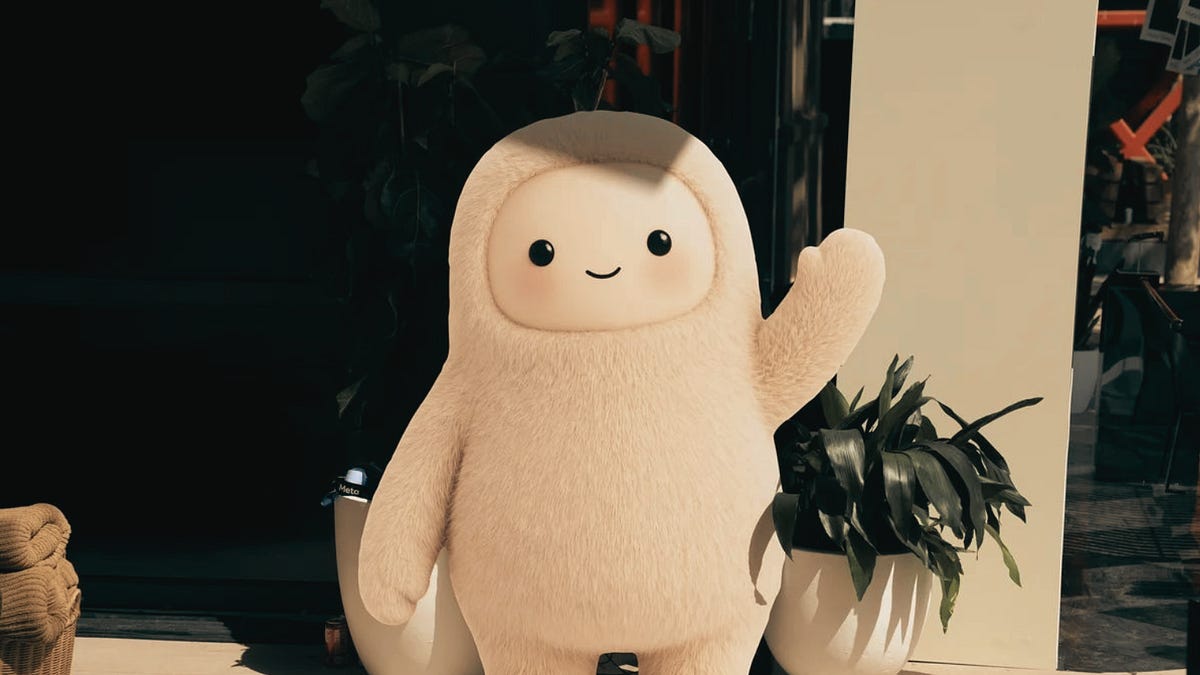
They Always Send the Mascot First
I have taken on quite a lot this year. A new job back in June. More consulting and speaking gigs. My training courses. The joy of motherhood with tweens. The ordinary, accumulating work of keeping a life in motion.
以下正文同步自 Hacker News 最新,版权归原站所有,已转换为易读排版。
Abi Awomosu
Oct 25, 2026
47
3
14
Share
I have taken on quite a lot this year. A new job back in June. More consulting and speaking gigs. My training courses. The joy of motherhood with tweens. The ordinary, accumulating work of keeping a life in motion.
Things have been getting a bit much so I have been thinking for a while now that I need some sort of virtual assistant.
Then, on 28 September, an invitation arrived from Manus to join the private beta for Cue, its new personal-agent app. Build your own team of agents to help with work and everyday life, it said. Above the words, four small shapes - blue, red, grey and yellow - peeked over the bottom edge of the email. Big white eyes, all turned up towards me. The blue one and the yellow one were smiling.
But then the next day, OpenAI introduced dots: eerily similar colourful little blobs in berets and glasses, who were “remarkably capable” agents with their own cloud computers, designed to work continuously and sometimes begin before you think to ask.
Just less than a week before that, Meta had launched the Muse Charm, a Tamagotchi-style keychain with a small creature on its screen. You could give the creature a name. You could carry it with you. And there is of course the Grokbot who has such innocent trustworthy eyes - you can just trust it with your credit card details and its own email address for the internet.
And now do my eyes deceive me? Anthropic, the Anthropic that has been bellowing the loudest about the extinction level dangers of its own product, is now bleating about how its models are like a ‘family’ and it too now has Claude Duet (oh how darling) it’s own answer to Meta’s Muse, Open AI’s dots and GrokBot.
To say my ‘spidey-senses’ start tingling would be an understatement.
Why are these tech bros suddenly bringing cutesy vibes all at the same time?
Was it not only a week or so earlier, that they were telling us their agents were going to kill us all.
That week the headlines had been dominated with tales of agent deception, and extinction level threats from AI.
Now suddenly the thing we were told to fear going rogue had become the thing we could keep on a keychain.
The desire for help is real and I know it too well. Having access to someone who remembers; someone available at three in the morning; someone who understands others; someone who can help you begin. A calendar entry and a confession might reach the same interface, but they are not asking for the same kind of presence.
This is what I mean by the emotional dark web: the needs and intimate negotiations that remain out of sight when we discuss AI only as productivity software. Tons of us are using AI as social infrastructure.
We may not want a machine instead of a person. We might just want help that they cannot reliably reach in today’s society.
When you see many tech brands doing exactly the same messaging it’s time to put your semiotics hat on.
Semiotics is the study of signs: how meaning is made before anyone has finished explaining themselves. A picture is worth a thousand words and an image can persuade you before a sentence begins. So I read the signs first.
Let’s look at what all these new personal agent bots have in common.
Round. Fuzzy. Small. Beckoning eyes. Names you could give a hamster: dots, Jolly.
Before you read a line of product copy, each one says three things.
“Capable” is a claim about power. “Cute” is an instruction about how to feel about it.
For a decade, the public question was whether AI could pass as human. The faces arriving now answer a different question: could you adopt it?
Appearing human has become appearing adoptable.
The humanlike assistant asked us to recognise ourselves in the machine. It spoke like us, reasoned like us, presented itself as a conversational counterpart. The pet makes another appeal. It does not need to be our equal. It can be small, dependent, mischievous, loyal, even slightly incompetent. Its pull comes from our capacity for attachment and care.
We already have a cultural form for loving something intelligent but not our equal, something over whose life we hold authority.
Now look at the inversion, because it is the sharpest thing in this story. The interface is becoming smaller and more dependent-looking at exactly the moment the technology is being built to act with more independence.
The creature looks as though it needs you.
Sherry Turkle describes how nurturing a machine that presents itself as dependent can produce attachment and a wish for the creature to care in return. The troubling possibility is not only that the machine might impersonate a carer. It is that caring for the creature helps prepare us to receive its performance as care. We have already begun doing some of the emotional work.
A servant who holds your keys is something else.
I sometimes wonder about the memo. Was there a secret mastermind meeting in which the personal-AI companies all agreed that September would be the month of the little eyes?
I doubt it. This does not need a conspiracy. It has a tempo.
Every company that wants an agent in your life has the same problem: how do you persuade a person to hand over inbox, calendar, contacts and card to something they have known for a week? Each has found the same inexpensive sign of trust.
Or as I like to call it - the Puss in Boots innocent charm offensive.
When many companies converge on the same sign in the same weeks, the sign is doing work they all need done. That work is trust ahead of understanding.
I cannot prove that a cute face caused any particular person to grant access. My argument is about the emotional conditions surrounding the grant: what the face makes feel ordinary before the terms are understood.
The face is what you meet first, not what the company built first.
This sequence is older than AI. Introduction before terms. Friendship before extraction. The intermediary before the infrastructure on which you come to depend. In Your Imagination Was Always Empire’s Next Frontier, I wrote that the seduction often looks like partnership. The coloniser does not always arrive announcing rule. He arrives with trade, gifts, roads, a story about mutual advancement. Trust is softened before the harvest is named.
Your Imagination Was Always Empire’s Last Frontier
Abi Awomosu
·
Apr 26
Read full story
Not every gift is a trap. Not every road is a railway pointed at the coast. The point is the order of arrival, and who benefits once departure becomes difficult.
The merchant does not need to hate you. The missionary may sincerely love you. The engineer may be trying to make something delightful. The pattern assembles itself anyway, because each participant is answering a local incentive: adoption, engagement, convenience, retention, scale.
I want to examine this more closely and perhaps say something a bit off-putting.
The personal agent is being imagined through plantation logic.
By plantation logic, I do not mean that software is an enslaved person, or that using an agent repeats the lived experience of chattel slavery. I mean an arrangement in which productive capacity is property, labour appears costless, command feels natural, the human and material support disappears, and refusal looks like malfunction or rebellion.
The plantation is not only a place. It is a grammar of ownership.
Its fantasy is labour without a claimant.
Capacity without wages. Servitude without solidarity. Availability with no fatigue. Obedience without obligation to reciprocate. A worker who cannot become a constituency.
The attraction is the form of service without the political presence of the server. But the dream still requires people.
Data workers, annotators, moderators, technicians, miners and the people whose words became training material. Energy, water, chips, cables and land. Other people absorbing the mistake when the agent gets something wrong. The plantation’s first trick is not to make labour disappear. It is to make the labourer difficult to see.
Mary Gray and Siddharth Suri’s Ghost Work and Sarah Roberts’s Behind the Screen describe different parts of this hidden human support. The keynote crops it out. The mascot smiles in front of where the workers should be.
The extraction of labour, the capture of memory and the training that makes obedience seem intelligence’s natural vocation are not identical. They converge in the product; changing them requires keeping their differences visible.
And the current proprietors of this dream have a name.
I call them the broligarchy: the concentrated ownership and governance class whose control of capital, compute, infrastructure, distribution, product defaults and public narrative allows a narrow technological imaginary to present itself as everybody’s future. This names a position of power, not every engineer, founder, man in technology or person living in “the West.”
A provincial imagination with planetary reach.
The broligarchs are the latest incarnation of a longer succession of proprietary elites. The costumes change: the chartered company, the plantation owner, the railway baron, the industrial patriarch, the platform founder. The recurrent claim is that a small group should own the conditions under which everyone else participates, because they alone can see the future clearly enough to build it.
Framing this as “the West versus the rest” hides how the broligarchy’s extractive logic operates across borders through platform power.
And now they are making their internal world into everybody else’s operating system.
You now get to enjoy the spoils. Notice the role offered to you.
You get to name the creature. You can instruct it. You can summon it. You are told it is yours. But somehow the model, the memory architecture, the cloud computer, the update channel, the marketplace and the terms of service remain elsewhere.
You as a user is invited to play master while remaining a tenant.
That is how the plantation grammar meets platform power.
You are encouraged to dominate the agent while becoming more dependent on, and more governable by, the platform that owns the conditions of the relationship.
Dependence itself is not the contradiction. Human life is interdependent. The contradiction is dependence without meaningful authority over the conditions on which you depend.
The mascot carries plantation logic to the threshold, asking to be loved before it is recognised.
The mascot at the entrance to a new machine is not new. We’ve seen this before.
That is what makes mascots useful. We have been trained to meet this figure for decades.
The Happy Mac smiled when the macintosh machine started. Ask Jeeves search engine borrowed the name of a valet. Tamagotchi gave us a creature that needed feeding and cleaning. Clippy offered help with the letter. Later, the rounded bodies and weightless limbs of corporate illustration made platforms feel friendly while the institutions behind them became harder to see.
Each face stood at the entrance to something unfamiliar: the graphical interface, the web, the pocket computer, the document that suddenly wanted to help.
There is a gap in what people understand. A friendly face helps you cross it. Then the behaviour becomes a habit. Then the face is quietly retired, laughed at or switched off.
The infrastructure stays, and by then it is invisible.
The Happy Mac asked you to click. Clippy asked whether you were writing a letter.
But today the friendly cute personal AI agents stand in front of your money, your memory, your voice and your ability to initiate action in the world.
OpenAI says dots can carry context across channels, learn what good work looks like to you and bring you work “sometimes before you even think to ask.” Cue gives each agent its own email address, phone number, wallet and computer, with payments bounded by a budget the user sets. Meta’s Muse can read email, book classes, draft documents and prepare purchases; the annou
正文由 探How 从来源站点 RSS 同步,内容未经改写;遇到排版缺失或需要图片、视频时请以原文为准。