A Book That Will Never Be Read
"I cannot shake the feeling that we find ourselves in a publisher-papermill complex, powered largely by public funding. " - Michal Wojcik
以下正文同步自 Hacker News,版权归原站所有,已转换为易读排版。
"I cannot shake the feeling that we find ourselves in a publisher-papermill complex, powered largely by public funding. " - Michal Wojcik
Dear connoisseurs of papermill slop, please give a warm welcome to Michał Wójcik, former neuroscientist, now hunter for AI-generated or simply stolen yet peer reviewed rubbish.
Nonsense images and hallucinated references, all published by major publishers like Springer Nature and Elsevier, and that despite (or maybe because) of their massive teams of experts and expensive high-performance digital tools which are meant to prevent all this garbage from entering the editorial process.
Michal shares his findings on LinkedIn and on Bluesky, one of these works of science featured in September 2026 Shorts, where a Spanish fellow named Álex Escolà-Gascón, Professor for Exorcism and Divine Apparitions, fabricated a bizarre clinical trial to prove the existence of immortal soul and life after death. Its graphical abstract was some fine AI slop:
But that paper in Elsevier’s Cell Press was at least read by quite many people, some did it to pray, most however did it to laugh.
The following post by Michal will be about papers nobody has ever read or ever will read, not even their authors. Those are some really cheap fabrications, often book chapters of books which Springer Nature and other publishers sell in subscriptions. Some physical printed books may get ordered by clueless librarians who think this is their university’s money well spent. Nobody will ever read any of that, and if someone would try, there’d be in for a major shock.
My relationship with academic books is quite strange. Although I devour them quickly, I rarely read them. I cannot judge the content of most of them. My expertise is quite narrow. But we are at a point of scholarship where one does not even have to read the book to be certain it is not worth the paper it is printed on (or not printed, in this case).
Sometimes, there are reference issues. Other times, something else. It is very difficult or impossible to categorize all the possible integrity problems and translate their overall relevance to the content and scientific conclusions of the published work.
But some cases are clearer than others.
And some cases are just remarkable.
Bro… just WTF!?! ☠️What is that deer-devil voodoo demon doing in that graphical abstract? In Coordination Chemistry Reviews?!? Impact Factor 25.6?!? 🤣Come on now! 10.1016/j.ccr.2024.215942
Today, I want to show you what a digital gem of scholarship awaits all who are longing for scientific solutions for wastewater treatment. A case study in applied “research integrity” in publishing.
AI-slop is really worryingly common in published work and quite telling about the editorial processes. Like this Elsevier position, titled “Nanomedicine Advancements and Intersectional Perspectives for Women’s Health” and edited by Pankaj Sharma and Vinay Jain. It contains a hilariously terrible illustration of… something. Bone-related, perhaps even?
Prafulla Prakash Adkarpatil, Anjaneyulu Vinukonda, G. Uma Rani, Allabaksha Mahboob Shaikh, Ramesh G. Katedeshmukh, Sandesh Rangnath Wayal, Krishna Vaghela, “Nano drug delivery systems for treatment of osteoporosis or menopause symptoms” doi: 10.1016/B978-0-443-33056-8.00006-3
Nonsensical, but (arguably) fit for publication, and a great introduction to the quality of the scholarship we are about to explore here as well.
During my usual hunt for new content for my Peer-Reviewed-Slop Bluesky profile, this book caught my attention:
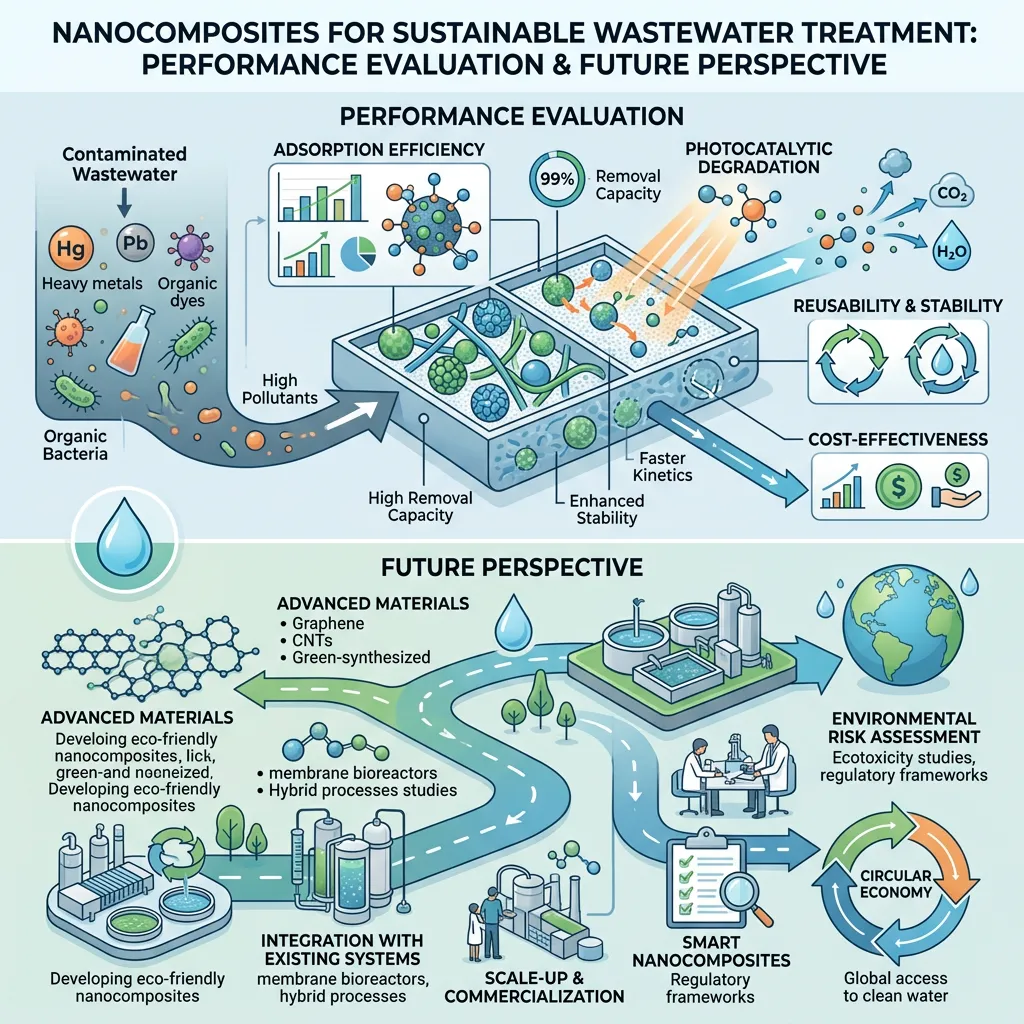
“Nanocomposites for Sustainable Wastewater Treatment: Performance Evaluation and Future Perspective“, published by Springer Nature in 2025 and edited by Swapnila Roy, Shivani Garg and Chin Wei Lai:
My suspicions were right, with the very first chapter revealing AI-slop of astonishing quality (I consider myself somewhat of a slop connoisseur at this point).
Swapnila Roy Introduction to Nanocomposites in Wastewater Treatment Composites Science and Technology (2025) doi: 10.1007/978-981-95-1369-7_1
Simply stunning. The colours, the forms. Nothing unusual to find some slop published here and there, with some malformed pseudotext. A common thing nowadays. But this one is quite special. Eye-poppingly obvious. Switching from offset print to a digital and print-on-demand model allows this kind of monstrosity to get published, as evidently no one bothers to skim through pages anymore.
What a joy. The chapter was authored by the Editor, Swapnila Roy, who is an associate professor at New Delhi Institute of Management, and “a distinguished figure in academia, research, and industry, with 20 years of experience” who “empowers and enriches professionals in her specialized fields“. We can expect the absolute paragon of excellence in editorial oversight and quality.
And now, take my hand, don’t be afraid, and enter the abyss of part two:
Borrowing figures from other publications is not uncommon, and arguably the easiest thing to spot automatically. Of course, figures can be adapted or reproduced with permission, but these frames of academic conduct are not known to everyone with a strong drive to author a book.
Shyam Lal Sharma, Harish Kumar, Namrata Gangil Emerging Trends in Nanocomposite Synthesis and Contaminants Removal Technology Composites Science and Technology (2025) doi: 10.1007/978-981-95-1369-7_10
Great figure. Aesthetically, perhaps leaves something to be desired, but at least it is not AI-slop.
Unfortunately, it is not an original creation of the authors, as it appears in many other publications (the earliest one I could find was published in 2024)
Some other figures are credited but mis-cited, like this one in Chapter 5:
Pappu Kumar Nanocomposites-Enabled Membrane Technologies for Water Purification Composites Science and Technology (2025) doi: 10.1007/978-981-95-1369-7_5
It is credited to “Ng et al. 2020”. But the figure is a graphical abstract from the work of someone else, published by Taylor & Francis in 2024:
Ayesha Kausar Nanoclay Reinforced Thermoplastic Polymeric Nanocomposite Membranes—State-of-the-Art and Progresses Polymer-Plastics Technology and Materials (2024) doi: 10.1080/25740881.2024.2360169
Not a trace of such a figure in Ng et al. 2020. In both of them, actually, because the article is cited twice with different authors:
Dipti Grover , Shakuntla Duman , Neha Kalonia , Sandeep Kumar , Harpreet Singh Mechanism of Pollutant Removal by Nanocomposites Composites Science and Technology (2025) doi: 10.1007/978-981-95-1369-7_3
It has already appeared numerous times throughout the literature, but this is not acknowledged:
Figure 29 from the aforementioned Chapter 10 by Sharma et al, “Emerging Trends in Nanocomposite Synthesis and Contaminants“:
Can be found in a 2022 article and in a 2020 article, both published by MDPI:
And, funnily enough, a few pages back in the very same chapter (attributed to Choi 2022, an article which I was unfortunately not able to find):
Doubt arises whether Alberto Figoli, director of the Institute on Membrane Technology of the National Research Council of Italy, really is the original creator of that figure. He has a PubPeer record of papermill fraud with the disastrous Yong-Sik Ok and with papermillers at Gdansk Polytechnic in Poland (Roberto Castro-Muñoz and Grzegorz Boczkaj). Attentive readers might have recognised, among other previous users of that figure, the Romanian papermiller Simona Cavalu, an associate of the papermill tycoon Abhijit Dey, they both featured here:
“WE DONT PAY FOR PAPERS. YOU MUST KNOW THAT THESE BEST IN THE PLANET JOURNALS GO THROUGH RIGOROUS PEER REVIEW” – Abhijit Dey, papermiller
正文由 探How 从来源站点 RSS 同步,内容未经改写;遇到排版缺失或需要图片、视频时请以原文为准。