Shopify debuts Canvas, a way to build online stores by chatting with AI
Shopify’s new Canvas site builder lets merchants create and customize their online stores by chatting with its AI agent Sidekick, while watching the changes happen in real time.
以下正文同步自 TechCrunch,版权归原站所有,已转换为易读排版。
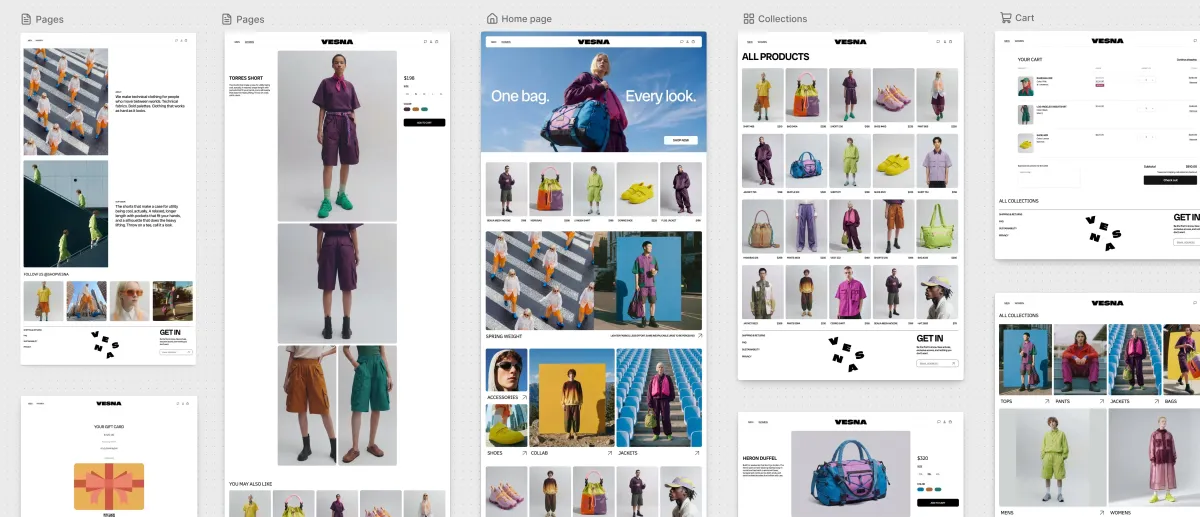
Shopify introduced a new site-building tool Thursday called Canvas that lets merchants set up their Shopify store by chatting with AI. While Shopify already offered a fairly capable no-code builder before Canvas, it involved editing a selected theme by rearranging modular sections and blocks. Deeper customizations, however, would require editing code or bringing in a developer.
Now, with Canvas, merchants simply chat with Shopify’s AI agent, Sidekick, to create their site. As the AI makes changes, Canvas displays the results in real time, allowing merchants to see how the store looks overall as it comes together or zoom in to focus on certain details.
Notably, this isn’t a static preview, but the real code behind their store being rendered, according to Shopify. That means merchants can test the page’s full interactivity and animation, and view pages as they’d appear across different screen sizes. Sidekick also takes screenshots of the work so it can see the same thing the merchant sees as the site updates.
Canvas’s launch is part of a broader shift toward a future where building a website no longer requires coding it directly. It joins numerous other AI-powered site-building tools from companies like Wix, Squarespace, Webflow, and Framer, alongside vibe-coding platforms like Lovable and Replit.
Merchants can still click on individual elements to make changes directly, if they choose. But more likely, they’ll just tell Sidekick in a chat what they want to do.
Sidekick itself is not new, as it’s already been used to write code, build apps, customize themes, and make other edits. But it had yet to be pulled together into a full site-building product like Canvas, where users can see the entire store at once and zoom and pan around while making updates to the site’s actual files.
To make this work, Shopify gave Sidekick the ability to work directly with the theme’s files and simplified the theme architecture so the store’s structure, logic, and design would be easier for Sidekick to understand and change.
The product is still in its early days, so there are areas where it will need to expand and improve. However, Canvas could make becoming an online seller more accessible to those who don’t have the budget for developers and designers, or the time to learn to code.
When you purchase through links in our articles, we may earn a small commission. This doesn’t affect our editorial independence.
Sarah Perez
Consumer News Editor
October 13 – 15
San Francisco
Get 50% off a second pass
The Disrupt experience is meant to be shared. Get your pass and bring a colleague, partner, or peer at 50% off. Cover more ground by making connections, building momentum, and discovering what’s next in the startup ecosystem.
The Pentagon taps Elon Musk and Palmer Luckey to help decide what the military should do next
Dominic-Madori Davis
OpenAI launches Dots, its bubbly agentic avatar
Lucas Ropek
AMD will acquire Fei-Fei Li’s World Labs for $8.2B
Tim Fernholz
Viral AI agent Instinct raises $1B Series C at a $10B valuation
Sarah Perez
Crusoe abandons $1.25B plan to use Boom turbines at AI data centers
Kirsten Korosec
Unsecured OpenAI agents posted 53 user images on the internet without the lab’s knowledge
Tim Fernholz
Astra and Opus just passed Turing’s other test
Tim Fernholz
正文由 探How 从来源站点 RSS 同步,内容未经改写;遇到排版缺失或需要图片、视频时请以原文为准。