What is a light-day? The milestone Voyager 1 is closing in on
The milestone Voyager 1 is closing in on is about distance, not time.
以下正文同步自 Hacker News 最新,版权归原站所有,已转换为易读排版。
Voyager Home
NewsMission Updates
Voyager Stories
News Media Contacts
MissionOverview
Status
Science
Timeline
Spacecraft
-Voyager 1
-Voyager 2
The Golden RecordOverview
The Cover
The Contents
The Making of
GalleriesVideos
Posters
Making of the Golden Record
Images on the Golden Record
Images Voyager Took
Images of Voyager
Illustrations
What is the Pale Blue Dot?
Where Are They Now?
FAQFrequently Asked Questions
Fact Sheet
Fast Facts
Q&A with Ed Stone
What Is a Light-Day?
The milestone Voyager 1 is closing in on is about distance, not time. And it's very, very far.
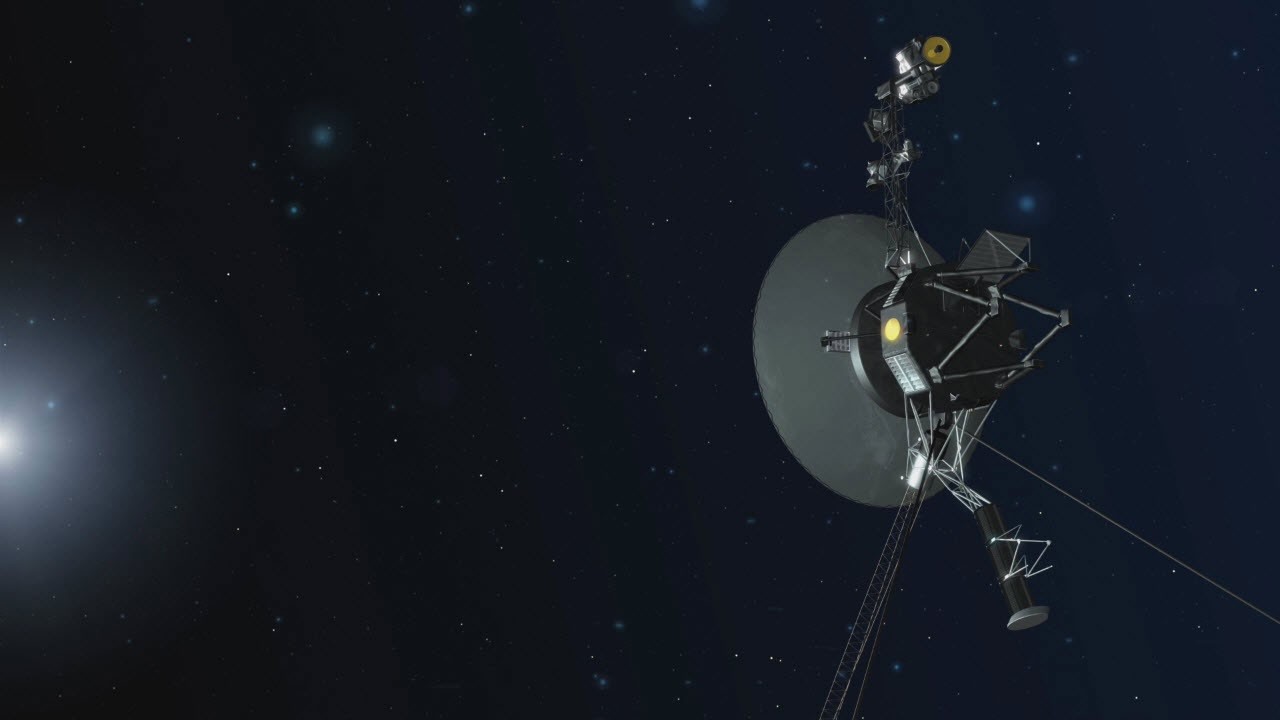
The Voyager 1 spacecraft, traveling for nearly 50 years, will soon cross a mile marker reached by no other human-made object — one light-day away from Earth. That’s the distance a particle of light can travel in 24 hours, equaling about 16 billion miles (about 26 billion kilometers), a point that Voyager 1 will reach on Wednesday, Nov. 18, 2026, at 5:16:07 a.m. EST.
Its twin spacecraft, Voyager 2, took a different path through the solar system after they launched in 1977, in order to visit Uranus and Neptune. Voyager 2 is on pace to be one light-day away from Earth in nine more years, in November 2035.
Nothing in the universe travels faster than light. Moving through space about 186,000 miles every second, it crosses enormous distances in a given time period, whether it’s a second, a day, or a year. This is true for any type of electromagnetic radiation, including visible light, microwaves, radio waves, gamma rays, X-rays, or infrared. A light-day is the distance that light will travel in 24 hours, or 16,094,799,096 miles (25,902,068,356 kilometers).
To put this mileage into perspective, consider some other light-distances:
That’s why light-year — how far light can travel in a year — is used to measure and convey the vastness of space. It’s about 5.88 trillion miles (9.46 trillion kilometers). The closest neighboring solar system to our own, the star Proxima Centauri and its one or more planets, is about 4.24 light-years away (or, about 24.95 trillion miles, or 40.15 trillion kilometers). And the next-closest galaxy to our own Milky Way, the Andromeda galaxy, is about 2.5 million light-years away.
Voyager 1 is headed in the direction of a star more than 17 light-years away from Earth called AC +79 3888, also known as Gliese 445. It’s an obscure star now in the constellation Ursa Minor (the Little Bear or Little Dipper), and Voyager 1 is expected to pass within about 1.7 light-years of it — in 40,000 years. Even though the spacecraft, in flight since 1977, is cruising at nearly 38,000 mph (61,000 kph) through the vacuum of space, that’s a relative crawl compared to the speed of light.
When Voyager 1 makes its mark Nov. 18, the spacecraft will have taken 49 years, two months, and 11 days to have traveled one light-day beyond Earth — a huge milestone by any measure, and a day worth celebrating.
Check the cosmic odometer for each spacecraft, and watch the miles roll over by the second — in real time.
More About Voyager 1
What has it discovered in its nearly 50-year journey? Which of its instruments are still operating? Learn more about the Pale Blue Dot and the Golden Record.
How Big Is Space?
Listen to Episode 61 of "We Asked a NASA Expert." (Spoiler: in getting to an answer, "things get really weird.")
Cosmic Distances
The space beyond Earth is so incredibly vast that, when expressed in miles and kilometers — the units of measure from our everyday lives — the numbers grow impossibly big.
Beyond Earth: A Chronicle of Deep Space Exploration
A comprehensive history of missions sent to explore beyond Earth.
See where Voyager 1 is now
Use NASA’s “Eyes on the Solar System” interactive visualization tool
Unable to render the provided source
Use NASA’s interactive tool “Eyes on the Solar System” to see where Voyager 1 is right now. Or, travel back in time and ride along when Voyager 1 visited Jupiter and Saturn, or when it turned homeward to capture the iconic “Pale Blue Dot” photo of Earth, or anytime since then, when it left the solar systema and became the first spacecraft to enter interstellar space.
NASA/JPL-Caltech
Keep Exploring
Discover More Topics From NASA
What is a light-year?
正文由 探How 从来源站点 RSS 同步,内容未经改写;遇到排版缺失或需要图片、视频时请以原文为准。