Awesome HN: The sites that mine its comments for picks
HackerTube set off a dozen spin-offs mining Hacker News comments for books, papers and more. The idea dates to 2011; its flaws were spotted by 2013.
以下正文同步自 Hacker News 最新,版权归原站所有,已转换为易读排版。
HackerTube set off a dozen spin-offs mining Hacker News comments for books, papers and more. The idea dates to 2011; its flaws were spotted by 2013.
Contents
1Every site runs the same funnel, from public archive to static page
2HackerTube, HackerBooks and WikiHack set the template
3The spin-offs cover products, papers, blogs and podcasts
4The idea dates to 2011, and two directories now track it
5Most of the old problems came along
6What the community thinks: warm at launch, cooler in later threads
7What’s still unbuilt, and what to watch
·Notes
Share
Copy link Bluesky LinkedIn Hacker News
Contents 1Every site runs the same funnel, from public archive to static page
2HackerTube, HackerBooks and WikiHack set the template
3The spin-offs cover products, papers, blogs and podcasts
4The idea dates to 2011, and two directories now track it
5Most of the old problems came along
6What the community thinks: warm at launch, cooler in later threads
7What’s still unbuilt, and what to watch
In short
Between 31 October and 2 November 2026, Andrej Karpathy’s HackerTube set off at least a dozen “HackerTube, but for X” sites that mine Hacker News comments for books, Wikipedia articles, products, papers, blogs and podcasts1,2,3.
The idea dates to 2011. What changed is free public copies of the whole Hacker News archive (the Parquet copy most sites use stopped updating in August 2026), large language model (LLM) labels that separate recommendations from mere mentions, and builds that take hours with a coding agent, by their builders’ account4,5,6,7,8.
Most old complaints came along: Hacker News taste, stale picks, matching errors and dead links. Of 281 comments we coded, 40.6% were positive overall, but in four later threads (58 comments, 44 of them from WikiHack’s) negative (34.5%) outweighed positive (27.6%)9.
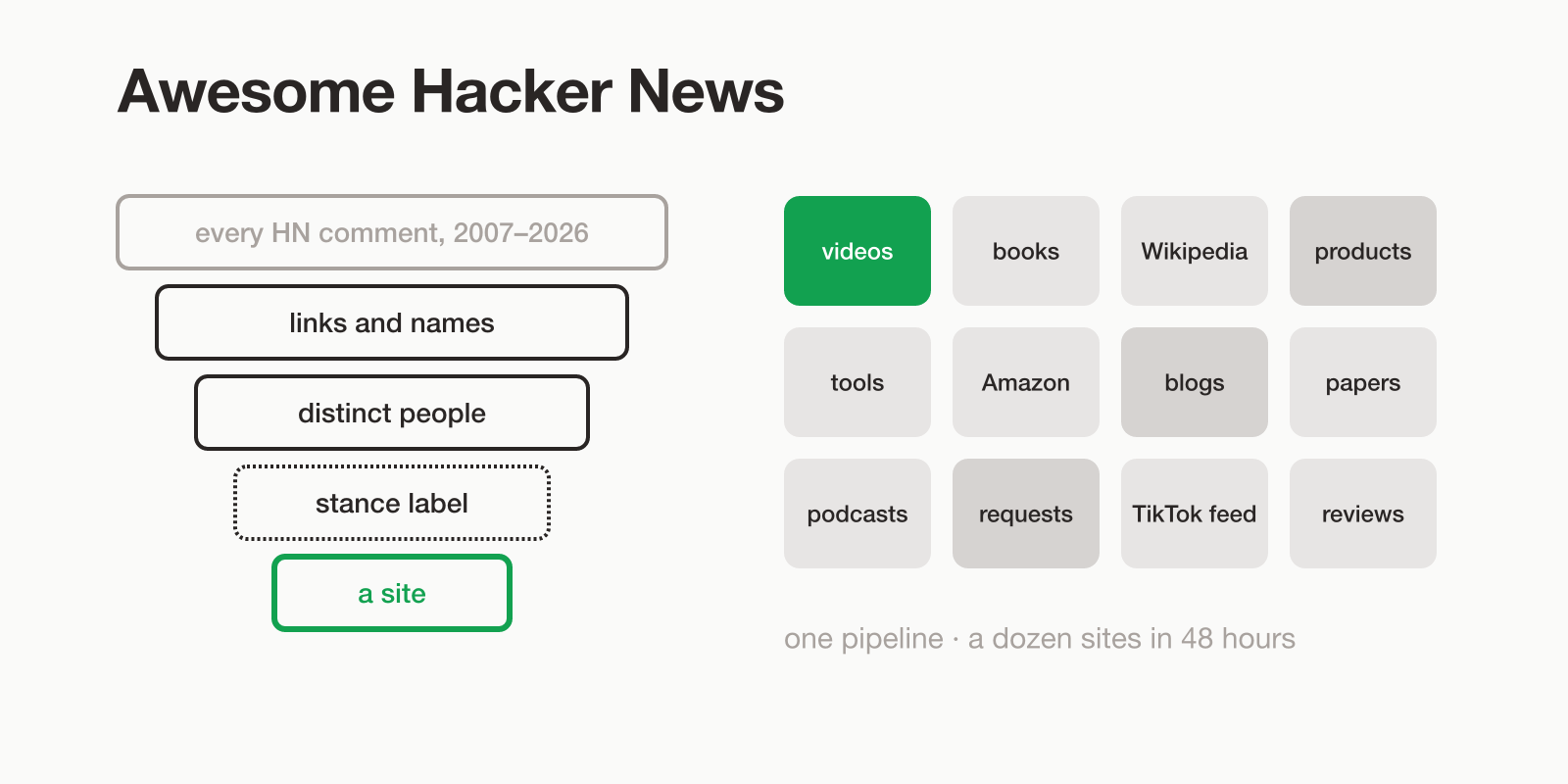
On 31 October 2026, Andrej Karpathy put up HackerTube, a YouTube-style site that shows only videos Hacker News (HN) commenters keep recommending, and its HN thread reached 2,770 points and 613 comments1. Within 48 hours, copies covered books, Wikipedia, products, papers, blogs and podcasts, and two directories tracked them10,11,2,3. Below is every site as of 2 November, plus six posted on 3 and 4 November, with link, thread, method and size. The idea is 15 years old, and its problems nearly as old.
HackerTube, HackerBooks, HackerZon and HackerBlogs start from open-index/hacker-news, a Parquet copy of the HN archive on Hugging Face whose card describes five-minute live updates7,12,5,13,14. It stopped updating on 23 August 20266. The live public copy is the ClickHouse Playground, a public SQL (structured query language) endpoint, which WikiHack queries15,16. HackerProducts adds the Algolia HN application programming interface (API), and HackerPapers uses Algolia alone17,18.
The steps vary in detail but not in order:
The last step closes a loop. HackerTube’s about page tells readers to “give the zip to your AI agent” and ask for a variant7. One video creator says he did so in “1 minute 55 seconds … about 60 cents” (a single source that runs a lead magnet)19. Data engineer Simon Späti reproduced the link-counting core of HackerTube, HackerBooks and WikiHack in DuckDB20.
Source: The sites’ about pages and Show HN posts7,10,12,16,13,14,17,18, the open-index dataset card and file tree5,6, a ClickHouse Playground query15 and the HackerTube about page’s invitation to fork the data7. Source states as of 2 November 2026; thresholds are each site’s own.
HackerTube, HackerBooks and WikiHack set the template
HackerTube: 6,454 videos HN keeps coming back to
hackertube.org · HN thread: 2,770 points, 613 comments, 31 October1.
Karpathy’s trigger was YouTube’s “enshittified wall of slop”8. The site scanned every HN comment from 2007 to 2026 for YouTube links, which “turns up well over a hundred thousand different videos”7. A video stays if “at least three different people linked it with some real commentary, in at least three different months”, leaving roughly 7,0007. Claude judged each comment’s stance, and videos rank by “how many separate months people recommended it in”7. The result: 6,454 videos from 39,834 labelled comments in 150 topics7.
A 17.8 MB data zip ships under the Open Data Commons Attribution licence (ODC-By 1.0)7. The credits name Claude Opus 5.5 in Claude Code, with cards “written by teams of Claude Sonnet 5.5 agents that Claude Opus coordinated”7. Karpathy says the build took about two hours; his only manual steps were a YouTube API key, a virtual private server (VPS) and a domain8,21. The data stops where open-index does: the newest mention was posted on 21 August 202622.
hackerbooks.org · Show HN: 1,760 points, 286 comments, 1 November10.
Rohit Shinde “had Claude build one (Opus 5.5)” the day after HackerTube10,12. Books are rarely linked, so the pipeline works on names: regexes and light natural language processing find candidate titles, Open Library resolves them, and every title is then searched across the corpus “so books are counted even when nobody linked them”12. Claude Sonnet 5.5 then labels each mention recommend, neutral, critical or not about the book12.
The about page lists 15,766 books, 281,363 mentions and 57,773 commenters; the Show HN had said “~16.5k books”10,12. Bookshop.org and Amazon buy links are disclosed affiliate links12. HackerBooks credits only open-index, yet its mentions run to 1 November 2026, from an unstated source12,23.
wikihack.netlify.app (now also wikihack.org) · Show HN: 324 points, 97 comments, 2 November11.
Isaac Gemal, who made WikiTok, a feed of random Wikipedia articles, built a TikTok-style scroll through the articles HN commenters link16,24. An article is listed when at least two different commenters linked it, or when it was itself submitted and scored 50 or more points16. Mentions inside a thread about that article don’t count16. Its about page describes no LLM step; topics come from Wikipedia’s own article-topic predictions16. It covers 76,074 articles, 540,037 links and 67,628 commenters, updated 1 November16.
All counts are self-reported, as of 2 November 2026 unless a section says otherwise.
hackerproducts.pages.dev · posted as a comment in the HackerTube thread1.
HackerProducts is a prototype built from 3,768,623 comments (November 2025 to October 2026), pre-filtered by phrasing such as “I use” and “switched to” to 347,262 candidates18. Claude Sonnet has labelled 75,185, of which 34,513 name a product18. Against Claude Opus on 500 comments, Sonnet scored 87.8% F1 (a score combining precision and recall) and Haiku 78.9%18. The Opus-written verdicts reject “any clause without a citation to a real comment”18.
shouvik12.github.io/hackertools · posted as a comment in the HackerBooks thread10.
HackerTools lists developer tools “that Hacker News commenters actually recommend”, ranked by distinct recommenders: 116 tools and 18,114 recommendations in ten categories25.
hackerzon.pages.dev · Show HN: 2 points, 2 November13.
HackerZon keeps every comment that links an Amazon product page (books excluded) and counts each HN account once; links carry no affiliate tag13. Of 9,532 products, 8,482 were still in Amazon’s catalogue on 2 November and 1,050 were gone13. Its own filter shows how long the tail is: of the 8,482 products found, 7,807 were linked by a single HN user13.
hackerblogs.app · Show HN: 4 points, 2 November14.
Ian Hsiao pulled 10.7M links from 518K people out of the 49.3M-item archive, and kept 35K sites that at least 15 people shared14. Claude Sonnet then sorted out the personal, company and group blogs: 9.4K, with data to 21 August 202614. The about page is frank that “it counts links, not praise”14. It was built with “Orbs with AmpCode” and exports follows as OPML (Outline Processor Markup Language)14.
hackerpaper.kaipfister.de · Show HN: 2 points, 2 November17.
Kai Pfister’s HackerPapers pulls HN data from the Algolia HN API and ranks arXiv papers by distinct commenters: 28,636 papers, 3,323 of them linked by at least two people (the Show HN title says 3,314)17.
sunmer.github.io/podcast-radio · Show HN: 2 points, 2 November26.
Hacker Radio tunes between HN-recommended podcast episodes like a radio26. It is a proof of concept: 104 episodes from 112 HN recommendations26.
stillunbuilt.shiptiffin.app · posted as a comment in the HackerTube thread1.
Still Unbuilt inverts the idea: it finds what HN wishes for. It collected 63,300 comments and posts with phrases like “I wish there was” or “I’d pay for”, kept the 12,441 that ask for software with an AI classifier, and ranked the top 100, for $6.00 of AI labelling27. Its sharpest finding: something matching 81 of the 100 has already launched on Show HN, “1,423 times between them, and people still ask”. Its verdict: “Building isn’t the gap. Finishing is.”27.
hissingkitty.com/hacker-churn · Show HN: 70 points, 24 comments, 3 November28.
HackerChurn flips the stance label from praise to complaint. It reads a sample of HN comments from the last three years that name software tracked by HissingKitty, a software review site, has an AI label them, and lists a tool once it has three complaints from two threads29. On 4 November it listed 101 tools from 1,551 negative comments, led by LastPass (49 complaints), CrowdStrike (47) and Evernote (44); Jira was 27th with 2229. A separate tally reads “139 built their own replacement”29. Data comes from the HN search API, counts update nightly, and every row now links to the comments it counted, added after a commenter asked for sources29,28.
It was the best received of the six sites added in this update, and its thread repeated the oldest objection in this post: “Popular services get more complaints”28. Another commenter checked the first CrowdStrike complaint and found the app “confuses a negative connotation of a post, with a mention of a product inside that post”28. The builder answered that the ranking is “based on % of negative vs. positive sentiment”28. HissingKitty’s site blocks headless browsers, so the thread stands in for a screenshot.
flaviaouyang.github.io/hackerjobs · Show HN: 6 points, 3 November30.
Flavia Ouyang turned HN’s monthly “Who is hiring?” and “Who wants to be hired?” threads into a filterable job board: role, pay, location, remote or not, technologies and industry, with a link to the original post on every card31. HackerTube and HackerBooks prompted her to give an old personal parser a front end; it is a static Astro site under the MIT licence30. Heuristics weren’t good enough, so Claude Haiku 5.5 parsed all 8,231 posts since January 2026 for about $1231.
Her write-up gives the rare full bill for one of these builds: $86.53 of Claude Code (Opus 5.5) over 2 hours 6 minutes of API time and almost 9 hours on the clock, for 7,486 lines added31. She “felt like a babysitter”, stopping Claude when it started coding, designing or parsing before she had approved the plan31. She also points to prior art: Jordi Noguera’s HNHIRING30,31.
HackTok scrolls through HackerTube’s 6,454 videos one at a time32. Two TV clients reuse the same picks: an open-source Apple TV app with a backend that refreshes the data, sideloaded via Xcode (Show HN, 5 points)33, and a SmartTube fork for Android and Fire TV (comment)1.
trustmebro.reviews/r/hackernews · Show HN: 9 points, 2 November34.
davidzweig made it “a couple of months ago” and re-posted it into the wave34. Gemma 4 26B, a mixture-of-experts model, did the extraction “running on pairs of NVLinked 3090 cards with vLLM, in my basement”34. It holds 13M opinions on 48k products from Reddit and HN; the HN page ranks 3,223 entries from 68,607 mentions in the last 12 months34.
HakTok (HN, 2 points) is a TikTok-style feed of HN stories, not mined from comments35. Hacker GitHub (HN, 1 point) counts 384,444 links to 44,192 repositories linked at least three times36. HackerNewsTV (HN, 3 points) is a d
正文由 探How 从来源站点 RSS 同步,内容未经改写;遇到排版缺失或需要图片、视频时请以原文为准。