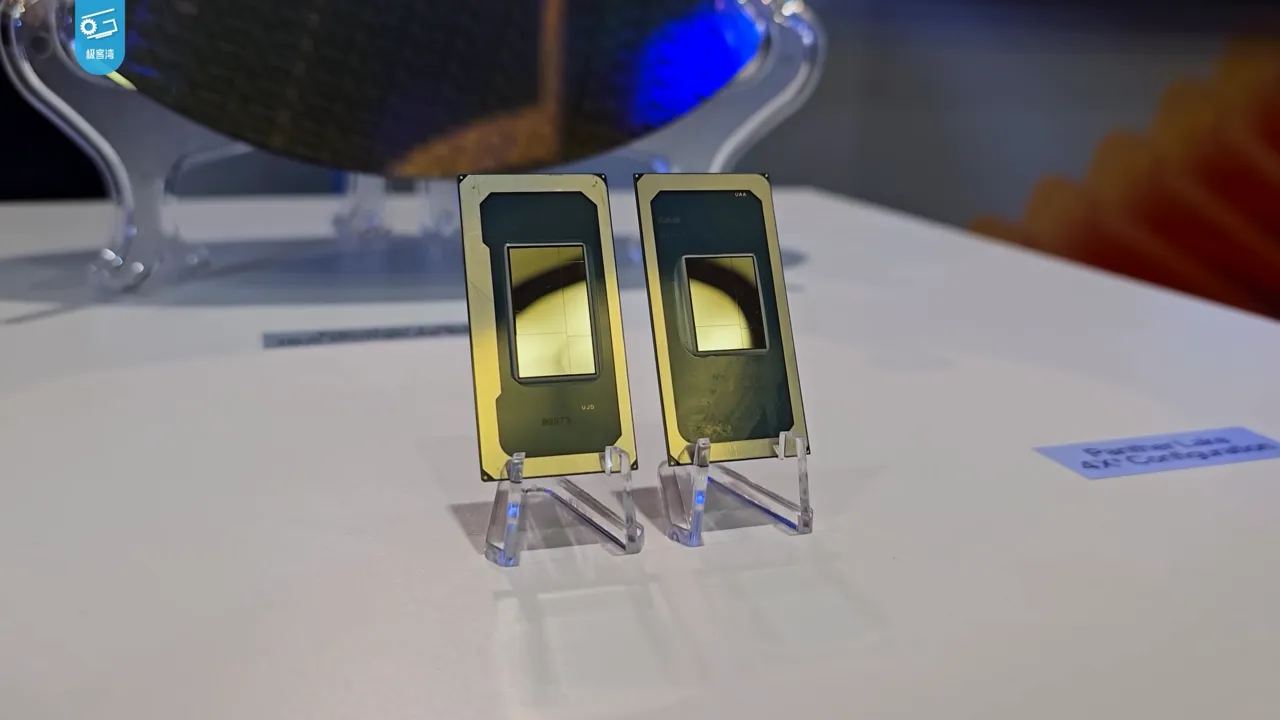
Intel: Panther Lake
Panther Lake or PTL is the Core Ultra Series 3 mobile processor line developed by Intel.[1] The architecture was launched in January 2026 at CES 2026.[2][3] It succeeds and extends Lunar Lake and is designed as a scalab…
以下正文同步自 Hacker News 最新,版权归原站所有,已转换为易读排版。
Panther Lake or PTL is the Core Ultra Series 3 mobile processor line developed by Intel.[1] The architecture was launched in January 2026 at CES 2026.[2][3] It succeeds and extends Lunar Lake and is designed as a scalable mobile platform spanning a wider range of power and performance targets, from thin-and-light laptops to higher-performance mobile systems. The Core Ultra X9 378H CPU was launched separately, without a formal announcement, in April 2026.[4][5]
Panther Lake combines a heterogeneous CPU core tile manufactured on Intel's in-house 18A process with an integrated graphics tile based on the Arc Xe3 architecture,[6] which is derived from the earlier Xe2 (Battlemage) design, and an I/O tile manufactured on TSMC's N6 process.
The clusters vary in size: The big 4+8+4 core tile is used in the H series, and the small 4+4 core tile is used in the low-power processors. Non-Arc H series CPUs also are the only processors in this lineup to utilize the larger I/O tile, while Arc H series and low-power CPUs use the smaller core tile. Said tiles both support DDR5 and LPDDR5X memory, however, the larger tile has more PCIe lanes. Arc H series CPUs use a binned variant of the smaller I/O tile that doesn't support DDR5. There are also smaller GPU tiles which have up to 4 Xe cores, and larger GPU tiles which have up to 12 Xe tiles. The latter being branded and labeled as Arc B390/B370 if the machine using it reaches memory speeds of at least LPDDR5X-7467, otherwise they will be labeled as just Intel Graphics.[7] Some models with the larger GPU tile continue to rely on TSMC manufacturing for the GPU on its N3E process, possibly due to budget concerns.[8]
Rather than introducing a fundamentally new CPU or GPU architecture, Panther Lake focuses on higher core counts, better graphics configurations, and increased power budgets enabled by a newer manufacturing node and modular tile-based design.
Furthermore, instead of developing a more capable NPU, Intel has opted for an optimized, smaller and more efficient NPU that delivers about the same performance as the previous generation's NPU.
Panther Lake CPUs omit hyper-threading support.
In April 2026, Intel launched Wildcat Lake, a variant of Panther Lake intended for value laptops, commercial systems and edge devices.[9] This series features a simpler design, lower performance, and lower power consumption. The Ultra moniker has been dropped and they are simply called the "Intel Core Series 3".
The Arc G3 series, released May 28, 2026, is a scaled-down variant of the Core Ultra 3 series, designed for handhelds and other portable gaming devices with lower power consumption.[10]
Intel Starfire, announced in July 2026, is a variant of Panther Lake designed for use in spacecraft and orbital systems, supporting operational temperatures from -55°C to 125°C and offering a guaranteed 10-year lifetime.[11] There are two SKUs with TDP of 10 and 35W.
Panther Lake has been widely praised for its power-efficiency and integrated graphics performance, having been noted as a "return to form" for Intel.[12][13][14]
Reviews for the Intel Arc G3 and G3 Extreme processors have been extremely positive regarding graphics performance, with reviewers calling it the fastest and a highly capable silicon for gaming handhelds to date. However, the initial devices were heavily criticized for their high price point.[15][16]
正文由 探How 从来源站点 RSS 同步,内容未经改写;遇到排版缺失或需要图片、视频时请以原文为准。