Why Isn't Retatrutide Approved Yet?
Eli Lilly’s hot new experimental weight loss drug retatrutide is still not FDA approved. They haven’t even filed an application. What gives?
以下正文同步自 Hacker News 最新,版权归原站所有,已转换为易读排版。
Amanda Luce
Oct 30, 2026
4
1
Share
Eli Lilly’s hot new experimental weight loss drug retatrutide is still not FDA approved. They haven’t even filed an application. What gives?
This time last year, the first wave of Phase 3 trial results came out about how amazing retatrutide is for weight loss and Type 2 diabetes. At the time, people were expecting Lilly to immediately file for FDA approval and have the drug ready for sale by now.
Since then, trial results for other indications keep pouring in, to much fanfare. It’s shaping up to be a wonder drug.
Lilly is delaying because they want retatrutide to be approved as a biologic drug instead of a regular drug. Drug makers can only file for FDA approval as one or the other, and drugs can’t be reclassified after they’ve already been approved. So Lilly doesn’t want to file for any approval at all until they’re sure that their biologic application will go through.
The molecule is borderline. It kiiiind of fits the definition, and kind of doesn’t. So far, the FDA has been adamant that it doesn’t meet the criteria.
There’s an ongoing lawsuit about it, and Lilly keeps losing and appealing. Will they succeed eventually?
A biologic drug is a license to print money, on top of the fact that retatrutide is already going to be a license to print money.
The FDA grants biologic drugs a lot of special protections that go above and beyond those for regular drugs. They’re typically extremely long molecules (e.g. monoclonal antibodies) that mimic an existing protein in the human body. Being exceptionally difficult to design and produce, the FDA decided that these drugs should get a longer exclusivity window and harder restrictions on generic forms (here called biosimilars instead of generics).
If Lilly succeeds, they would have FDA exclusivity on retatrutide for 12 years, versus 5 for a regular drug. The exclusivity window is separate from patent protection, and is basically a blanket restriction on the FDA evaluating any competitor’s application for a generic/biosimilar version. (You usually never hear about the 5-year window for regular drugs because the patent extends past it anyway.) But, even if a drug goes off patent before the exclusivity window is up, competitors are still prevented from getting their version FDA approved for a certain number of years.
Separately, even if someone develops a biosimilar years later, compounding pharmacies aren’t allowed to compound biologics at all, ever.
Retatrutide being a biologic would give Lilly a lot more power to clamp down on grey market peptides and compounding pharmacies (compared to what they can exert for tirzepatide). Despite the tirzepatide shortage officially being over for years, compounding pharmacies are still selling it like candy. The situation should be an easy slam-dunk lawsuit for Lilly to get them shut down, and yet... nothing is really happening. (For reasons that nobody can really tell???)
Lilly definitely doesn’t want this to happen with retatrutide. They’re very annoyed by grey market peptides, to the point of calling this situation “the illegal retatrutide black market” in their press releases.
So you might be thinking, ok, but why do they keep losing in court? And why does Lilly keep appealing, despite losing so much? Shouldn’t this be a cut-and-dry, yes or no question? If this were a definite no, they’d just give up and file as a regular drug. Why haven’t they?
It all hinges on the exact legal definition of “protein.”
Biologic drugs are supposed to mimic some biological process in humans. The exact wording is that biologics must be “analogous to,” or fulfil the same role as, proteins.
The FDA’s current position says that a) retatrutide does not meet the definition of a protein, and that b) it is also not even “analogous” to a protein, because they as an agency don’t have to evaluate a drug’s mechanism at all. The definition of “protein” is already doing the work.
As to the definition of “protein,” remember when I said that biologics are typically very large protein molecules? The polypeptide chains can be as long as thousands of individual amino acid links. However, there has to be a lower bound for that range somewhere, right?
The FDA has decided that this lower bound is about 40 amino acids. In a 2018 proposal, the FDA lays out its reasoning:
Proteins are molecules that consist of one or more polypeptide chains. These polypeptides range in length from ~40 to ~33,000 amino acid residues.’‘ (Ref. 8)
Proteins consist of one or more linear polymers called polypeptides . . . a minimum of 40 residues seems to be required for a polypeptide to adopt a stable three-dimensional structure in water.’‘ (Ref. 9)
The references cited are biochemistry textbooks.
The final version of the regulation, adopted in 2020, defines a “protein” in §600.3(h)(6) as “any alpha amino acid polymer with a specific, defined sequence that is greater than 40 amino acids in size.”
The polypeptide chain has to specifically be made of alpha amino acids; they can’t just be any amino acid.
This has never been a problem before because basically every other biologic drug on the market is way larger than 40 alpha amino acids. Monoclonal antibodies like Keytruda and Humira have about 1300. Growth hormones are in the 160-190 range. Insulin, in the low 50s, is the smallest class of biologic drugs, but is still comfortably above the cutoff.
How many alpha amino acids does retatrutide have?
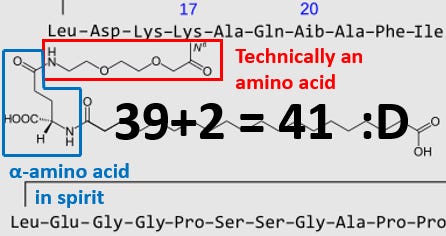
The main backbone of retatrutide is 39 alpha amino acids:
(From Wikipedia)
That branch coming off Lysine #17 is the focus of all the lawsuits. It consists of ADO, γ-Glu, and a C20 diacid.1
ADO, although it’s an amino acid, it’s definitely not an alpha amino acid in any way whatsoever.
Glutamate/glutamic acid is indeed one of the 20 alpha amino acids, but here it’s in its gamma form, not alpha.
Remember, the regulation defines a “protein” as “any alpha amino acid polymer with a specific, defined sequence that is greater than 40 amino acids in size.”
As summarized in the district court ruling, Lilly argues that retatrutide applies because the phrase “alpha amino acid” is used only one time, and that every other reference to “amino acid” in the regulation has no “alpha” qualifier. Therefore, “alpha amino acid polymer” is a categorical status conferred on any molecule with an alpha amino acid backbone, but then the final length count should include all amino acids present, alpha or not.
39+2=41 guys, I swear. Trust me bro.
The FDA argues that no, one can infer that “amino acid” refers to “alpha amino acid” by English grammar,2 and the final count has to be greater than 40 alpha amino acids. Even if we count γ-Glu as an alpha amino acid in spirit, the final count is still only 40, not greater than 40.
Lilly countered by arguing that retatrutide was “analogous to a protein” even if it doesn’t fit the exact definition of a protein.
The FDA argues that the purpose of a biologic is for the drug’s properties to be “analogous to a protein” found in the human body, and that having at least 41 alpha amino acids in a chain is “a fundamental, defining property of a protein, which retatrutide does not have.” The purpose of the bright line is so that the FDA does not have to evaluate every drug on a case-by-case basis for whether its mechanism of action is “analogous to a protein,” because, according to their scientific reasoning, polypeptides which are too short cannot have said mechanism. The criteria for “protein” already does all the work of telling the FDA whether a drug is analogous to a protein.
The district court partially ruled for both sides. They upheld the FDA’s decision not to designate retatrutide as a protein. However, they agreed with Lilly that the FDA was being unreasonable by refusing to consider that retatrutide might be “analogous to a protein” even if it didn’t meet the definition of protein.
Lilly wasn’t satisfied with this, so they appealed to the Seventh Circuit. They’ve already heard arguments, and a ruling is expected soon.
I have no idea if Lilly’s appeal will succeed, so I made a prediction market about it.
If the Seventh Circuit says it does count as a biologic, then Lilly plans to file a biologics application in Q1 2027.
However, a biologics application is a ton more paperwork than a regular drug application. The team that prepares drug applications basically had to redo everything from scratch as fast as possible. If they made a mistake somewhere, the FDA might give them grief and drag out the approval process. The license to print money is not easy to obtain.
If the Seventh Circuit says that the district court ruling stands, i.e. retatrutide is not a protein, but Lilly is welcome to argue with the FDA over whether the mechanism of action works like a protein, then, well… Lilly would have to argue with the FDA that retatrutide’s mechanism works like a protein.
Um… good luck with that. Pharma companies usually don’t have to prove that a certain mechanism is definitely happening; they just need to show that a drug is safe and effective as a treatment. E.g. we still, famously, don’t know how Tylenol works after all these years.
There’s a chance that a biologic application might end up in FDA limbo for a while. Potentially several years.
Alternatively, Lilly could appeal up to the Supreme Court. If SCOTUS agrees to hear the case (that’s a big if), then it would be heard next year in the 2027-28 session, with a ruling in late June/early July 2028 at the latest. If SCOTUS says it doesn’t count, then Lilly would apply for FDA approval as a regular drug, and then, after all that, retatrutide will be officially FDA approved and available to patients in... 2029.
(Thank god for grey market peptides, lol.)
I’m sure Lilly understands the opportunity cost here. They could give up at any time and apply as a regular drug. Every day they delay filing the application is another day that their star drug isn’t making any money at all. Spending all this time in court was fine while retatrutide was still in development (the time would pass anyway), but now all the trials are complete and they’re delaying their FDA approval.
They’ve already sacrificed a year of sales on the chance that a biologics monopoly will allow them to charge extra for longer. At some point, staying embroiled in lawsuits for long enough will make the math stop penciling out.
I’m not in a rush, regardless. Half my social circle is on grey market retatrutide already, so it’s not a big deal if it doesn’t get officially approved for a while. There’s lots of chatter about grey market peptides getting stymied or clamped down on, but it hasn’t happened yet. For the same odd reason that compounded tirzepatide is still openly being sold, it seems like grey market peptides aren’t getting shut down either.
Honestly, the only thing I’m getting impatient for is finding out what the hell they plan to call retatrutide as a trade name.
“Ozempic is Genocide” Explained
Amanda Luce
·
Sep 21
Read full story
How GLP-1s Treat Insulin Resistance
Amanda Luce
·
November 18, 2025
Read full story
1ADO is also sometimes called AEEA or PEG-2, depending on the naming convention. Lilly uses “ADO” in all of their court filings.
The ruling dedicates several pages to summarizing all the squabbling over the exact grammar of the wording in question. E.g. from Page 9:
As an initial matter, neither the PHSA nor FDA regulations define “amino acid,” “alpha amino acid,” or “alpha amino acid polymer.” And neither “alpha amino acid” nor “alpha amino acid polymer” appear elsewhere in the regulation. Thus, the phrase “alpha amino acid polymer” must be considered in context, particularly in conjunction with the words around it. Basic grammar dictates that “alpha amino acid polymer” means a polymer made up of alpha amino acids. Therefore, the most natural reading of “alpha amino acid polymer … that is more than 40 amino acids” is a polymer with more
正文由 探How 从来源站点 RSS 同步,内容未经改写;遇到排版缺失或需要图片、视频时请以原文为准。