Behind the Scenes: Evolving Netflix’s Ads Event Pipeline for Live — Part II
By Yogesh Nagarur ### Introduction In Part 1 of this series, we shared how Netflix built the Ads Event pipeline and approached it as a system design problem: replacing fragmented pipelines with a centralized collection,…
以下正文同步自 Netflix TechBlog,版权归原站所有,已转换为易读排版。
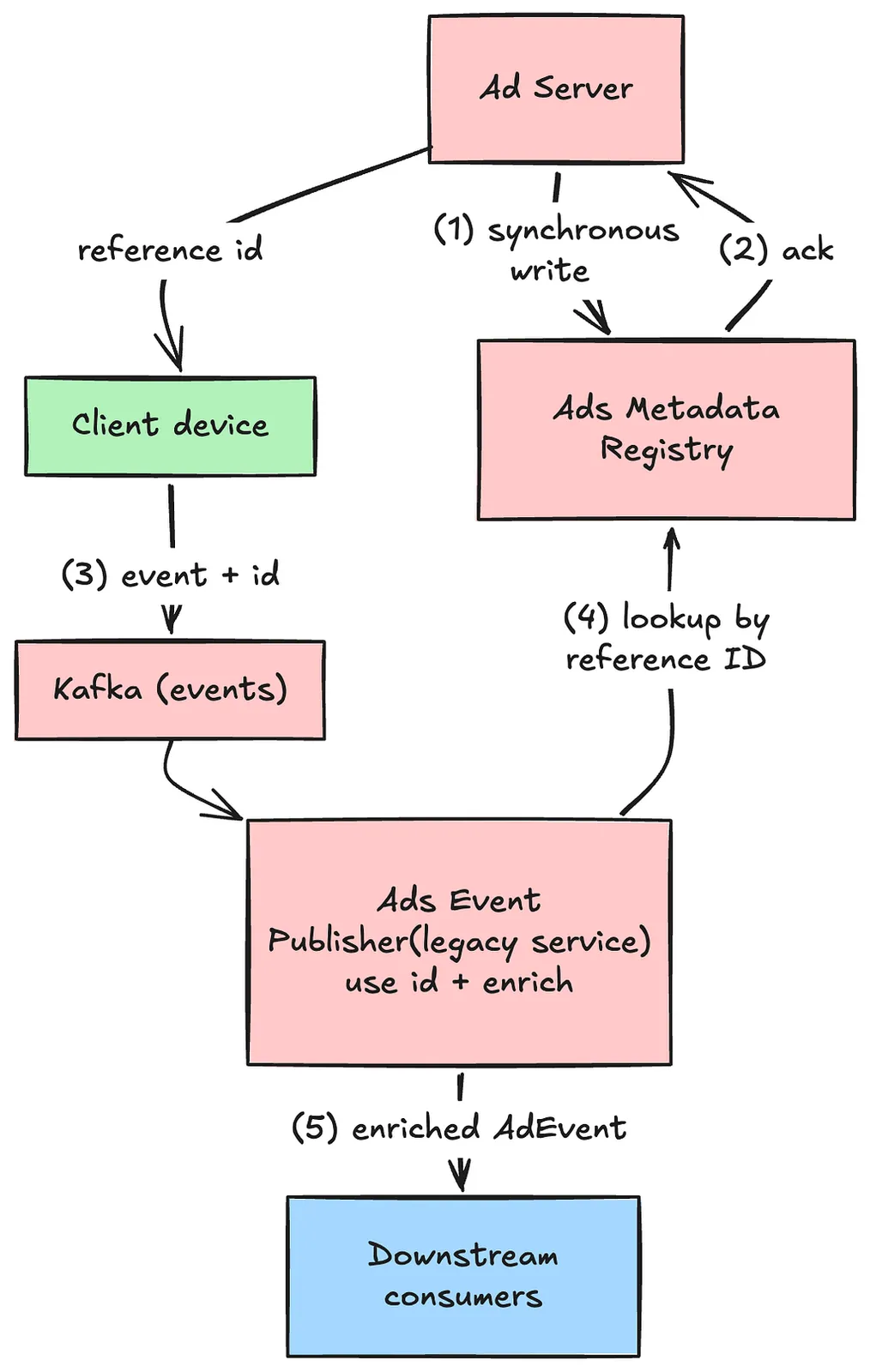
By Yogesh Nagarur Introduction In Part 1 of this series, we shared how Netflix built the Ads Event pipeline and approached it as a system design problem: replacing fragmented pipelines with a centralized collection, enrichment, and a standard data contract. The result was Ads Event Publisher, the system that collects ad telemetry from client devices, enriches it with the context of the ad that was actually served, and publishes a single, unified stream of ad events to every downstream consumer: frequency capping, metrics, billing, measurement partners, and reporting. Any member viewing or account details that move through this pipeline end-to-end are encrypted and handled in accordance with Netflix’s strict privacy and security practices to safeguard member PII. If ad serving is the “brain” and ad events are the “heartbeats” that feed it, then enrichment is what gives each heartbeat its meaning, turning a bare “[Somebody] watched an ad to completion” signal into “this campaign, this creative, at this price, for this break.” Part 1 described that enrichment step as a single box in the architecture. This post is about what was inside that box, and why we rebuilt it. Part 1 ended with a look at what was on the horizon: ads on live streams, de-duplication, and richer data signals. A single project delivered all three by rebuilding the Ads Event Publisher around stateful stream processing. We replaced a database lookup with a real-time streaming join in Apache Flink, which let the system scale for Live, took a dependency off the critical path, and replaced the engine of a high-traffic pipeline without downtime. Let’s dive in. A quick recap: enrichment and the Metadata Registry When an ad is served, the ad server knows everything about it: the campaign, the creative, the price of the impression, the targeting context, and the tracking URLs that measurement partners expect us to fire. The client device, by contrast, knows almost nothing: just an opaque token and when to send each event. Enrichment is the act of reuniting the two. In the architecture from Part 1, that reunion happened through the Ads Metadata Registry, a Key-Value store:
- When the ad server made a decision, it wrote the metadata for that impression into the registry.
- It encoded only reference identifiers into the opaque token returned to the device, keeping the token small.
- Later, when the client fired an event carrying that token, the Ads Event Publisher decoded the token, looked up the metadata in the registry, and stitched the two together into an enriched ad event. This design served us well. The registry was globally replicated, which gave us a useful property almost for free: an event arriving in any region could find its metadata regardless of where the ad was decided. It future-proofed the token against ever-growing metadata, and it carried us through the first phase of Netflix’s advertising growth. The ad server writes per-impression metadata to the globally replicated registry on the serving path, and the Ads Event Publisher reads it back to enrich each client event. But as we looked ahead, especially to ads on live streams, the limits of this design became clear. Why we needed to evolve The forcing function was Live. Netflix’s live slate has grown rapidly, from NFL games to blockbuster fight nights to the FIFA Women’s World Cup 2027, and viewership keeps growing. That traffic looks nothing like Subscription Video on Demand (SVOD): a single event can surge toward tens of millions of concurrent viewers within minutes, then drain just as fast when it ends. Building the ad pipeline for Live meant building for that trajectory. To see why the old design could not get there, let’s put some numbers on it. When Netflix streamed the Jake Paul vs. Mike Tyson fight to more than 100 million viewers, a single ad break at that scale would generate an enormous volume of ad events. Serving those ads in the old design would have meant writing metadata for each of them to the Metadata Registry and waiting for acknowledgment before the ads could serve: millions of must-succeed database writes per second on the ad-serving critical path. That pattern created three core problems at Live scale:
- It was a scaling bottleneck. Every ad and every ad break is a write. Multiply that by tens of millions of concurrent viewers, keep it non-lossy (a dropped write is a dropped ad, and lost revenue), add Live’s spiky on/off pattern, and the write load becomes enormous. But you cannot safely scale the registry up once the event starts. Adding nodes reshuffles data across the cluster to rebalance it, and doing that in the middle of a live event could slow or even fail the very writes you are adding capacity for. That leaves one safe option: pre-scaling for the peak in advance and hoping the forecast is accurate.
- Fewer dependencies on the critical path. Serving an ad meant a synchronous, must-succeed write to the registry, followed by a wait for its acknowledgment. Every system on the critical path is one more thing that can stop an ad from serving, and the metadata registry had no fallback, so an unhealthy registry meant serving stopped. Taking hard dependencies off that path was the goal, and the registry was the biggest one we could remove.
- It put event freshness at risk. If writing slowed down under load, or lookups timed out, events spilled into retries and dead-letter queues, and enriched ad events were delivered late. Some systems might be fine, but others, such as frequency capping, cannot. It needs events under a strict SLA to decide whether the next selected ad can run without breaking policies. So we asked a simple question: the ad server already knows and logs everything about the ad it served. Does it really need to write that to a database on the hot path? Can we match that against the downstream Kafka stream of client events, which is always there, after the fact? The write leaves the critical path entirely; no shared datastore outage can stop serving, and enrichment becomes something we scale elastically with Live rather than a cluster we babysit. Matching two streams after the fact is a streaming join, and that is where Flink comes in. Why Flink We chose Apache Flink because near-real-time, stateful stream processing is exactly what it is built for, and because it has deep, production-tested platform support at Netflix. Just as important, we already knew how to run it. As Part 1 noted, our Ads Sessionizer is a large stateful Flink job, so operating one at scale, tuning state, checkpoints, and recovery under production load, was familiar ground for the team. Enrichment on Flink was built on that experience rather than starting from scratch. The new architecture At its core, the new Ads Event Publisher is built as an Apache Flink streaming job. Each event moves through a handful of stages:
- Normalize. Client events arrive from several sources, including SVOD, live, playback, and embedded ad breaks, each with a slightly different shape. We first normalize them into a common form.
- Re-route. Client events and response events may appear in different regions; we inspect and reroute them to the correct job-processing region for a successful join.
- Join. The heart of the job: we match each client event to the ad-serving response for the same impression, enriching it with the full serving context using a KeyedCoProcessFunction
- Deduplicate. Revenue-bearing events are de-duplicated, so nothing is counted twice.
- Publish. We extract measurement beacons for our partners and route the enriched ad event to its downstream consumers. The ad server logs responses to Kafka rather than writing to a registry; the Flink job joins responses with client events in real time and routes enriched ad events downstream. The join is the interesting part. Client events and ad serving responses arrive on separate streams at different times, so the job holds recent responses in memory and matches events against them over a 60-minute window. Three things can happen:
- The response is already there when an event arrives → we enrich it on the spot.
- The event arrives first → we hold it for a configuration duration (currently set to 60 minutes) until the matching response shows up, then enrich it.
- No response arrives within the window → we mark the event as unmatched for later recovery. We built the join as a custom Flink operator (a KeyedCoProcessFunction) rather than a built-in windowed join. We do not need a windowed join ordering and time-window semantics, since downstream consumers handle ordering; we simply match each client event to its response by key. Owning the operator at its lowest API form lets us control the matching state directly, including how long we hold it and what we do with an event that never matches. This allows us to tune retention per stream or persist unmatched events to a durable store later without rewriting the join. Our goal is always to build a strong base to reap the benefits later as we scale. To make that concrete, picture a member watching a live game. When the ad server decides which ad to show, it logs its response, and a few seconds later, the member’s device fires a “first quartile” event carrying the opaque token. Both arrive at the job keyed to the same impression, and because the response is already waiting, the event is enriched on the spot with its campaign, creative, price, and tracking URLs, then published downstream in near real-time. Why 60 minutes? Almost all events, roughly 99.999% of them, reach the job well before that, so extending the window further would only grow the state store and lengthen checkpoints for a vanishingly small gain. The remaining 0.001% still matters for precise billing and reporting, and we recover those events via a separate path described later on. Cross-region: matching events where their data lives The Metadata Registry handled cross-region enrichment for us because it was built on a globally replicated key-value store: a client event could land in any region and still find its ad’s metadata. Global replication was a feature the platform provided (see Netflix’s Key-Value Data Abstraction Layer), so serving an ad in one region and enriching its events in another was simply not something we had to think about. A streaming join does not come with that convenience, and here the two sides of the join live in different places. The ad serving response stays in the region where the ad was served. The client event, though, is fired by the device, and the device can be anywhere: a member might start an ad on home wifi and switch to mobile data partway through, and that network change can route the event to a different region than the one that served the ad. So a client event is routed to a region that does not have the matching serving response. The tempting fix is to stream every region’s serving responses into every other region so that each region can match any client event locally. We rejected it: that would mean every region storing every serving response worldwide, the vast majority of which will never be used in the join, which is wasteful in both cost and compute. Instead, we treat this as a routing problem and route the client event rather than replicating the response. We encode the serving region into the ad token, so when a client event arrives in the wrong region, we forward it to the region that owns its response. For example, an ad is served in us-east-2, the member’s device switches from wifi to mobile data mid-ad, and the resulting event arrives in us-east-1. That region reads the token, sees the ad belongs to eu-west-1, and forwards the event back there, where its serving response is waiting. Only the small trickle of genuinely cross-region events pays for the extra hop. Catching the long tail of late-arriving events Sixty minutes covers the vast majority of events, but not all of them. A device may have been offline, an ad paused, or an engagement event
正文由 探How 从来源站点 RSS 同步,内容未经改写;遇到排版缺失或需要图片、视频时请以原文为准。