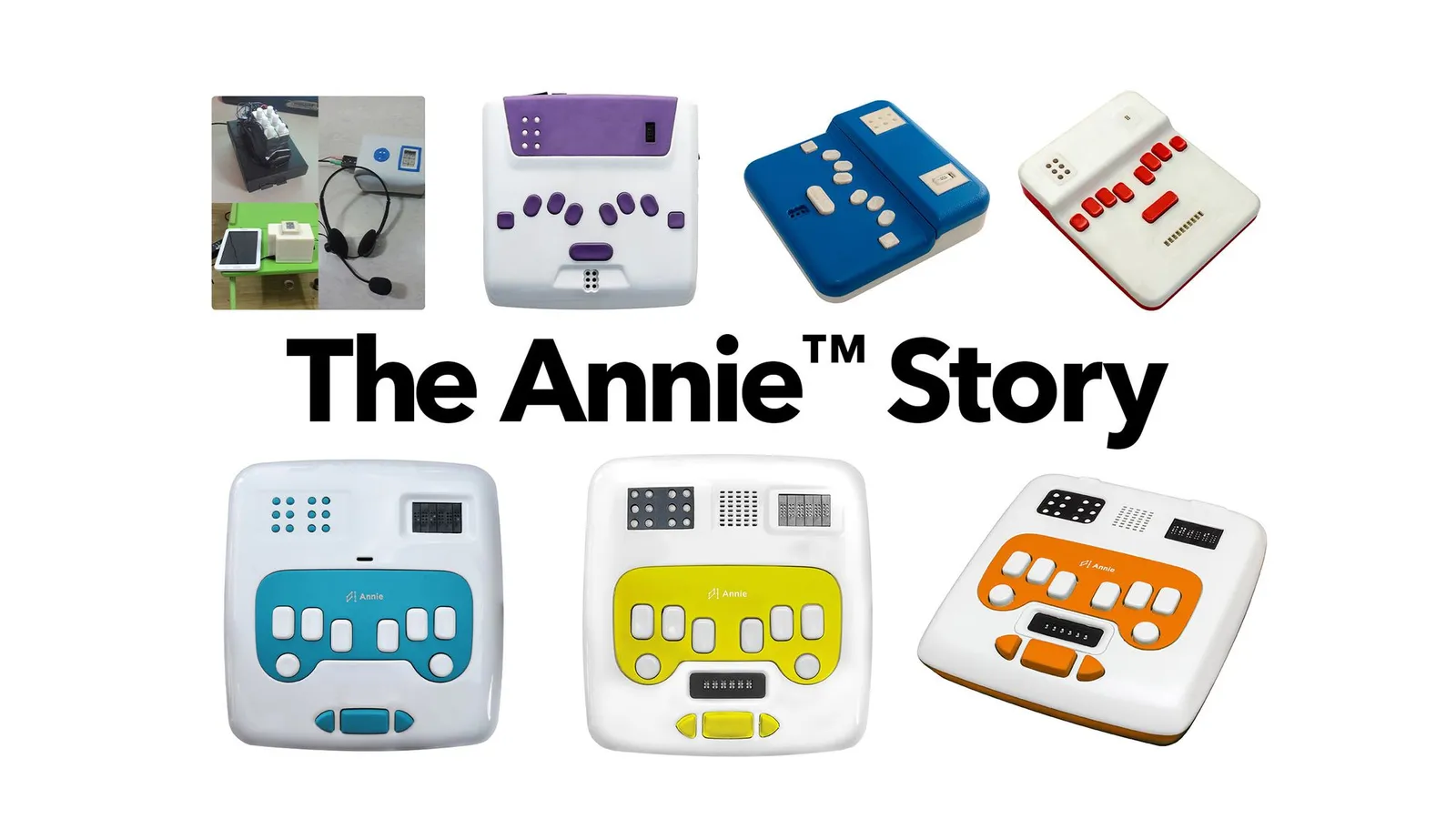
The Annie Story: How We Innovated Braille Education for Today's Learner (2020)
Annie has, at its heart, a story. Not simply of a product, but a story of the people at Thinkerbell Labs who built it, and of those whose lives we sought to impact through Annie. It’s a story that draws on a legacy as f…
以下正文同步自 Hacker News 最新,版权归原站所有,已转换为易读排版。
Annie has, at its heart, a story. Not simply of a product, but a story of the people at Thinkerbell Labs who built it, and of those whose lives we sought to impact through Annie. It’s a story that draws on a legacy as far-reaching as that of Anne Sullivan’s: Helen Keller’s passionate teacher who guided her learning of Braille, and the inspiration behind the name of our own innovation in Braille learning. We often remember the time a visually impaired child at the National Association for the Blind, Goa, upon learning of the history of Annie’s name, insisted that she would learn Braille only from “her.”
Annie’s has been a rewarding and still-flourishing story, all of four years old, but we are driven by the belief that Thinkerbell Labs will grow to contribute to the legacy of Braille learning in a significant way. And this story of learning begins, as it does for us all, with the alphabet.
In 2014, Sanskriti Dawle and Aman Srivastava, co-founders of Thinkerbell Labs and then-students at BITS Pilani, Goa Campus, had a unique project on their hands. Made with a Raspberry Pi and coded in Python, Project Mudra was Annie’s simple predecessor, a dicta-teacher designed to help learn the Braille alphabet. However, as their work received acclaim, they realized there was potentially more to the device than simply being a student project - there was, in fact, a very real need to better the modes of Braille learning.
Braille literacy rates in India are at an abysmal low of less than 1%, with a lack of trained educators being a severe impediment to proliferating Braille - a script that is typically taught in close engagement with the learner. The fewer the teachers, the harder it is for a visually impaired child to get the attention they need for an education truly beneficial to them. With these modes of teaching and learning having remained surprisingly unchanged for several decades, the founders saw the value of technology as a means to improve how visually impaired children engaged with Braille in their classrooms. For example, as Sanskriti puts it, she “grew up with better educational games in the ‘90s than blind children [have access to] today...That had to change.” It was time to build the technology for Braille learning that would come to be known - and loved - as Annie.
As we moved from ‘Project’ Mudra to a full-fledged organization in 2016 as Thinkerbell Labs, the company began the dual journey of building a company and innovative technology. Tough as it can be, the start-up journey has been one of immense passion and unparalleled learning for us, having found an idea to believe in - one of inclusive education - while building a successful venture. From our earliest days, we’ve received encouragement from many - including from some unexpected quarters. In April 2016, Prince William and Duchess Kate Middleton were one of the first people to publicly interact with Annie at an event for the awardees of the Great Tech Rocketship by UK Trade and Investment (UKTI). Their delight in learning to spell their son George’s name in Braille remains a fond memory for our team, and an early validation of our mission.
With the foundations for the company being laid by a vibrant team of co-founders - Sanskriti, Aman, Dilip Ramesh and Saif Shaikh - Annie was being shaped as a comprehensive Braille self-learning device, one that could make learning fun, engaging and intuitive for students with visual impairments. It was important to develop a child-friendly hardware that had a sense of playfulness, a form that encouraged the learner to have fun with their Annie. At the same time, the learning materials on Annie had to engage the attention of children through a mix of Braille lessons and games to improve their performance in reading, writing, and typing Braille. This was essentially a shift both in the pedagogical and technological means of Braille education.
One of the major challenges lay in understanding how to create Annie’s tactile and auditory UX. We conceptualized this multimodal learning as ‘Mudra’ in ways that were specific to how visually impaired children interacted with their learning materials, their peers and teachers, and in their classroom. As sighted developers, we needed to understand for ourselves what these learners required from their learning tools to have an effective educational experience. For example, in 2017, we conducted field trials for learner feedback on the hardware, software, and content of Annie at the National Institute for the Empowerment of Persons with Visual Disabilities (Divyangjan) at Dehradun and Shree Ramana Maharishi Academy for the Blind, Bangalore. Along the way, developed a uniquely comprehensive learning experience on Annie.
While designing the learning experience, we've consistently prioritized learner retention as well as sustained engagement with Annie’s contents, be it from the software, content or hardware perspective. Annie’s content draws on the Royal National Institute of Blind People, or RNIB’s Hands On, an introductory Braille reading scheme that is widely known and well-regarded. But rather than wholly rely on it, our content reflects the best of the Hands On scheme, the founding team’s experiences learning Braille, as well as our collective knowledge from the development of Annie.
Beyond Annie itself, there was much work to be done to ensure that we had the logistical and operational systems in place to develop, manufacture and supply Annies to our future partners. While much of the developmental process - from content to software to hardware - was ably handled by our internal team, we also had to rely on external partners for other processes. From finding vendors for Annie’s components, ensuring their regular and reliable supply, and planning the assembly process, to ensuring the final quality of the devices met our standards, we had to adequately prepare for and successfully put into place the processes best suited to our work, from the early days of production.
As a greenfield innovation, these early days were an exciting period of development for Annie, but it was also a huge challenge, as there was no existing template for our work. Everyone on the team knew that we could rely on each other, that we would go the extra mile in solving any issues - we came in to work every day with the passion to truly make a difference. This mutual support and hard work meant that as 2017 wrapped up, we had a version of Annie that we were preparing to show the world. Simultaneously, we gained support towards our mission of inclusive education through funding from the Indian Angel Network and Anand Mahindra. Along the way, we would be reminded why our mission of encouraging inclusive education through Braille literacy mattered in the first place.
Annie was built with the focus on Braille literacy as a means to a comprehensive education for visually impaired children, for broad reasons that we were theoretically aware of. There was a significant corpus of learning materials and mechanical technologies already available to learn a variety of subjects in Braille. While the dissemination of these were limited by the realities of implementation, the foundation of Braille education in special schools was in place. It is also well-established that Braille literacy can go a long way in encouraging the social inclusion of visually impaired persons, including their higher education and potential employment opportunities. But as we interacted with the children and teachers who would ultimately learn and teach with Annie, we would learn how Annie could be a critical learning tool, and how we could ensure that our partners could use Annie to deliver the learning experience we believed they deserved.
Annie’s interactive pedagogy was established based on two lessons that we understood early on. First, that Annie is after all, meant to help children, who like to play and learn from their surroundings, compete with their peers and can get frustrated in the mundanity of a classroom. Secondly, that these visually impaired children’s learning is limited not by their disabilities, but by the conditions of their education, and the often outmoded forms of engagement with Braille - engagement that sighted children often have ready access to.
From the Project Mudra days, we’ve seen even teenagers playing with a basic letter game for hours and learning Braille themselves. In developing Annie, we noticed that in special schools, children teach and learn from each other, as well as compete with each other to give answers in the classroom. This is why we emphasized both collaboration and competition with Annie in the classroom. For example, we record all the scores of the learners in a classroom in a common leaderboard, which speaks to the children’s intuitive and playful wish to one-up their friend on the games on their cool new gadgets. The learning incentives, such as accuracy in typing and spelling words, speed in reading and writing, and more, aligned with this balance of peer collaboration and competition.
Across our team, the advocacy for Braille literacy comes from personally witnessing the difficulties Braille educators faced in imparting quality education to not just their students, who were limited in their modes of learning without being made aware of it, but many more visually impaired children who could participate in self-learning given the right resources. Saif Shaikh, our CPO, remembers a conversation with a student of Class 10, Shoib, from the Devnar School for the Blind in Hyderabad in our early days of December 2015. When introducing himself as a student of Mechanical Engineering, Shoib piped up, telling Saif that he aspires to pursue the same program. “Blind students grow up with no less ambitions and competence than sighted kids. Their limitations shouldn’t be the reason for them not achieving things they aspire to,” notes Saif - a principle that has been cemented in our work. Access to a plurality of pedagogies and learning materials may be limited simply by their availability, as these haven’t been updated in decades. Learners and educators may not even realize that there are better ways to teach and learn Braille, and the onus for filling this gap with the innovations of Annie lay with us. Recounting her experiences with a blind entrepreneur friend from Austria who actively used Braille alongside the assistive technology that was made available to him without requiring an unnecessary choice, Sanskriti notes that for visually impaired children “Braille learning needs to become available by default, for people to make real choices not defined by constraints.”
The need for technological enhancement of Braille teaching and learning was validated by many of the team’s real-world experiences - across the world. At the LV Prasad Eye Institute Rehabilitation Centre for the Blind at Hyderabad, for example, our team noted that technological modes of teaching could enable self-learning and help educators reach students who might not be able to come regularly to the centre. When we demonstrated Annie’s potential in such a scenario, these educators came to understand the value of this innovation. In meeting with Qualified Teachers of the Visually Impaired (QTVIs) in London, we learnt that they often had to record lessons on cassettes and MP3 players for students to home for practise & completing assignments on their Perkins Brailler. Annie closed this long and arduous loop by allowing for children to learn from and practice on the same device, providing instantaneous feedback. This demonstrated Annie’s ability to be an innovative technological replacement for ad-hoc solutions used even by well-resourced teachers.
Through these lessons, we fine-tuned Annie to be an effective self-learning tool, that allowed learners to take their time with their lessons and practice until they were satisfied. At the same time, we knew that integrating Annie into the cl
正文由 探How 从来源站点 RSS 同步,内容未经改写;遇到排版缺失或需要图片、视频时请以原文为准。