An Arrogant Way of Killing (2016)
Jeremy Jimena had just started his shift when he found the body. At 6:30 on the morning of February 13, 2012, Jimena, a garbage collector in the Philippines, had set out with his driver on their regular route through Ta…
以下正文同步自 Hacker News 最新,版权归原站所有,已转换为易读排版。
Jeremy Jimena had just started his shift when he found the body. At 6:30 on the morning of February 13, 2012, Jimena, a garbage collector in the Philippines, had set out with his driver on their regular route through Taytay, an industrial city an hour east of Manila. It had rained most of the night, and a light drizzle fell as they turned down Paseo Monte Carlo, a quiet road with no streetlights. Their first stop was a large vacant lot overrun by low shrubs, a green carpet of vines, and a scattering of banana trees.
The field wasn’t an official pickup spot, but local residents often dumped garbage there anyway, and the collectors had informally added it to their route. There was a small pile of trash that morning spilling into the road: two large grain bags filled with waste and a bulging, rolled-up bedspread. Jimena hopped off the truck and approached the pile. When he leaned down and grasped the damp edge of the blanket, he saw a human foot.
Jimena dropped the blanket and ran, shouting to the driver, and the two of them left the truck and sprinted to the municipal headquarters, 200 yards away. There they told Ricardo Maniego, the local head of security, what they found. Maniego called the police and brought a long cord to rope off the area, like he’d learned in first-responder training.
Nearly four years later, in December 2015, I sat with Jimena outside the municipal headquarters. He is a small, wiry man with jet black hair and a wisp of a mustache. He looked off in the distance as he recounted the story, his eyes wide and mournful. He’d known right away that the foot was a woman’s, he said, but couldn’t remember much else. “I was shocked and disoriented,” he said.
After he’d shown Maniego the body, Jimena had returned to his route in a daze. He never spoke to the police, he told me, and never learned who the woman was. But for years, he had dreamed of her every night. “She’s screaming, asking me for help,” he said. “Sometimes she is wrapped in a blanket. Sometimes it wakes me up.”
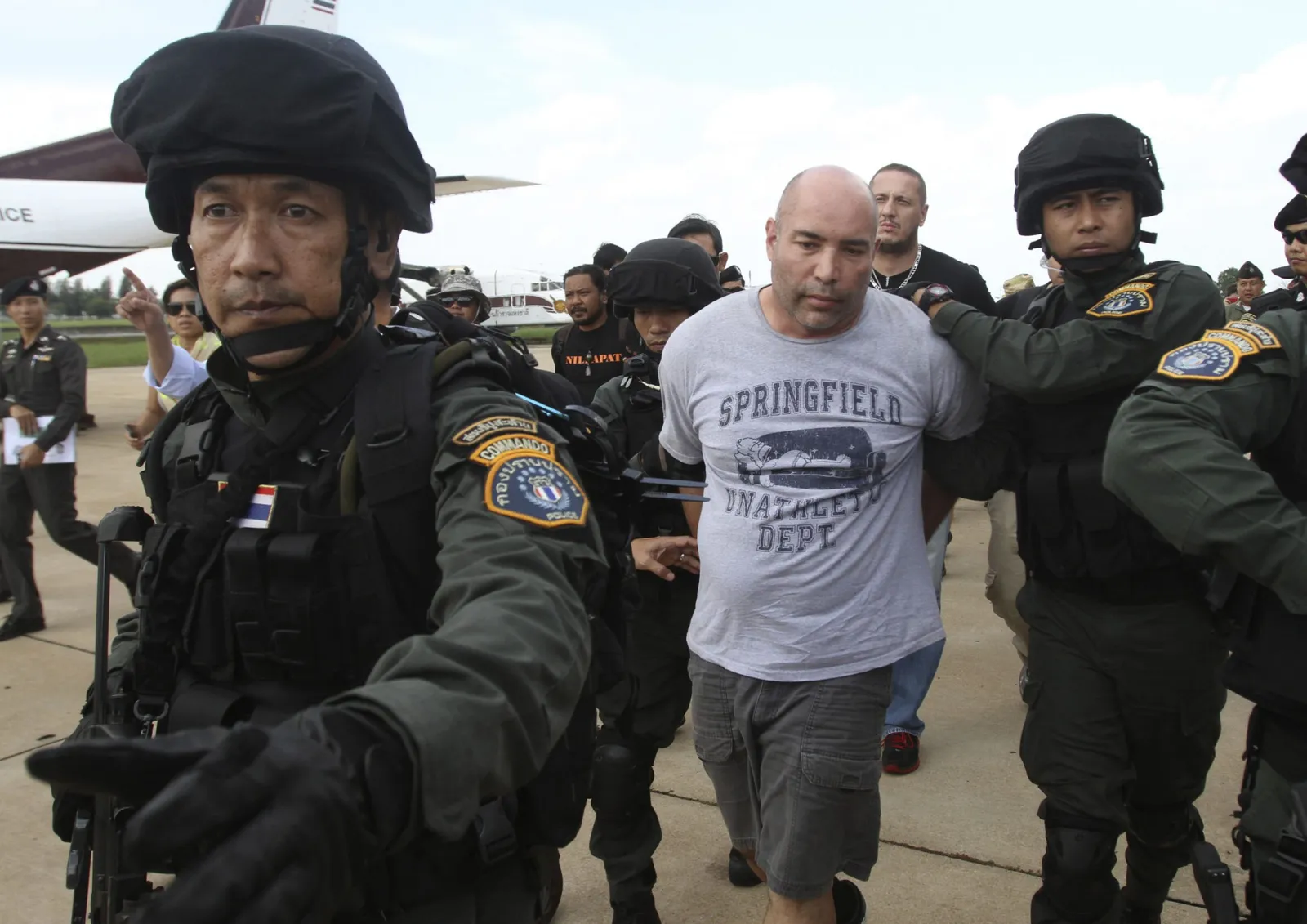
I came to Taytay that afternoon because I believed that the woman Jimena had found was a small thread in a much larger story. Somewhere between a pile of American legal documents and a two-paragraph story about Jimena’s discovery in a Philippine newspaper, I had noticed a hazy connection between the body and a man named Paul Le Roux, a South African who was reputed to be the most prolific international criminal of the 21st century. The scant information I could find on Le Roux suggested his involvement in weapons shipments, gold smuggling, and online prescription-drug sales. But he was also a kind of phantom, reportedly captured by the United States Drug Enforcement Administration in 2012 and then disappeared to work as a valuable asset. My attempts to find out who Le Roux really was, and why the U.S. wanted so badly to keep him a secret, had led me from New York to Manila and then to this vacant lot, where I suspected that Le Roux’s ghostly influence had once been manifest.
The investigative division of the Taytay police is housed in a neglected cinder-block building on the side of a hill in the town’s historic district. I went there with a local Filipino-American journalist, Aurora Almendral, on the same day I met with Jimena. Almendral and I walked past a woman stapling Christmas decorations to the wall, through a pair of swinging doors, and into a cramped room with four officers’ desks. An air conditioner rattled in the window, and three detectives pecked away on ancient-looking computers.
Almendral, who had been helping me since I’d arrived in the country two days earlier, tried to rouse one of the detectives and explain, in Tagalog, why we were there. (The Philippines’ official languages are English and Filipino, which is a standardized form of Tagalog.) The chief of police had promised to show us where the body was found, but that morning he’d been called away by a kidnapping incident. The other cops, largely indifferent to our desires, had no idea when he would return. The original officer on the case, they said, had left the force and become a sailor.
While we waited, I stared at an oddly menacing police “Loyalty Pledge” that hung framed on the wall. “Remember that an ounce of loyalty is worth a pound of cleverness,” it read.
If you must growl, condemn andeternally find faultWhy! resign your position.And when you are outside,Damn to your hearts content.But as long as your a part of the institution,Do not condemn it.If you do, the first high wind thatcomes along will blow you awayAnd probably you’ll never know why.
After some coaxing from Almendral, an officer named Abigail Del Monte agreed to pull the case file. She returned from a back room and proceeded to flip through it idly at her desk, as if trying to discern why I had flown 8,000 miles and then driven three hours in the Philippines’ punishing traffic to visit a four-year-old crime scene.
Twenty minutes later, another detective, George Arada, wearing jeans and a denim jacket, showed up and suddenly the mood shifted. “You’re here for the Catherine Lee case?” he said. “OK, let’s go.” We offered our slightly beat-up rented van and driver for transportation, and Del Monte decided to join as well. We picked up Maniego, the local watchman, and drove over to the vacant lot.
Maniego showed us how he’d marked off the area back in February 2012. “The body was moved a little bit by the guy who picked up the blanket,” he said, officially. “I didn’t find out anything about who she was, because my job was just the immediate response.”
We walked over to an older woman selling drinks at a roadside stand next to the lot; she said she remembered that day, too. “I saw the body,” she said, “but it was covered up, so we couldn’t see who it was. Three streets down, somebody had been missing for a couple of days, so we thought it could be them.” Later, word came back from the cops that the body belonged to a real estate agent from another part of the country. When I asked what happened to the neighbor, the drink-stand woman said that the family of the missing person had been renters, and not long after they’d moved on.
I walked around taking photos, looking for signs that Jimena’s horrible discovery had somehow transformed this otherwise ordinary place. A group of young kids stopped to watch us, and I wondered if the incident had become part of their childhood lore. Whatever mark the body had left, I couldn’t see it. We piled back into the van, and on the drive back to the station I asked Arada and Del Monte whether they often encountered dead bodies in Taytay, a city of just under 300,000 people. “Sometimes over five in a month, but not over ten,” Arada said cheerfully. “It’s kind of a well-known place to dump bodies. Don’t tell the chief!” He laughed. The cases were difficult to solve, he said. The bodies were often mutilated or “broken up and stuffed in garbage bags.”
I asked if I could look at the case file, and to my surprise Del Monte handed it to me. Photos taken at the crime scene showed the body, unwrapped, lying facedown with its feet in the road, a crowd standing at the edge of the cordon.
The facts were spare: a team from the national police’s Scene of Crime Operations division had arrived at 7:50 that morning to examine the woman, who’d been found wearing a black jacket and jeans. An autopsy report listed the cause of “instantaneous death”: gunshot wounds under each eye.
The investigators had little trouble identifying the victim as Catherine Cristina Lee, a real estate broker from Las Piñas City, an hour south. She was found with her identification, as well as a Nokia smartphone, an Anne Klein wristwatch, a silver bracelet, and a pair of rings, gold and silver. She had not been robbed; there was no sign of sexual assault.
Deeper in the file, I discovered that I wasn’t the first person to travel to the Philippines and ask questions about the body. On one page were handwritten notes from a February 2015 meeting with a special agent from the DEA’s Los Angeles office, along with a copy of his business card. A follow-up report stated that two Americans had been arrested in connection with Lee’s murder. One of the two, according to the notes, had confessed, claiming that a Filipino local had supplied the murder weapon and the vehicle used to dump the body. At the bottom of the page, someone had written: “Hunter ordered.”
A few days after Catherine Lee’s body was discovered, her husband contacted the Philippine National Bureau of Investigation (NBI) and requested that the agency look into her case. The ranks of local and national police in the Philippines are rife with corruption—“planting evidence is pretty much a regular occurrence,” the country’s former interior secretary Rafael Alunan told me—and the NBI has a better, though not perfect, reputation for integrity. The agency is required by law to take over cases at the request of victims’ families, and often those requests stem from concerns that local officers have been paid off, or worse. In targeted killings, as the Lee case appeared to be, it’s not unusual to hear whispers that cops themselves were in on the job. Contract murder is a thriving industry in the Philippines; having someone killed can cost as little as 5,000 pesos, or around $100. But police work pays poorly, and as much as 60 percent of the national police force lives below the poverty line. In 2013, Human Rights Watch documented police involvement in a death squad responsible for almost 300 killings over a six-year period in one city alone.
At NBI headquarters in Manila, the Death Investigation Division was housed in a drab, tiled-floor room with the insipid fluorescent lighting that marks bureaucracies worldwide. On the wall was a whiteboard outlining agents’ assignments, organized by nickname: “Cardinal,” “Undertaker,” “Mechanic,” “Hitman,” “Braveheart,” “Snakedoc,” “KGB.” Almendral and I went there one morning to see an agent named Rizaldy Rivera, a garrulous cop with a waist-length ponytail and a talent for sharpshooting. A natural showman, he urged us to check out his videos on YouTube. (Later I did; the clips—including one in which he cuts a credit card in half at 20 yards with a handgun, aiming over his shoulder using a compact mirror—are impressive.) Most people called him Zaldy, but his nickname around the NBI offices, he said, was Slayer, bestowed after he lucked into three shootouts early in his career, one of which left a bullet in his thigh.
It was Rivera who handled the Catherine Lee case after her husband had requested that the NBI take over the investigation. “I cannot provide the real names of the witnesses, or their addresses and photos, in order to protect them,” Rivera told us as Almendral and I sat in a pair of plastic lawn chairs in his cubicle, across a desk completely devoid of papers or equipment. Otherwise, he said, “I can probably answer any question that you want me to answer.”
He started at the beginning, talking above the sounds of an NBA basketball game from a television somewhere just out of sight. Over the course of an hour, Rivera laid out everything he knew about Catherine Lee’s murder. He spoke in the matter-of-fact style of a cop who had seen his share of vicious crimes. But at times, he sounded genuinely mystified that someone like Lee could end up a target.
In early February 2012, Catherine Lee received an email from a Canadian man living in Manila named Bill Maxwell. Maxwell said that he and his colleague, Tony, were looking to invest in real estate. They had searched online for a broker and found Lee, a well-known agent whose territory ranged throughout the southern part of the Philippines’ main island, Luzon. A few years prior, she had served as president of her local chapter of the Real Estate Brokers of the Philippines. “She won several trophies and awards,” Rivera said. Lee, who was 43 but looked younger, with a pixie haircut and a welcoming smile, “had
正文由 探How 从来源站点 RSS 同步,内容未经改写;遇到排版缺失或需要图片、视频时请以原文为准。