Popcorn: The Only Grain That Performs
Last weekend, the village of North Loup, Nebraska, population somewhere around three hundred, threw its 125th Annual Popcorn Days. A carnival took over Highway 11 from Friday to Sunday. There was team penning and sortin…
以下正文同步自 Hacker News 最新,版权归原站所有,已转换为易读排版。
Last weekend, the village of North Loup, Nebraska, population somewhere around three hundred, threw its 125th Annual Popcorn Days. A carnival took over Highway 11 from Friday to Sunday. There was team penning and sorting, a turtle race, kids’ games, a juvenile parade, a men’s slow pitch tournament, sand volleyball, a street dance, and on Sunday the largest parade in the area to close the show. The theme this year was “Looking Back at 125 Years of Popcorn Days,” which is what happens when the anniversary becomes the headline: the parade turns into a mirror. II spent my childhood summers in North Loup with my grandfather, in a house where the television pulled in exactly one signal, channel 10/11, and where the calendar bent around one August weekend the way other towns bend around Christmas. The smell arrived before the event did. Hot oil, salt, the sweet dust hanging over the poppers. You could stand at the edge of town with your eyes closed and know what week it was.
So who invented popcorn? The honest answer insults every patent office on Earth: a grass did, and the grass took its time. Around nine thousand years ago, in the Balsas River country of southern Mexico, people began selecting a stingy wild grass called teosinte into what became maize. Teosinte offers a few armored kernels to a stalk, too hard to chew and too hard to grind, and it holds one talent. Heat it and it pops. Dolores Piperno, the Smithsonian paleobotanist who has spent a career on the question, put it flatly: “All early corns were popcorns.” The first corn on Earth was popping corn. Everything else in the family, the sweet, the dent, the flint, the flour, descends from a seed whose original virtue was explosion.
The oldest physical popcorn we have was dug out of two mounds on the desert coast of northern Peru, at sites called Paredones and Huaca Prieta. Cobs, husks, tassels and stalks recovered there run from about 6,700 to 3,000 years old, and the earliest cobs belong to popping varieties. The detail that stops me is that the people eating that popcorn owned no pottery yet. Ceramics came to the region later. They were popping corn on coals and heated sand before they had a pot to do it in, which makes popcorn older than cookware in that corner of the world. North of there, in 1948 and 1950, a Harvard graduate student named Herbert Dick and the botanist Earle Smith pulled tiny popcorn ears out of Bat Cave in west central New Mexico, some smaller than a penny, with datings that have ranged from about four thousand years to well past five thousand, depending on the laboratory and the decade doing the counting.
The grain entered the hemisphere’s ceremonial life early and stayed there. Aztec accounts describe popped corn strung into garlands and worked into headdresses. The Inka, who called it piscancalla, decorated their dead with it, and fishermen had it scattered around their boats for luck because popped kernels on the water looked like white flowers. A funeral urn from around the year 300 shows a maize god wearing popcorn in his crown. Before this grain ever sold a movie ticket, it dressed gods and blessed boats. It has always been a performer.
Now for the story your third-grade teacher told you. There was no popcorn at the 1621 harvest feast in Plymouth. The tale of Quadequina, brother of the Wampanoag leader Massasoit, arriving with a deerskin bag of popped corn traces to an 1889 novel, Standish of Standish by Jane G. Austin, and then grew in the retelling until the bag became a bushel and the bushel became a children’s breakfast with maple syrup poured over it. The corn grown around Plymouth in that century was Northern Flint, a variety that will not pop, and the chief historian of Plimoth Plantation has confirmed that no trace of popcorn has ever surfaced in the region’s excavations. Andrew F. Smith, whose Popped Culture remains the standard social history of the snack, dates the whole legend to the 1880s, when magazines and school curricula were manufacturing wholesome national origin stories at industrial speed. The genuine northern record sits elsewhere: French accounts from around 1612 describe Iroquois cooks popping tough kernels in pottery jars filled with heated sand near the Great Lakes.
Why does it pop at all? Because a popcorn kernel is a pressure vessel with a script. The variety is Zea mays everta, and each kernel seals a drop of moisture, around fourteen percent of its weight, inside hard starch under a glassy hull. Put it over heat and the water turns to steam with nowhere to go. Pressure climbs to several times what your car tires carry. Somewhere past 350 degrees Fahrenheit the hull loses the argument, the kernel turns itself inside out, and superheated starch flashes into a foam that sets in a fraction of a second, up to forty times the original volume, white as the flowers those Peruvian fishermen saw. Growers sort the results into two shapes, the ragged butterfly that takes butter well and the round mushroom that survives a caramel coating, and they call the kernels that fail to fire “old maids,” casualties of a leaky hull, little theaters that never opened. A one-act play waits in every kernel: pressure, crisis, transformation, applause.
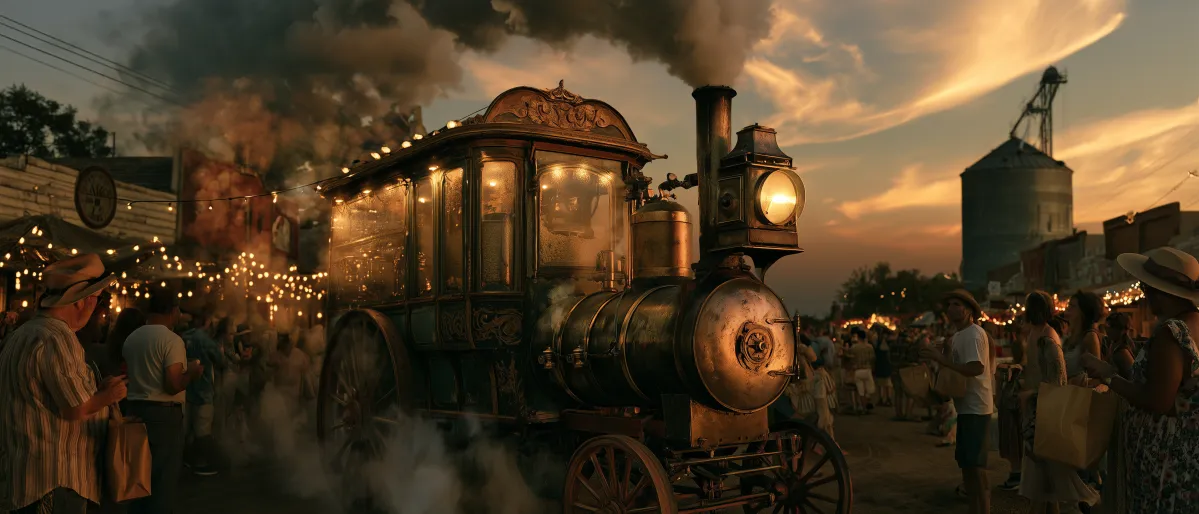
The man who changed the technology was a candy man who never meant to. Charles Cretors, born in Lebanon, Ohio, drifted through the Midwest painting houses and baking bread before opening a confectionery in Decatur, Illinois. He bought a peanut roaster for the shop, hated it, and rebuilt it around a small steam engine that automated the entire roast. Convinced the machine was the real business, he moved his family to Chicago and, on December 2, 1885, bought a peddler’s license to run it on the sidewalk in front of his shop. That license is the birth certificate of C. Cretors and Company.
The corn came next. By 1893 Cretors had a steam machine that popped corn directly in a blend of butter, salt and lard, every kernel heated evenly, every batch seasoned in the pan as it popped. He hauled the rig to the Midway of Chicago’s Columbian Exposition that year, gave the popcorn away free, and sold the machines; his patent arrived on October 10, 1893, and a small steam-driven clown called the Tosty Rosty Man cranked the peanut tumbler and pulled the crowds in. What he changed was the taste itself. Hearth corn had been dry and pale, and what came off the Cretors wagon was hot, glistening, salted and buttered, the flavor we still mean when we say the word. He had also built an economy along the way, the machine sold to a vendor who sold the corn, a franchise model wearing a steam whistle.
The company housed its poppers in ornate horse-drawn wagons, introduced the big Special model in 1900, and, once storefronts moved indoors and electricity spread, patented an electric conversion in 1907, father and son on the same filing. C. Cretors and Company holds one of the oldest active Underwriters Laboratories numbers for an electrically operated machine, the United States Postal Service put the firm’s 1902 wagon on a stamp in 1988, and the family still runs the operation from Wood Dale, Illinois, five generations along, building the poppers behind movie-theater counters across America. The smell of a multiplex lobby is, in a direct line of descent, the smell of a Decatur candy shop’s cranky peanut roaster.
The theaters resisted at first, which is the funniest chapter in the whole account. Early movie palaces considered themselves opera houses with projectors, and popcorn meant grease on the carpets and crunching through the drama, so plenty of houses banned it while vendors simply set up on the sidewalk outside and intercepted the audience on the way in. The Depression settled the fight. A bag of popcorn cost a nickel when almost nothing else did, and the houses that swallowed their pride and wheeled the machines inside rode those nickels through the decade while prouder theaters went dark. When wartime sugar rationing throttled the candy counter a few years later, the marriage of screen and kernel turned permanent. Popcorn had found the second-best stage of its career.
The next machine was an accident with a security clearance. In 1945, a self-taught Raytheon engineer named Percy Spencer stood near an active magnetron, the vacuum tube at the heart of wartime radar, and noticed that the chocolate bar in his pocket had melted. The first food he deliberately tested under the tube was a handful of popcorn kernels, and they popped. The second was an egg, which detonated in a skeptical colleague’s face, and the rule that microwaved food goes in a covered container dates to that afternoon. Spencer’s 1949 patent for microwave popping shows corn packaged in a bag and, in one drawing, a whole cob waiting its turn; Raytheon paid him its standard two dollars for the invention and shipped the first Radarange in 1947, a 750-pound cabinet priced for restaurants and railroads. Popcorn was the first food ever cooked on purpose with microwaves. The countertop would need another twenty years to catch up.
Home popping between those eras belonged to the stovetop and the wall socket. Electric corn poppers reached kitchens by the mid-1920s, and in 1954 a Michigan inventor named Benjamin Coleman packaged kernels, oil and salt in a disposable aluminum pan under a foil cap that swelled as the corn popped, a product called E-Z Pop. Four years later Frederick C. Mennen of LaPorte, Indiana brought out a suspiciously similar pan with a stronger handle and a better spiral dome, named it Jiffy Pop, survived the inevitable lawsuit on appeal, and sold the brand to American Home Products in 1959. By 1976 the magician Harry Blackstone Jr. was on television calling it “the magic treat,” and he had the dramaturgy of it right: the faint first pop, the accelerating drumroll, the foil rising into a silver dome like a curtain going up. Jiffy Pop made the pan itself the show.
The postwar electric popper grew a transparent dome, and the dome learned a trick. Shut the machine off when the popping stops, flip the whole thing over, and the lid becomes the serving bowl, butter melting down through vents in the top the entire time. Machines in the Stir Crazy mold added a rotating wand through the oil so nothing scorched. Every American kitchen of a certain vintage kept one of these in a low cabinet, faintly amber with old butter, and the sound of that little motor is an entire generation’s Friday night.
Then the country took up jogging and the oil became a moral problem. In 1978 the Wear-Ever Popcorn Pumper arrived, the first hot-air popper, a plastic tower that blasted kernels with heated air alone and fired the finished corn down a chute into your bowl like a slot machine paying out. Presto and others followed. Air-popped corn carries roughly five percent of its calories as fat against about forty-five for oil-popped, which the 1980s received as a commandment, and a decade of Christmas mornings produced that unmistakable jet-engine whine followed by dry white corn that tasted, in the judgment of every honest child who ate it, like packing material with salt. Virtue rarely tastes like butter. The machines themselves were built like tractors, and people still run forty-year-old Pumpers today.
The bag won the war. General Mills researchers patented the first microwave popping bag in 1981, while Pillsbury had been selling refrigerated microwave popcorn through vending machines since the mid-1970s, because those early recipes used real butter and real butter spoils. A former Pillsbury engineer named James Watkins bet his career that the microwave would conquer the kitchen, founded Golden Valley Microwave Foods in Edina, Minnesota, in 1978, and shipped a refrigerated popcorn called ACT I in 1981. The breakthrough came in 1984 with ACT II, shelf-stable at last because the butter inside was now an act itself, an artificial flavor riding above a metallized patch called a susceptor that concentrates m
正文由 探How 从来源站点 RSS 同步,内容未经改写;遇到排版缺失或需要图片、视频时请以原文为准。