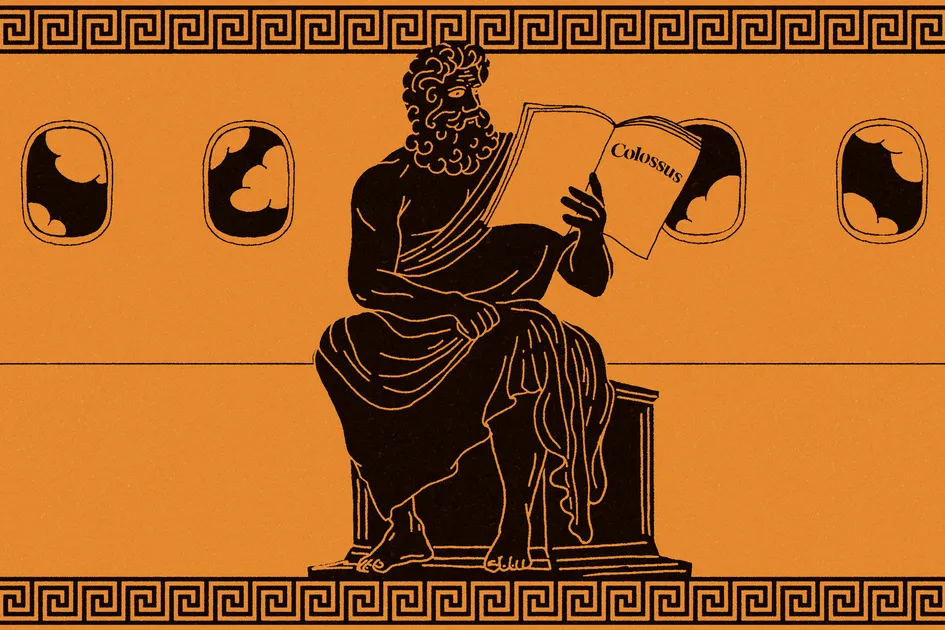
Colossus gives moguls the coverage they crave
Inside tech’s corner offices, there’s no love left for the news media. “I think you’re the problem, the media,” Elon Musk told The Economist’s editor, Zanny Minton Beddoes, in July . “You are loathed far more than I am.…
以下正文同步自 Hacker News 最新,版权归原站所有,已转换为易读排版。
Inside tech’s corner offices, there’s no love left for the news media. “I think you’re the problem, the media,” Elon Musk told The Economist’s editor, Zanny Minton Beddoes, in July . “You are loathed far more than I am.” Colossus , a lushly produced, oversize print quarterly and website, wants to make tech fall in love again. Launched in 2024, its journalistic approach — heavy on access, short on skepticism — has been heaped with praise by the very entrepreneurs and investors it covers. “Gives me hope for journalism,” Reddit cofounder and venture capitalist Alexis Ohanian wrote on X. “This is by far the best profile I have ever read on a firm,” hedge fund manager Bill Ackman posted about a cover story on Thrive Capital founder Joshua Kushner. LinkedIn cofounder and venture capitalist Reid Hoffman shared the Kushner profile, writing, “Highly recommend giving this a read.” Indeed, tech investors like Kushner are opening their homes and clearing their calendars for Colossus, while remaining largely inaccessible to mainstream media. The magazine has featured lengthy, gauzy cover stories on Greenoaks Capital’s Neil Mehta, Conviction’s Sarah Guo, Hyperliquid’s Jeff Yan, and Trilogy Software’s Joe Liemandt. In September, Colossus scored its biggest get yet, publishing a 15,000-word cover story on Mark Zuckerberg that featured scenes with the Meta CEO and his family at their various homes. “It’s the single best profile I have ever read of anyone,” one reader posted . Journalists, on the other hand, are unimpressed. “It is PR,” said veteran tech reporter Kara Swisher, who famously made Zuckerberg sweat . “These people are so fragile and made of papier-mâché that they need Vaseline mirrors to reflect them back at themselves.” “I think Kara is wrong when she calls it just PR,” countered Hiten Samtani, who runs a commercial real estate-focused media company and has written favorably about Colossus . “If it were just PR, it would be much easier to ignore.” Many media veterans doubt the profiles accomplish their subjects’ public relations goals. “It’s all well and good for the tech industry media bubble to have its own in-flight magazine, but audiences aren’t stupid,” Nilay Patel, editor-in-chief of The Verge, said in an email. “Writing a massive profile of Mark Zuckerberg in which … his staggering unpopularity with everyday Americans is treated as an unfortunate byproduct of his ambition just isn’t going to convince anyone of anything. “If Mark actually wanted to be understood as he says he does, he’d sit down for a truly adversarial journalistic interview and try to make his case,” Patel added. “But I don’t think he can take the risk.” *** Colossus is the brainchild of Patrick O’Shaughnessy, a Connecticut-raised heir to an oil fortune, who went to work for his father James’ firm, O’Shaughnessy Asset Management, in 2007. Patrick took over the company in 2018 and sold it four years later to Franklin Templeton. In 2016, he launched a podcast called “Invest Like the Best,” borrowing the title of a book his father published in 1994. His guests on the podcast have included Berkshire Hathaway Vice Chairman Charlie Munger and OpenAI CEO Sam Altman. In 2020, building on the success of “Invest Like the Best,” which O’Shaughnessy has said gets north of 100,000 downloads per episode, he launched a podcast network called Colossus, which now has shows like “Business Breakdowns” and “Founders.” The same year, he spun up a venture capital firm, Positive Sum. When O’Shaughnessy started thinking about adding a print magazine to the Colossus stable, he recruited Jeremy Stern to serve as editor-in-chief and write its most prominent profiles, including those of Kushner and Zuckerberg. Stern had been deputy editor of Tablet, where he wrote a widely praised, if deeply sympathetic, profile of Anduril founder Palmer Luckey. Officially, Colossus appears to be a side project of Positive Sum, with many on its masthead listed as part of the firm’s team. Neither O’Shaughnessy nor Stern responded to requests for comment. O’Shaughnessy was not the first VC or tech company to realize the value of a publication for those disillusioned with traditional journalism. Believing the tech press was untrustworthy and superficial, Andreessen Horowitz launched Future.com in 2021, then shut it down the next year. Stripe started publishing its quarterly magazine Increment in 2017, running for 19 issues; it now publishes books through Stripe Press and a magazine and website called Works in Progress . In April, OpenAI acquired “TBPN,” a talk show made exclusively for and by tech bros. Occasionally, these sorts of media ventures backfire in hilarious ways. In September 2022, weeks before FTX collapsed, Sequoia Capital self-published a glowing profile of Sam Bankman-Fried. “I couldn’t shake the feeling that this guy is actually as selfless as he claims to be,” its writer declared. “It’s actually great that venture capitalists are now writing all of the founder hagiography, because it means that when, inevitably, one of these people goes to prison, the blowback will not affect mainstream journalists,” said Casey Newton, founder of Platformer and cohost of the new NPR podcast, “Machine Gods.” “It will just affect the venture class, and they can take it.” But Colossus is the first in this wave of VC-sponsored media to make a serious effort to ape the writing and photography of glossy magazines. “This kind of wet kiss has always existed, but it was never done this artfully,” said Samtani. “To be super clear, it is not journalism. It is positioned, oftentimes, as journalism. They hire journalists, but it is not journalism. Think of it as high-grade, tier-one content marketing.” *** If Colossus is content marketing, who is it marketing to? Annual subscriptions run $299, which works out to $74.75 per issue. (Back issues are a relative steal at $50 a piece .) Even tech publicists are confused. “Who actually subscribes to it other than the other investors and entrepreneurs also seeking their own editorial platforms?” asked Brooke Hammerling, founder of the communications advisory firm The New New Thing. The upside is less for the magazine itself, Samtani explained, than for O’Shaughnessy’s venture firm. “Their economics are not media company economics. This is at least partly a clout exercise and an access game, and it’s a very smart one,” he said. “Media is an incredible way to create connections and develop your own influence.” Still, the people behind Colossus try to position the magazine within the traditions of legitimate journalism. On his colleague David Senra’s eponymous podcast , distributed by the Colossus network, O’Shaughnessy paraphrased New Yorker editor David Remnick’s introduction to a compilation of the magazine’s profiles, saying the best examples “are defined by somebody doing a thing they’re obsessed with and a writer that is as obsessed with the person as the person is with the thing.” It was an aha moment for O’Shaughnessy: “Wow, that’s what I want to read.” Notably, O’Shaughnessy failed to absorb the first paragraph of Remnick’s introduction, which establishes the form’s ethos. He wrote that The New Yorker’s founding editor, Harold Ross, “prized intimacy and wit over biographical completeness or, God forbid, unabashed hero worship. Ross told his writers and editors that, above all, he wanted to get away from what he was reading in the other magazines — all the ‘Horatio Alger’ stuff.” The typical Colossus profile follows the classic Alger trajectory: scrappy kid overcomes adversity to achieve success. But Colossus adds a twist befitting our nepo-baby era. Its subjects tend to be born not in rags but with relative riches. Their great accomplishment is to accumulate even more money than their well-off parents. To fit Kushner’s story to the Alger narrative, Stern spans three generations to his beloved grandmother Rae, who survived the Holocaust. He glosses over the less savory parts of the Kushner family history — among them, his father Charles hiring a prostitute to entrap his brother-in-law. With Zuckerberg, the Colossus editor focuses on Mark’s father’s quaint dentist office and both parents’ authentic New York accents, spelling out their pronunciation. He skips mentioning Phillips Exeter, the elite prep school that polished Zuckerberg’s Latin and nurtured his sense of imperial destiny. Stern likes to emphasize the trappings of serious journalism at Colossus, including employing independent fact-checkers. When subjects’ publicists approach them — which happened in the Zuckerberg case, according to Stern’s interview with Senra — they push for a more complete narrative. “It’s on us to avoid the trap of being the outlet for founders to get their story out in exactly the pre-cooked way that they have it,” Stern told the publicist Lulu Cheng Meservey. “Can we accommodate their need for that while also telling the story that we get and that we see and gather in the course of the interviews?” The secondary sources are routinely impressive. The Kushner profile includes comments from Altman, Demis Hassabis, Jony Ive, John Collison, and the former dean of Harvard Business School. But it’s rare to find independent perspectives; almost everyone quoted by name has a financial relationship with the subject. And few of Colossus’ sources ever criticize or question the motivations of the subject. In the magazine’s pages, we’re invited to understand and relate to these wounded colossi, vulnerable hulks persevering on the path to greatness through a nearly insurmountable accumulation of wounds. (Think of St. Sebastian, beatific with all the arrows in him.) Stern praises Kushner’s “mostly vindicated admirers” and castigates his “increasingly sheepish critics.” Zuckerberg’s detractors suffer from “Zuckerberg Derangement Syndrome,” persecuting “the most persistent scapegoat of the 21st century.” When journalists talk about Stern and his Colossus colleagues, you sometimes hear traces of pity. They know what the marketplace for magazine journalism looks like today — there are few paying customers for profiles that actually delve into the darker corners of celebrity businesspeople’s psyches. “I’m sure that there is some desire by the writers writing these pieces to go further than the actual piece goes,” said Samtani. Even the rare stab at confrontation comes off as an exception that proves the rule. In a profile of venture capitalist Guo, the 37-year-old investor in AI startups including Harvey, OpenEvidence, and Mistral is offered the opportunity to deny that her AI fund was initially conceived as a crypto fund. “It’s certainly a recurrent rumor,” she responds. And the story moves on. In interviews, Stern occasionally expresses mild revulsion toward technology investors. “I had always found the personality types kind of annoying,” he told Meservey. “As a class of people, these people feel like they’re full of shit.” Yet such sentiments are rarely reflected in his work in the magazine. Other practitioners suspect Colossus writers are simply wasting their time. Zuckerberg and oligarchs of his ilk, Newton said, make for bad interviews because “most important information about them is already public. You’ve seen the products. You’ve seen what they do to people. You’ve seen the fact that the company will often try to evade making [its products] safer or reckon[ing] with its role in society.” Newton questions the value of trying to understand or analyze their interior lives. “Against that backdrop, what kind of kid was Mark Zuckerberg? It’s like, who fucking cares?” he said. “I’m sorry. It doesn’t matter.”
正文由 探How 从来源站点 RSS 同步,内容未经改写;遇到排版缺失或需要图片、视频时请以原文为准。