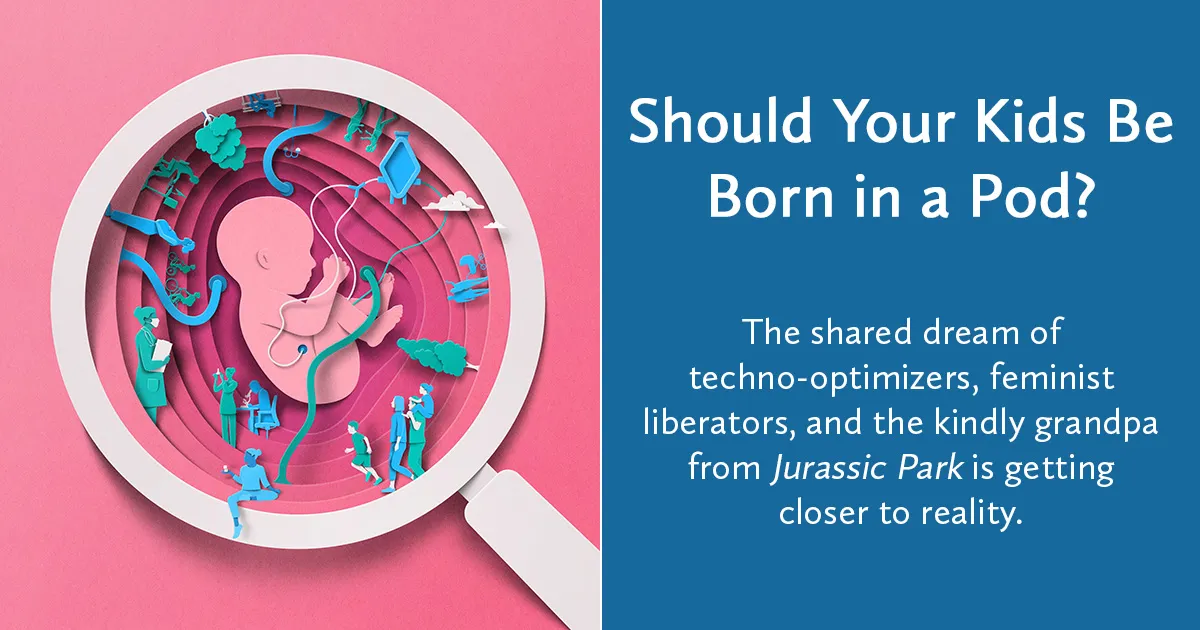
Should Your Kids Be Born in a Pod?
I ascend to the second floor of a cement-gray building in a part of West Dallas that’s all highways and office parks. In the lobby, I’m greeted by two wolves. The first is tearing at a large hunk of meat on a wall-sized…
以下正文同步自 Hacker News 最新,版权归原站所有,已转换为易读排版。
‘We Have to Recreate How It Functions’
I ascend to the second floor of a cement-gray building in a part of West Dallas that’s all highways and office parks. In the lobby, I’m greeted by two wolves. The first is tearing at a large hunk of meat on a wall-sized TV screen. The second, a mechanical version standing on a faux-rock outcropping to its brother’s left, gives me a jump-scare when it turns its head to follow my movements as I walk over to say hello. These are dire wolves, which Colossal has resurrected in real life — or approximated — in 2024 by gene-editing gray wolves and birthing them using surrogates. The dire wolf, once just a museum piece, is now being watched over carefully by a team of enterprising conservationists and veterinarians in an ecological preserve.
But much more will be required for the woolly mammoth’s resurgence. A massive graphic of the mammoth looms over the lab’s entrance on the opposite wall as Mailaender leads me back to the studio for my first interview. In the tastefully modern open-plan lunch room — light wood and potted plants, coffee bar–style drinks on tap — a copy of Jurassic Park reclines on a book stand behind a group of sofas.
So they know what all this sounds like? I ask Beth Shapiro, Colossal’s chief scientific officer. Yes, she laughs. In fact, the scientists who extracted DNA from the skin of an extinct zebra-like species in the 1980s and discussed bringing back mammoths helped inspire Michael Crichton’s iconic story. But this project isn’t like that: Colossal isn’t bringing back dinosaurs. Their DNA deteriorated long ago. Anyway, it would be a dubious prospect, since (as Crichton demonstrates) today’s ecosystems are in need of a lethal new apex predator like Chernobyl needed a nuclear meltdown.
But Colossal is aiming to perform similar feats of reproductive engineering — and gene editing is only part of the program. After the test tube, it is the later development of animals that poses the challenges the team is wrestling with now: how to gestate animals that are either too large for a surrogate or for whom surrogacy would be impractical at scale. Restoring the Tasmanian tiger or the mammoth in a natural ecosystem instead of a zoo paddock would require large numbers of animals, and IVF and surrogacy are risky, expensive, and inefficient — many embryos and pregnancies are lost in the process. The controlled environment of an artificial womb would be far more reliable.
It’s not easy to build, though. One of the main reasons is the stunning variety of ways mammals have found to structure their placentas. “I didn’t even know before I started here that there are so many different types of placentas,” Shapiro says. “And they all behave differently.” This is one of the biggest challenges for creating a fully viable artificial womb.
To see that process closer up, I have to snap on my lab coat. Sara Ord, director of biotechnology innovation at Colossal, is dressed, like most of the company’s employees, in jeans, sneakers, and a stylish black Colossal T-shirt, but when we walk into the entryway to the lab proper she slides on a black coat and offers another to me. It’s surprisingly comfortable, with fitted cuffs and deep pockets for things like my cell phone, which I’m using to record my tour, and whatever people with degrees from M.I.T. need to carry around while editing ancient DNA and testing synthetic placental structures for gestating baby mammoths.
Ord takes me to Exo Dev first, where three young scientists — the lab’s average age appears to be early thirties — show me their artificial chicken eggs, along with a “roller culture” system that looks like a tiny front-load washing machine. Instead of washing lab coats, it grows embryos. The rotating vials inserted in the rim of the device carry mouse embryos until the tricky stage Shapiro and I talked about: placentation, or the development and attachment of the placenta to the uterus. Bryan McLendon, one of the Exo Dev researchers, tells me that some placentas “invade” into the uterus more deeply than others — some, including those of elephants, attach in a ring around the uterus, some invade in multiple places, and others don’t connect to the womb at all. They’re working on mice right now, which are familiar lab subjects, but they will have to adapt for the mammoth project, where the placental structures are different. McLendon tells me that in place of the uterus they’re using hydrogels infused with uterine chemicals that send developmental cues to the embryo, which will then grow a placenta. They think the placental structure is less important than the chemical signaling: “We don’t know if we have to recreate how it looks,” McLendon speculates. “At the moment, the hypothesis is we have to recreate how it functions.” The main questions right now are which chemicals to introduce, in what amount, and at what time. But with the first mammoth calf scheduled to arrive in 2028 after a twenty-two-month gestation period, the clock is ticking.
As I’m led to the desks of researchers squinting at rows of DNA code on screens, activating cultured cells with edited DNA, and extracting samples from the yolks of eggs to alter their embryos’ genetic material, I’m struck by how the DNA editing itself is the easy part, at least in the sense that DNA is known information. Thanks to Watson, Crick, & co., we’ve cracked the code that makes species distinct. We — or at least these smart young PhDs in lab coats — know how to read it, and Colossal has found ingenious ways to alter it to create animals that resemble extinct species by inserting their genetic material into the code of the target species’ living relatives. As they describe it to me, turning the fat-tailed dunnart, which is a mouse-sized marsupial, into a Tasmanian tiger, a wolflike marsupial, is in large part a programming exercise.
It’s the unknowns that are the bigger challenge, from the limits of biological knowledge — what makes a placenta function? — to the inevitable uncertainties of epigenetic effects on development: How will the environment and circumstances of a given animal’s development change how it turns out? I had heard that mice produced outside a uterus in earlier experiments had emerged deformed, though recent experiments had been more successful, at least in the early stages of development. The reigning theory at Colossal is that gestation is essentially a chemical signaling problem. But even if they can get the programming right, can they achieve enough control to replicate nature? Or has the laboratory of nature already produced the most efficient systems: the womb and the birth canal, the shell and the egg?
The last stop on my tour is the room “where the magic happens,” Ord says. This is the cloning lab, where the wild-sounding idea of replicating reproduction is becoming reality. Namdori Mtango, a senior embryologist at Colossal, is cloning cow oocytes — immature egg cells — at a large machine mounted with a microscope, where she is extracting the contents of the cells and inserting edited DNA. This is one step in how the new — or old — animals come to life. She’s doing impossibly detailed work, zooming in with a computer monitor on the collection of cells in a petri dish in front of her, operating laser-thin needles with what look like advanced arcade joysticks, and then using an actual laser to puncture the cell membrane and make the DNA swap. Mtango asks me if I want to give it a go. Surprised, I nod yes, and she points to a pedal on the floor. I step down and into reproductive history: The laser zaps a hole into the cell wall, Mtango sucks out its contents, and now I have edited an oocyte.
A few minutes later, in the office lounge, I skim the framed printouts of media coverage on the wall. Since Colossal’s launch in 2021, everyone from the New York Post to Wired to National Geographic has written about the resurrection campaign. Skepticism and enthusiasm appear in varying doses — Shapiro herself expresses doubts in an early New York Times piece from before she joined the company in 2024. But clearly the attention itself is part of the strategy. Ben Lamm is engaged in more than a pet project to meet a woolly mammoth, and more than a conservation project to save ecosystems ravaged by the loss of apex predators and other essential points in the circle of life.
When I’m fetched from the lounge to his office next door and ask about his motivations — he’s in a denim jacket over a black shirt with some sort of dinosaur-like creature roaring out at me, sneakers, hair to his shoulders, twirling in his easy chair with aging boy genius energy — he says he sees Colossal as a pitch for science over mindless entertainment: “We’re competing with whatever the latest celebrity pop culture craze is on TikTok.” And it seems to be working. Thirty percent of their investors got motivated by their kids’ interest in Colossal, he says. Another significant portion of their funding is from celebrities: Tom Brady, Tiger Woods, the Hemsworth brothers, Paris Hilton, George R. R. Martin, Peter Jackson. In Colossal’s social media sentiment analysis, more than three-quarters of the general public is enthusiastic about the de-extinction projects; with children and teachers, Lamm tells me, that number is almost 100 percent.
None of this — the slick aesthetic, the scientist-next-door vibe, the walls of media in the lounge — is incidental to Colossal’s scientific program. The message is that real technological progress has never been tried: The reason Jurassic Park spun out of control wasn’t the attempt to control nature but the lack of eco-conscious ideals, and perhaps the proper tools. Crichton, after all, was writing before CRISPR (though a tiny elephant raised in an artificial womb — the book’s only mention of the technology — is dismissed early in the novel as a circus freak). Ian Malcolm, the story’s resident skeptic, condemns its creators not for their choice of species or the limits of their scientific knowledge, but largely for the lack of responsibility enabled by their business model: “You don’t even know exactly what you have done, but already you have reported it, patented it, and sold it. And the buyer will have even less discipline than you. The buyer simply purchases power, like any commodity.” Malcolm is criticizing John Hammond, the theme park’s billionaire founder, who thought he could sell biotechnology as entertainment. But Colossal is not so naïve, its leaders claim; they have principles, guardrails that keep their project, while similarly commercial, similarly splashy, and similarly sci-fi, from devolving into the destruction Malcolm predicts because of the predictable unpredictability of all action — including technological development.
Colossal is different from Jurassic Park, Lamm says. First, because their conservation project lies on stronger ethical foundations than making bank by building a dinosaur funhouse. And second, because they have set limits on their own power: “We are not going to develop human artificial wombs,” Lamm assures me.
“But,” he adds, “I do believe that we will build technologies that are fundamental to those successes. And I do believe that we have the highest likelihood of success.” They won’t develop artificial wombs for human applications, but should they win the race to develop artificial wombs for animals, they will consider licensing the technology to researchers who will: “If we are successful growing mammoths ex utero, that technology could easily be applied to humans, provided it’s scientific.”
In fact, Colossal’s co-founder, George Church, is at work on a project at Harvard’s Wyss Institute, with funding from Colossal, that Church believes will go beyond de-extinction to “revolutionize reproductive biology for all species,” according to a press release. On this view, the commercialization of reproductive technologies — a world where a company like Orchid screens human emb
正文由 探How 从来源站点 RSS 同步,内容未经改写;遇到排版缺失或需要图片、视频时请以原文为准。