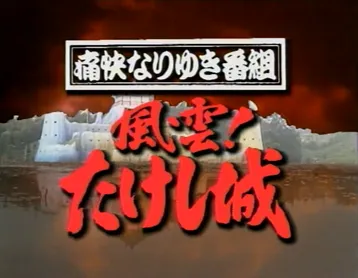
Takeshi's Castle
Takeshi's Castle (Japanese: 風雲!たけし城, Hepburn: Fūun! Takeshi-jō) is a Japanese game show that aired between 1986 and 1990 on the Tokyo Broadcasting System (TBS). It features the Japanese comedian Takeshi Kitano (also kno…
以下正文同步自 Hacker News,版权归原站所有,已转换为易读排版。
Takeshi's Castle (Japanese: 風雲!たけし城, Hepburn: Fūun! Takeshi-jō) is a Japanese game show that aired between 1986 and 1990 on the Tokyo Broadcasting System (TBS). It features the Japanese comedian Takeshi Kitano (also known as Beat Takeshi) as a count who sets up difficult physical challenges that players (or a volunteer army) must overcome in order to reach him in his castle.
The show became a cult television hit around the world.[2] It was highly influential in global popular culture, inspiring a genre of game shows involving physical challenges and painful entertainment, as well as other media. On 2 April 2005, a special live "revival" was broadcast for TBS's 50th anniversary celebrations. A reboot of the show was released on Amazon Prime Video on 21 April 2023.[3] German-Japanese actor Subaru Kimura joined the returning Tani as co-leader of the contestants.[4]
35°34′06″N 139°29′02″E / 35.56833°N 139.48389°E / 35.56833; 139.48389[[Geographic coordinate system|Coordinates]]: {{#parsoid\u0000fragment:27}}<span class="plainlinks nourlexpansion">[https://geohack.toolforge.org/geohack.php?pagename=Takeshi%27s_Castle¶ms=35_34_06_N_139_29_02_E_region:JP-14_type:landmark_source:dewiki <span class="geo-default"><span class="geo-dms" title="Maps, aerial photos, and other data for this location"><span class="latitude">35°34′06″N</span> <span class="longitude">139°29′02″E</span></span></span><span class="geo-multi-punct"> / </span><span class="geo-nondefault"><span class="geo-dec" title="Maps, aerial photos, and other data for this location">35.56833°N 139.48389°E</span><span style="display:none"> / <span class="geo">35.56833; 139.48389</span></span></span>]</span>[[Category:Pages using gadget WikiMiniAtlas]]</span>"}}'/>
The original show involved between 86 and 142 contestants whom General Tani (Hayato Tani) "forced" into a series of elimination-style physical challenges, which were similar to those found in It's a Knockout. At the end of each episode, the contestants who survived all challenges faced off directly against Takeshi and his army in one final assault on his castle, with the goal of claiming it for Tani.
The series featured extensive landscaping of a fixed campus at TBS-owned Midoriyama (Green Mountain) Studios in Yokohama, Kanagawa. The setting included large man-made lakes and elaborate permanent obstacles. The final regular episode aired on 14 April 1989, followed by 4 one-off specials until 19 October 1990. A special revival took place just outside the TBS Building for the network's Spring All-Star Thanksgiving Festival on 2 April 2005, featuring Lake of the Dragon God and Gibraltar Strait. In 2004, the website "Takeshi Mania" published an injury list of show participants. The publisher later admitted fabricating the list in an effort to "make a little fun".[5] While minor injuries were reported, few to no major injuries occurred on the show.[6]
A wide range of challenges were used throughout the history of Takeshi's Castle. Depending on their popularity and ease of preparation, some challenges occurred only once or twice, while others took place in virtually every episode. Many challenges involved falling into water or mud upon failure.
In early episodes, the contestants stormed the castle in a short-range water gun assault. Later episodes introduced carts with paper rings and eventually lasers and light-sensitive targets. If the contestant's gun penetrated the paper ring or hit the sensor on Takeshi's cart (which was defended by weapons such as a large water gun and a laser-armed plane), Takeshi's cart would deactivate, and the castle was "taken," and the game won. During the water-gun version, if Takeshi was defeated, all surviving players split the prize between them. In the laser-gun version, the player who stopped Takeshi won 1 million yen (which, at the time, was roughly equivalent to US$8,000 or £5,000 sterling).[citation needed]
In the Amazon Prime reboot, the finale game "Yabusame" had the remaining contestants playing against BANANAMAN, Lord Ueda, Lord Neomi, Lord Watanabe, and kickboxer Tenshin Nasukawa, who played on Count Takeshi's behalf. The contestant rides across a track in a pod firing tennis balls into the funnel of their opponent's pod. The defender of the castle shoots back at the paper target on the contestant's pod with larger balls. If the castle defender breaks the contestant's paper target, the contestant is out. If a player lands a ball in the funnel of the defender, the contestant wins a million yen. If nobody is defeated, it is considered a draw with no victories.
Takeshi's Castle challenges used a wide variety of well-known songs from movies, television shows, video games, anime, and other sources.
In Arab countries the show was called Al Hisn (Arabic: الحصن, lit. 'The Fort'). It originally aired in the mid to late 1980s where it became a cult hit.[7][8] The show was syndicated to multiple TV stations across different countries, which was a common practice at the time for localized foreign programs. Various public stations re-run the show on non-specific occasions. Other than the voice-over commentary and the opening/closing themes, the episodes were largely retained as originally aired in Japan. The commentary was provided by Lebanese television personality Riad Sharara, then later by Jamal Rayyan.[7][8] The Arabic version was produced and distributed by Amman-based company Middle East Art Production and Distribution (الشرق الأوسط للإنتاج والتوزيع الفني).
In 2017 the Saudi Arabian Sports Authority signed a contract with TBS to build a Saudi-inspired Takeshi's castle in Riyadh, the first episode of which aired on 25 September 2019 on MBC 1.[9][10][7]
An edit of the show was produced by The Comedy Channel. It had hosts in the local studio and was redubbed. This has since been cancelled and/or finished. The show was hosted by two housemates from series two of Australian Big Brother Shannon Cleary and Nathan Morris. It also featured a crossdressing Geisha girl named Beryl. Some episodes featured a special guest third host, including Greg Fleet. Highlights appeared in Australia on the television program World's Weirdest TV. The American version MXC currently airs on Fox8 (an Australian cable network). The Australian writer and critic Clive James was once a celebrity contestant on the original show.
Starting on 19 November 1989,[11] a version was aired by Rede Globo, called Olimpíadas do Faustão (Portuguese for "Faustão's Olympics"), as an insert in Fausto Silva's Sunday-afternoon variety show Domingão do Faustão. In 1994, rival SBT copied that version, and a legal action by Globo and SBT stopped the broadcasting.[12] On 1 June 2008, SBT Keshi remake reappeared on TV, now licensed, remaking Faustão's known games (as Bridge Ball and The Run Way), not-seen in Globo games (as Skittles and Ride the Wave), and original games (cross a balance beam after spin, or cross a small bridge using a crank-kart). The games are a segment named "Gincana"[13] in the Programa Silvio Santos.
It was shown by the name Takešiho hrad (Czech), with comedic voice-over by two Czech comedians. The commentary was mostly fictional. The show was popular among young viewers.[citation needed] The Czech TV channel also broadcast the show to Slovak Republic where it gained some popularity[citation needed] as well. In 2011 was Takešiho hrad broadcast on channel Prima Cool with a new single-voice commentary.
The Danish TV station TV 2 Zulu bought the rights to air the Challenge version in Denmark, thus making the Danish broadcast identical to that in Britain.
On 7 January 2008, the television channel Jim started airing the UK version of the program. The comments are subtitled in Finnish. The show is titled Hullut japanilaiset (The Crazy Japanese)
A shortened version given a comedic[citation needed] voiceover by comedians Vincent Desagnat and Benjamin Morgaine has been shown on the W9 TV channel since October 2006, in a program called Menu W9 (which also presented a shortened version of Sushi TV on its first season, now replaced by Sasuke). It has been also broadcast on the channel M6 which shown 2 episodes per day at 6.50 p.m from Tuesday to Friday. The voices were those of the late sport presenter Thierry Roland and Moon Dailly.
A dubbed version of the show aired on DSF in 1999. This version was released on a DVD box set with 12 selected episodes. Two more volumes were planned but were presumably canceled. A German dubbed version of the 2002 UK edit airs from 3 July 2007, on RTL II. There also exists an adaptation called Entern oder Kentern (engl.: Board or Capsize) with almost the same games but pirates as antagonists and celebrities as Team Captains. This version was aired on RTL in summer 2007. Shorter versions of episodes with comical commentary air on Comedy Central.
A version aired from 2005 to 2009 on Skai TV by the name Το κάστρο του Τακέσι (Takeshi's Castle). It has been dubbed by Kostas Papageorgiou and Akindynos Gkikas.
In early 2022, the Hungarian version of Comedy Central started to broadcast the Indonesian show, redubbed with stand-up comedians Péter Elek and Péter Janklovics who tend to know nothing about the aim of the game, thus strengthen the funny circumstances of the show just like in the Czech version. However, after the premiere, repeats are aired in CET nighttime only.[14]
A shortened version of the show aired on Pogo on 1 March 2005, with Hindi commentary by Jaaved Jaaferi.[15] Jaaferi's commentary was praised for its humour, and this increased the show's popularity. It additionally featured guest commentators such as Raju Srivastav, Sunil Pal, Navin Prabhakar, and Ahsaan Qureshi.[16] The show aired on Pogo until January 2019.
Amazon Prime Video's 2023 reboot of Takeshi's Castle was released on 2 November 2023, featuring the voice of Bhuvan Bam as his character "Titu Mama" from BB Ki Vines, taking over as the new commentator, replacing Jaaved Jaaferi. Bhuvan spent four months dubbing and writing the script for the show, with some promotional videos filmed in September.
The original Japanese show was being re-broadcast (with Indonesian dubs) on RCTI from December 1989 to December 1992, TPI from 2002 to 2007 (with most reruns) and GTV in 2013 and 2014. In 2017, MNCTV acquired the license to remake the show which was later known as Takeshi's Castle Indonesia (a.k.a. Benteng Takeshi Indonesia) with a grand prize of IDR 100.000.000,-. After two successful seasons, the show was originally planned to enter its third season in 2018; however, due to a drug case involving Reza Bukan (the cast of King Takeshi at that time) the launch of the third season was delayed until mid-2019.
The main cast of Takeshi's Castle Indonesia includes Fero Walandouw (as the Captain), Nabila Putri, Poppy Sovia, and Desy JKT48 (as Vice-Captains in Season 1, 2, and 3 respectively), Lee Jong Hoon (as the Reporter), and Reza Bukan and Kenta (as King Takeshi in season 1–2 and 3 respectively).
It was aired by the name Masir-e Talaa'ee (Persian: مسیر طلایی) (when translated it means "Golden Path"), on Iran's Channel 3 in 2009 and 2010. It was hosted by Morteza and Mostafa Hosseini, the brothers of the refugee host Mohammad Hosseini.
Renamed Mai dire Banzai (Never Say: Banzai!) it first aired in 1989 on Italia 1. A reedited version interspersed with clips of another Japanese gameshow called Za Gaman, it was given a comedic voiceover by Gialappa's Band, who changed Kitano's and Saburo Ishikura's names to Gennaro Olivieri and Guido Pancaldi, historically Swiss Italian judges in Games Without Frontiers. They also renamed in absurdist comical ways the other figures of the show like calling the in-game reporter 'Pokoto Pokoto', the huge-headed fake Takeshi being called 'Mashiro Tamigi', the martially-attire'd host 'General Putzerstofen' and so on. Gialappa's Band making fun of the duty-bound, stoic stereotype of Ja
正文由 探How 从来源站点 RSS 同步,内容未经改写;遇到排版缺失或需要图片、视频时请以原文为准。