Drone Live Streaming. What You Can Use It for and How to Set It Up
Drone live streaming has been a steadily growing real-time video use case over the past decade. In this blog, you’ll learn what it is, how it works, why a server setup outperforms peer-to-peer, what real-time drone stre…
以下正文同步自 Hacker News 最新,版权归原站所有,已转换为易读排版。
Drone live streaming has been a steadily growing real-time video use case over the past decade. In this blog, you’ll learn what it is, how it works, why a server setup outperforms peer-to-peer, what real-time drone streaming solutions Red5, Nomad Media, and AWS offer, and how organizations like the San Diego County Sheriff’s Department are using it.
A content creator controls the drone to capture footage.
Drone live streaming is the real-time transmission of video and audio captured by a drone’s onboard camera to an online audience. Many modern drones feature advanced cameras and connectivity that enable smooth, high-quality streaming for uses like content creation, event coverage, traffic monitoring, emergency response, and news broadcasting, delivering dynamic and timely insights from unique perspectives.
According to the Federal Aviation Administration of the United States Department of Transportation, as of July 2025 there are:
When you look at drones, it helps to think about them in two ways: what they’re built to do and what they’re used for.
Drone live streaming starts when the drone’s onboard camera and transmitter capture and transmit video to a receiver or streaming platform. The video signal can travel far over WiFi, cellular, or other wireless links, allowing operators to simultaneously view and share footage through an app on a phone or computer. Popular live streaming protocols like WebRTC, RTSP, and RTMP make it possible to stream securely with low latency. Batteries power both the drone and its transmission systems, so careful management is important to avoid a crash mid-flight.
Flexible deployment options include cloud, on-premises, or air-gapped setups to meet specific security requirements while maintaining performance. Depending on the streaming provider’s capabilities, latency can vary. Red5 delivers sub-250 millisecond latency, enabling true real-time drone streaming capabilities. Feeds from drones can be seamlessly combined with body cameras and fixed surveillance systems into a unified command center for public safety and defense use cases. High-definition recordings can be captured with instant playback while meeting strict chain of custody standards.
One real-time video use case that has gained momentum lately is how drones are being used in public safety and defense. Drones stream video, audio, and data in real time to command centers, helping increase situational awareness and speed up decision-making when it matters most.
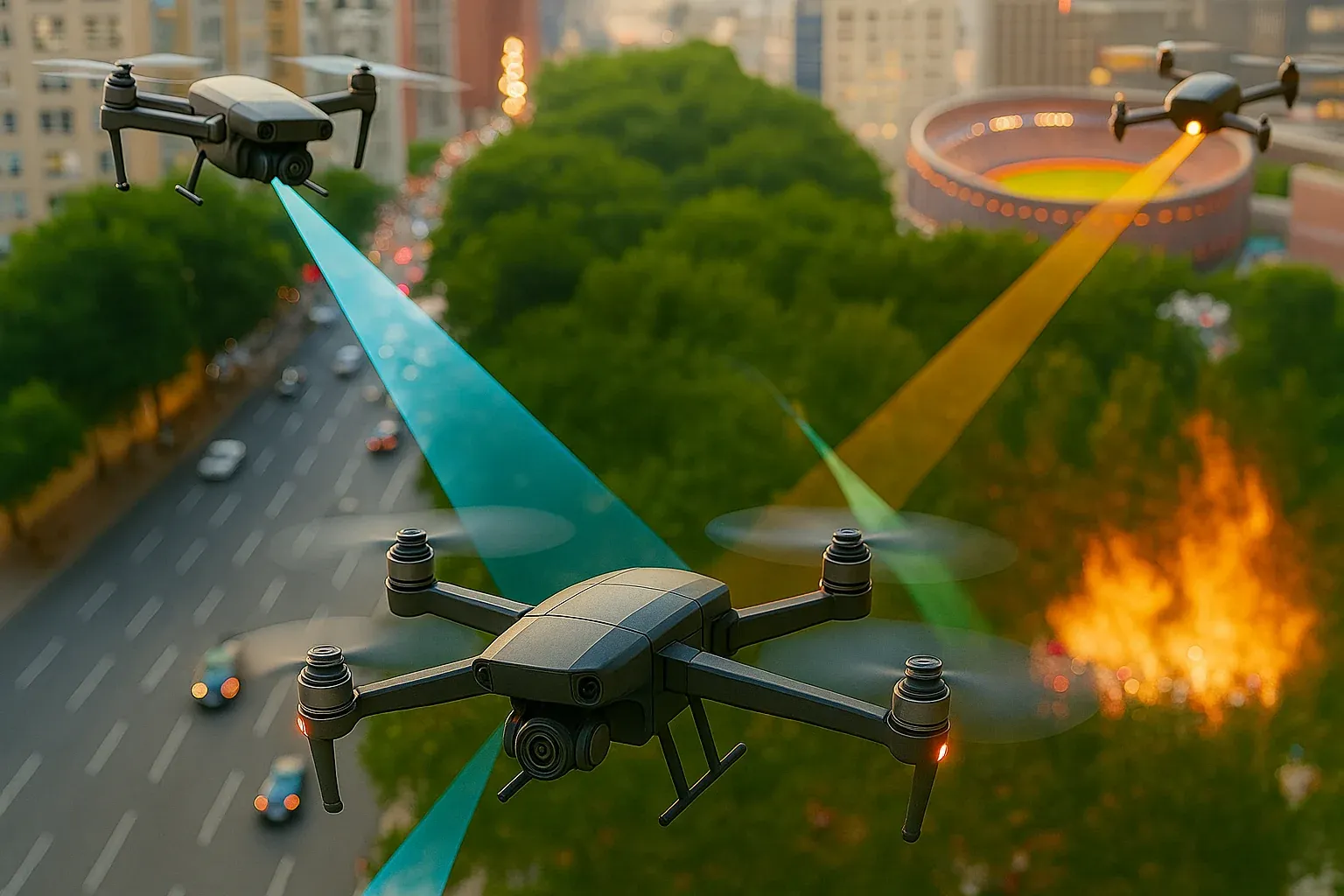
Not only are drones a critical component to these use cases, they’re mobile sensor hubs feeding real-time intelligence into server-side AI workflows. Red5 plays a critical role in these use cases, enabling real-time video ingestion from drones directly at the edge, making it possible to detect critical events like traffic congestion, wildfires, or crowd anomalies as they unfold.
Different situations where live streaming from drones can be useful.
With frame-level access through the Red5 Brew API, developers can stream raw video into AI models running on GPU nodes for immediate analysis. Combined with a hybrid cloud architecture, Red5 allows computing resources to scale dynamically and follow the drone’s location, ensuring low-latency processing even in remote or mobile environments. Learn how AI-based video analytics enhances video surveillance and how AI is changing live streaming in our other blogs.
Drone real-time streaming from remote locations.
However, there is one common misconception is that peer-to-peer is the best way to stream from drones to an operator/viewer. That’s because a direct connection seems simpler and more secure. The idea is that a stream should go directly from a drone to a viewer without a server in between.
Drone live streaming peer-to-peer (P2P) setup deployment diagram.
But in practice, that setup has real limitations:
At Red5, we recommend using a server (or a cluster of servers) between a drone and a viewer.
To get started with drone streaming, read our RTMP vs RTSP blog. For step-by-step instructions on connecting drone or remote camera feeds to Red5, see the detailed guide from our senior software engineer, Paul Gregoire. Depending on your level of control and customization needs, you can set up drone streaming with either of Red5’s real-time streaming products.
Watch the Red5 Cloud product overview on YouTube.
Once you reach the 50 GB monthly limit, you can:
Check out this Youtube playlist to get started with Red5 Cloud.
If you need full customization, maximum flexibility, and complete control over your infrastructure, choose Red5 Pro, our server software built for ultra-low latency streaming at scale. Start with a 30-day trial and get access to all capabilities without limitations.
This approach is already in use. In our recent deployment with Nomad Media, AWS and the San Diego County Sheriff’s Office, we helped build a real-time drone streaming solution that lets deputies access aerial footage with sub-250 ms latency. They can monitor events live, review footage on demand, and share content across agencies while maintaining consistent performance and strict security controls.
The Red5 and Nomad Media joint solution deployment diagram
For high-stakes environments like law enforcement, these technical choices matter. It’s about what works reliably, in the real world, under pressure.
Still not sure which solution is the best fit for your streaming challenges? Visit our product comparison page or contact us to discuss your project.
A live streaming drone is a flying robot that can be remotely controlled or fly autonomously using software-controlled flight plans in its embedded systems. It is equipped with a camera and transmission technology to capture and transmit video and audio in real time to public, private or hybrid networks.
Yes. Drone live streaming may capture private property, individuals, or sensitive information. Always follow local privacy laws and regulations to avoid legal issues.
Secure real-time video and audio streaming can be achieved by connecting secured offline environments directly to government cloud systems like GovCloud. This approach bridges physically isolated networks with centralized command infrastructure without compromising security or speed, ensuring sensitive data remains protected while enabling rapid situational awareness. Read the Red5 and Nomad Media capabilities overview study to learn more.
If the signal is lost, the stream will disconnect. Some drones feature an automatic reconnect feature, which may reconnect the stream.
Yes, but indoor livestreaming requires strong signal quality, careful piloting in confined spaces, and often GPS-independent positioning for stability.
Absolutely. Wind, rain, and extreme temperatures can impact flight stability, video quality, and battery life, making weather checks essential before flying.
Use a drone with a high-resolution camera, maintain a stable signal, adjust bitrate for available bandwidth, and keep the lens clean for sharp footage.
Drone live streaming has evolved into a powerful tool for real-time situational awareness, creative production, and mission-critical operations. Whether you choose a fully managed service like Red5 Cloud or a customizable setup with Red5 Pro, you can achieve ultra-low latency, secure streaming, and seamless integration with other systems. As adoption grows across industries, the key to success lies in pairing the right drone technology with a robust, reliable streaming platform. With Red5, you have the performance, flexibility, and security to make every stream count.
Chris Allen is the co-founder and CEO of Red5, with over 20 years of experience in video streaming software and real-time systems. A pioneer in the space, he co-led the team that reverse-engineered the RTMP protocol, launching the first open-source alternative to Adobe’s Flash Communication Server. Chris holds over a dozen patents and continues to innovate at the intersection of live video, interactivity, and edge computing. At Red5, he leads the development of TrueTime Solutions, enabling low-latency, synchronized video experiences for clients including NVIDIA, Verizon, and global tech platforms. His current work focuses on integrating AI and real-time streaming to power the next generation of intelligent video applications.
Chris Allen is the co-founder and CEO of Red5, with over 20 years of experience in video streaming software and real-time systems. A pioneer in the space, he co-led the team that reverse-engineered the RTMP protocol, launching the first open-source alternative to Adobe’s Flash Communication Server. Chris holds over a dozen patents and continues to innovate at the intersection of live video, interactivity, and edge computing. At Red5, he leads the development of TrueTime Solutions, enabling low-latency, synchronized video experiences for clients including NVIDIA, Verizon, and global tech platforms. His current work focuses on integrating AI and real-time streaming to power the next generation of intelligent video applications.
正文由 探How 从来源站点 RSS 同步,内容未经改写;遇到排版缺失或需要图片、视频时请以原文为准。