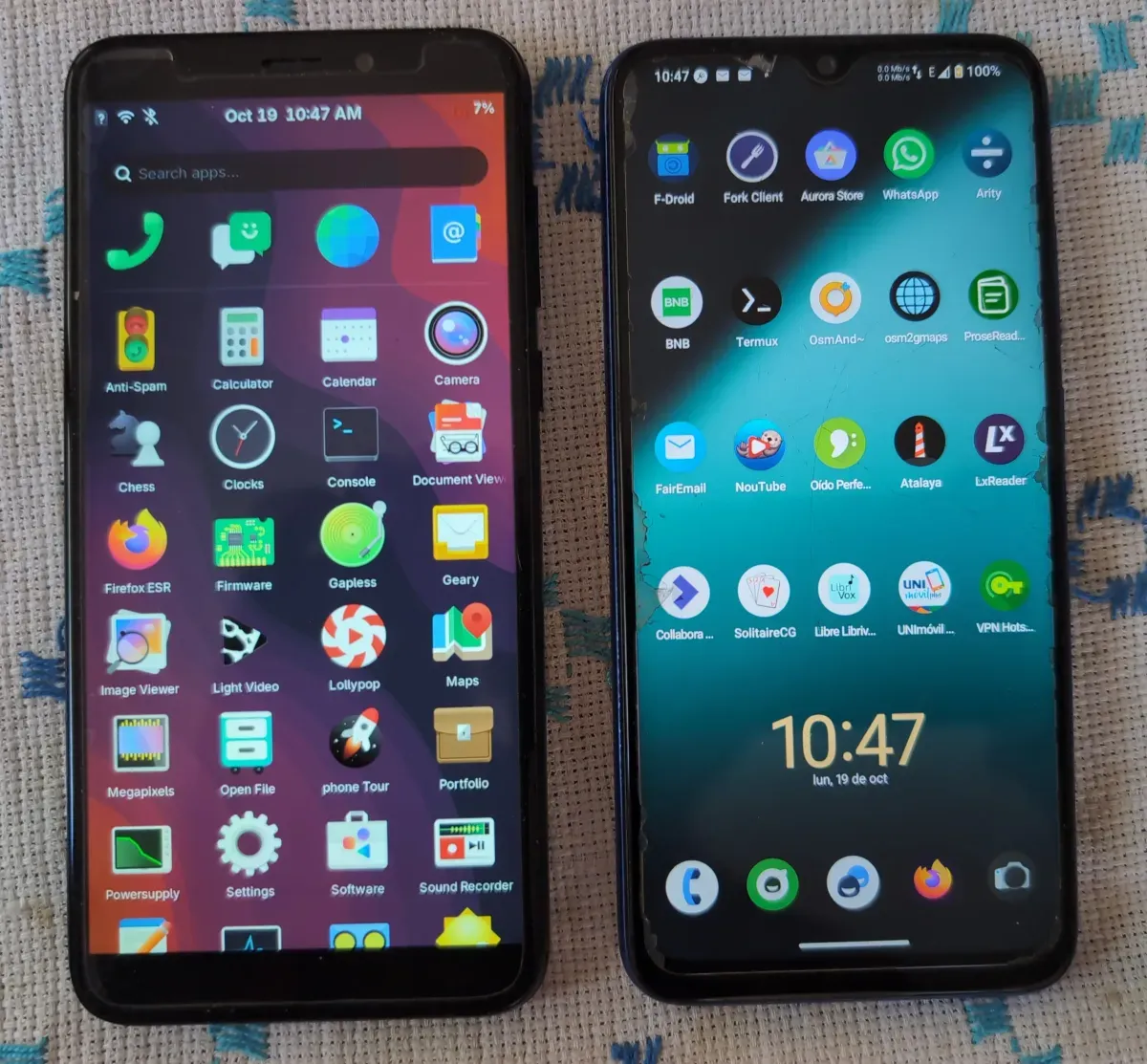
The advantages of mobile Linux over AOSP
by Amos Batto (2026-10-19), License: CC BY 4.0, Download: PDF, ODT
以下正文同步自 Hacker News 最新,版权归原站所有,已转换为易读排版。
by Amos Batto (2026-10-19), License: CC BY 4.0, Download: PDF, ODT
In response to my previous article asking, “Will Linux phones become a viable alternative to the Android/iOS duopoly?,” I received a torrent of comments at Hacker News, r/linux, r/Purism, r/mobilelinux, r/PINE64official, OSNews and on the forums at SailfishOS, Purism and PINE64. There were a total of 660 comments and still counting, so people have a lot to say on the subject of Linux phones.
The vast majority of commentators don’t believe that Linux phones will ever crack the market stranglehold that Google and Apple currently hold over the mobile phone industry. However, many of the commentators argued that we already have a free/open source mobile Linux operating system in the Android Open Source Project (AOSP), which is the base on which Google and the phone manufacturers add their proprietary apps and services. They insisted that AOSP runs on a Linux kernel, so an AOSP phone already is a Linux phone. They asked why waste so much effort developing another mobile Linux operating system which won’t be nearly as good as AOSP. Other commentators argued that most people would never adopt Linux phones, because they are locked into one of the app ecosystems controlled by Google and Apple.
Here is a sample of the comments that the article received:
microtonal wrote on Hacker News: No, they [Linux phones] won’t become a viable alternative: – Worse compatibility with the millions of Android apps already out there. – Hardware vendors (outside Apple) all target Android. – The usability of Android/iOS is far better than non-Android Linux phones. – The security of non-Android Linux phones is in a bad state (e.g. lacking proper app sandboxing). Heck, even the Android emulation layers that some of these phones have, throw the strong Android sandbox model out of the window.
The answer is very obvious and it is AOSP. Even though Google is trying to close AOSP more (e.g. by not pushing source continuously to the AOSP Git repos and keeping QPR1/3 for themselves), it is still an open source system. Play Services can either be run sandboxed or emulated with microG. AOSP allows alternative systems to hit the ground running, you get great app compatibility, a tested security model, great usability, and support from hardware vendors, including vendors that are alternative friendly (used to be Pixel, now Motorola, Fairphone, etc.). If ever needed, AOSP could be forked and it would still be leagues ahead of non-Android Linux phones.
All the downsides that apply to AOSP-based systems (like things getting blocked by Play Integrity, unlockable bootloaders) also apply to non-Android Linux systems. … The difference is that there is already a great open source smartphone OS that works today, it’s AOSP. The most effective path would be for the FLOSS ecosystem to pour their resources into making AOSP independent from Google. But instead people will just fork N half- or non-working solutions for reasons.
drnick responded to a previous comment on Hacker News:
Play Services can either be run sandboxed or emulated with microG. Play Services is absolutely not needed for a usable Android experience. I am running GrapheneOS without any Google crap and you could not pay me to do so.
TFNA then replied to drnick: Many bank apps, and apps to interact with official state services, usually depend on Play Services. Sometimes it is all banks in one’s country, so no, one can’t just “switch to another bank” as US Americans on HN often assume.
FrebTheRat wrote on r/PINE64official: It’s not the phone or the os that’s the issue. It’s the app ecosystem. They own the store. In order to get a viable app store they need enough market share. In order to get market share they need a viable app store. Chicken meet Egg…I used a pinephone for hot minute and it was passable except I couldn’t use Slack, Teams, do banking, access my obsidian notes, etc.
blue_horizon_x wrote on r/linux: No. They will never become a viable alternative to Android because those who want Android they [w]ill always prefer something like GrapheneOS. A smartphone is like a handheld computer. You will never get apps, productivity apps – flights, hotels, banking on a Linux phone. GrapheneOS has sandboxed Google Play to deal with it while handling it while staying open source.
jonf3n wrote on r/Purism: AOSP is based on Linux, but FAR more secure, especially in GrapheneOS with tight hardware support. Why step backwards into standard Linux that has a HUGE attack surface and inferior sandboxing / low level security hardening?
PriorFortune1 wrote on r/Purism: Developing a third platform to compete with Android and iOS requires one thing and one thing only: apps. Phones that don’t support the apps people use will never sell. Microsoft couldn’t do this in the early days of the smartphone market even by throwing millions of dollars at app developers. It’s incredibly unlikely Linux will somehow solve that problem.
sleepingonmoon wrote on r/linux: No unless some company decides to burn billions. Phones are extremely UX sensitive and I don’t see a way GNU/Linux can beat even Android, not to mention things like power management.
Schlonzig wrote on r/linux: There are millions of apps for iOS and Android now. Any new system would struggle because EVERYONE will have at least one app they can’t live without.
VolksPC wrote on r/linux: In comparison the application ecosystem on Linux is very limited. This is primarily because there is no stable API on Linux for application development and companies are not going to port their software to Linux.
Jimbuscus wrote on r/linux: Android is the answer to the problem, with the problem being Google’s AOSP. Free Software Foundation (GNU), Canonical, F-Droid, KDE, Graphene, Lineage & Murena would do well to all get behind a shared soft fork of AOSP for a new base that isn’t governed by Google. If Microsoft couldn’t get apps developed for a third mobile OS, it’s even less likely to be viable to get a Linux for mobile app in addition to Android & IOS. It’s also not necessary or beneficial to throw away 15+ years of community work towards Android, just to get away from corp controlled code, as the AOSP licence permits forking. Android is the future of mobile Linux, it just needs a single major fork that replaces Google’s proprietary blobs, which can be used as the new base for non-Google certified mobile distros. An Android-like Open-Source Project would have the general benefit of supporting native Android apps, without having to fix each roadblock or curveball Google throws at FOSS with each AOSP version change.
Android is the Linux kernel mobile OS, AOSP is just the largest distro.
anomaly256 wrote on r/linux: Android is Linux Phone. What is it you’re hoping to replace? The UI? Application frameworks? You want to use a different runtime? … But it is… and I think people must clarify what exactly they want changed if they want ‘Linux but not Android’. What the fuck is Op actually asking for when they ask for Linux, but rule out the Linux phone environment with the current largest userbase? Does it mean they want GNU libc and userland? GTK and QT UIs? Fedora branding? Do they want systemd? Gentoo portage and ebuilds? They want to install packages directly from AUR? The ability to hand edit files in /etc? They are literally given a Linux kernel then turn around and say ‘nooo, I said I want LINUX!’ …?!? Linux is the kernel and we already have that in spades, so what the fuck is actually being asked for?
I think it’s very fair to remind people that they already have a fucking Linux phone and ask them for clarification when they say they want a different Linux phone just not the current mainstream Linux phone because the concept of a Linux ANYTHING is so fundamentally nebulous in the first place.
palata wrote on Hacker News: Let’s make a thought experiment: let’s think about designing a new Linux distro from scratch. Obviously starting with Linux-the-kernel, and then thinking about what we need to be a modern smartphone OS.
– We’ll probably want the security model, with the nice sandboxing and I would argue the verified boot. – We’ll want the battery optimisation. – We’ll want access to the firmwares of the components running in the phone.
From the very first step “start from Linux-the-kernel”, every single question I ask myself goes towards the Android design and away from the classical Linux distro design. In other words, the open source Linux distribution that is the closest to a modern mobile system is… Android :-).
al_borland wrote on Hacker News: It’s just a question of funding. Ubuntu made a push for mobile years ago. They put up a phone on Indiegogo, but it didn’t hit its funding goal. https://en.wikipedia.org/wiki/Ubuntu_Edge This is what their Unity Desktop was for as well. A desktop environment that had a consistent design language from desktop to mobile. The remnants of all of this are still kicking around, I think the community still maintains the phone OS, but without the weight of Canonical really pushing it, and a phone shipping with the OS pre-installed, it won’t get as far.
serbuvlad wrote on Hacker News: iOS and Android have an incredible amount of engineering to make them RAM and battery efficient that desktop Linux simply doesn’t have. And its not a case of simply implementing some feature, since all apps have to written with this stuff in mind: apps can be suspended/killed at any time and should be able to restart gracefully, notifications go through a side channel, etc etc Do these [Linux] phones have any of this?
Many of these commentators aren’t grasping the advantages to developing mobile Linux as an independent operating system that can’t be controlled by any single company. They aren’t seeing the advantages that mobile Linux offers over AOSP, nor are they accounting for the difficulties of modifying AOSP to respect its users, compared to developing mobile Linux.
Whenever discussion of AOSP arises, people inevitably argue about the meaning of the word “Linux” and whether Android can be considered a Linux distribution. As much as it annoys the pedants, most people refer to “Linux” as the entire operating system found in one of the major desktop distributions such as Debian, Arch, Fedora, openSUSE, NixOS, Gentoo, etc. or their derivatives. See the appendix below for further discussion about the problematic terminology, but this article follows the commonly accepted practice of referring to “Linux” as an operating system and saying “Linux kernel” to refer to just the kernel. It follows the conventional practice of the software and chipmaker industries by designating Android kernels as separate from Linux kernels.
AOSP’s source code is published by Google with a permissive Apache 2.0 license that allows anyone to modify and distribute it. After 23 years and billions of dollars of development, Android currently commands 75% of the global market share among smartphones, so at first blush, it does seem ridiculous to demand the development of mobile Linux, when we already have access to the most popular mobile operating system with AOSP.
More importantly, using AOSP gives us access to the biggest source of apps in the world. Google’s Play Store grew to 3.6 million apps in 2017, before Google started implementing aggressive policies to cull unmaintained apps from the Play Store to improve the quality and security of its apps. AppBrain estimates that there are currently 2.03 million Android apps in the Play Store. Business of Apps estimates that Google’s Play Store got 104.6 billion downloads in 2025, compared to 36.6 billion downloads from Apple’s App Store. Consumers spent an estimated total of $49.2 billion in the Play Store in 2025, compared to $117.6 billion in Apple’s App Store.
The problem is that Android was designed as a vehicle to collect the personal information of users to feed that data to Google’s servers for its targe
正文由 探How 从来源站点 RSS 同步,内容未经改写;遇到排版缺失或需要图片、视频时请以原文为准。