Digital radio-based train control system
The European Train Control System (ETCS) is a train protection system designed to replace the many incompatible systems used by European railways and railways outside of Europe. ETCS is the signalling and control compon…
以下正文同步自 Hacker News 最新,版权归原站所有,已转换为易读排版。
The European Train Control System (ETCS) is a train protection system designed to replace the many incompatible systems used by European railways and railways outside of Europe. ETCS is the signalling and control component of the European Rail Traffic Management System (ERTMS). It has two major parts: trackside equipment and on-board (on train) equipment.
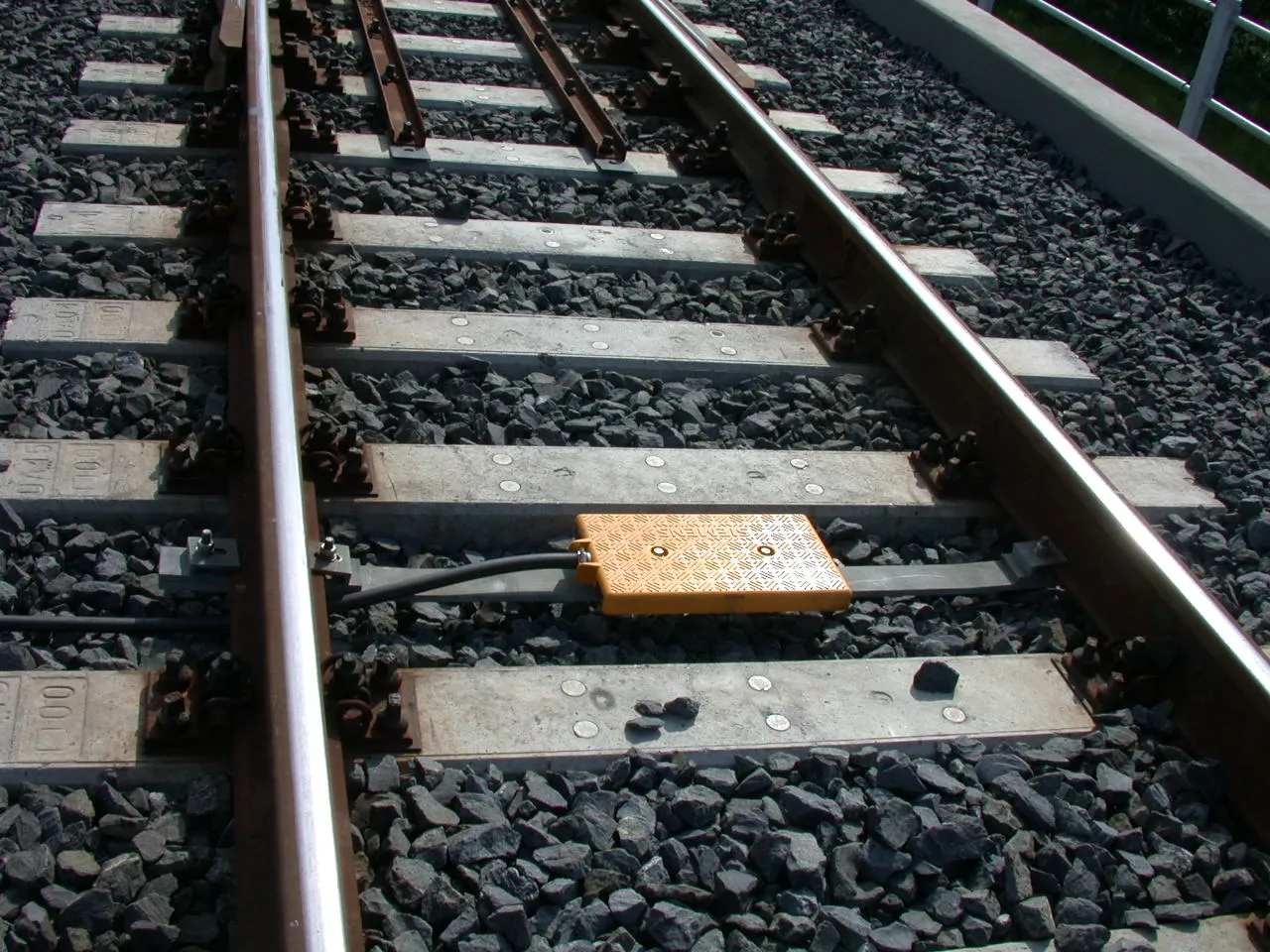
ETCS can allow all trackside information to be passed to the driver cab, removing the need for trackside signals. This is the foundation for future automatic train operation (ATO). Trackside equipment aims to exchange information with the vehicle for safely supervising train circulation.[1] The information exchanged between track and trains can be either continuous or intermittent, according to the ERTMS/ETCS level of application and to the nature of the information itself.[1]
The need for a system like ETCS stems from more and longer-running trains resulting from economic integration of the European Union (EU) and the liberalisation of national railway markets. At the beginning of the 1990s, there were some national high speed train projects supported by the EU which lacked interoperability of trains. This catalysed the Directive 1996/48 about the interoperability of high-speed trains, followed by Directive 2001/16 extending the concept of interoperability to the conventional rail system. ETCS specifications have become part of, or are referred to by, the Technical Specifications for Interoperability (TSI) for (railway) control-command systems, pieces of European legislation managed by the European Union Agency for Railways (ERA). It is a legal requirement that all new, upgraded or renewed tracks and rolling stock in the European railway system adopt ETCS, possibly keeping legacy systems for backwards compatibility. Many networks outside the EU have also adopted ETCS, generally for high-speed rail projects. The main goal of achieving interoperability had mixed success in the beginning.
The European railway network grew from separate national networks with little more in common than standard gauge. Notable differences included voltages, loading gauge, couplings, signalling and control systems. By the end of the 1980s there were 14 national standard train control systems in use across the EU, and the advent of high-speed trains showed that signalling based on lineside signals was insufficient.[citation needed]
Both factors led to efforts to reduce the time and cost of cross-border traffic. On 4 and 5 December 1989, a working group including Transport Ministers resolved a master plan for a trans-European high-speed rail network, the first time that ETCS was suggested. The commission communicated the decision to the European Council, which approved the plan in its resolution of 17 December 1990. This led to a resolution on 91/440/EEC as of 29 July 1991, which mandated the creation of a requirement list for interoperability in high-speed rail transport.[2] The rail manufacturing industry and rail-network operators had already agreed upon the creation of interoperability standards in June 1991.[3] By 1993 an organizational framework was created to start technical specifications that would be published as Technical Specifications for Interoperability (TSI). The mandate for TSI was resolved by 93/38/EEC.[2] In 1995, a development plan first mentioned the creation of the European Rail Traffic Management System (ERTMS).[3]
Because ETCS is in many parts implemented in software, some wording from software technology is used. Versions are called system requirements specifications (SRS). These are bundles of documents which may have different versioning for each document. A main version is called a baseline (BL).
The specification was written in 1996 in response to EU Council Directive 96/48/EC[2] of 23 July 1996 on interoperability of the trans-European high-speed rail system. First the European Railway Research Institute was instructed to formulate the specification and about the same time the ERTMS User Group was formed from six railway operators that took the lead role in the specification. The standardisation went on for the next two years and was felt to be slow by some industry partners. 1998 saw the formation of Union of Signalling Industry (UNISIG), including Alstom, Ansaldo, Bombardier, Invensys, Siemens and Thales that were to take over the finalisation of the standard.[3]
In July 1998, SRS 5a documents were published that formed the first baseline for technical specifications. UNISIG provided for corrections and enhancements of the baseline specification leading to the Class P specification in April 1999.[citation needed] This baseline specification has been tested by six railways since 1999 as part of the ERTMS.[4]
The railway companies defined some extended requirements that were included in ETCS (e.g., RBC-Handover and track profile information), leading to the Class 1 SRS 2.0.0 specification of ETCS, published in April 2000. Further specification continued through a number of drafts until UNISIG published the SUBSET-026 defining the current implementation of ETCS signalling equipment. This Class 1 SRS 2.2.2 was accepted by the European Commission in decision 2002/731/EC as mandatory for high-speed rail and in directive 2004/50/EC as mandatory for conventional rail. The SUBSET-026 is defined in eight chapters where chapter seven defines the ETCS language and chapter eight describes the balise telegram structure of ETCS Level 1.[3] Later UNISIG published the corrections as SUBSET-108 (known as Class 1 SRS 2.2.2 "+"), that was accepted in decision 2006/679/EC.[5]
The earlier ETCS specification contained many optional elements that limited interoperability. The Class 1 specifications were revised in the following year, leading to the SRS 2.3.0 document series that was made mandatory by the European Commission in Decision 2007/153/EEC on 9 March 2007. Annex A describes the technical specifications on interoperability for high-speed (HS) and conventional rail (CR) transport. Using SRS 2.3.0 a number of railway operators started to deploy ETCS on a large scale, for example the Italian Sistema Controllo Marcia Treno (SCMT) is based on Level 1 balises. Further development concentrated on compatibility specification with the earlier Class B systems, leading to specifications like EuroZUB that continued to use the national rail management on top of Eurobalises for a transitional period. Following the experience in railway operation, the European Union Agency for Railways (ERA) published a revised specification Class 1 SRS 2.3.0d ("debugged") that was accepted by the European Commission in Decision 2008/386/EC on 23 April 2008.
This compilation SRS 2.3.0d was declared final (later called Baseline 2) in this series. There were a list of unresolved functional requests and a need for stability in practical rollouts. So the development of Baseline 3 series started in parallel to incorporate open requests, strip off unneeded material and combine it with solutions found for Baseline 2. The structure of functional levels was continued.
While some countries switched to ETCS with some benefit, German and French railway operators had already introduced modern types of train protection systems and so would gain no benefit. Instead, ideas were introduced on new modes like "Limited Supervision" (known at least since 2004[6]) that would allow for
These ideas were compiled into a "Baseline 3" series by the ERA and published as a Class 1 SRS 3.0.0 proposal on 23 December 2008. The first consolidation SRS 3.1.0 of the proposal was published by ERA on 26 February 2010[7] and the second consolidation SRS 3.2.0 on 11 January 2011.[8] The specification GSM-R Baseline 0 was published as Annex A to the Baseline 3 proposal on 17 April 2012.[9] At the same time a change to Annex A of SRS 2.3.0d was proposed to the European Commission that includes GSM-R Baseline 0 allowing ETCS SRS 3.3.0 trains to run on SRS 2.3.0d tracks.[10][11] The Baseline 3 proposal was accepted by the European Commission with decision 2012/88/EU on 25 January 2012.[12] The update for SRS 3.3.0 and the extension for SRS 2.3.0d were accepted by the European Commission with decision 2012/696/EU on 6 November 2012.[13]
The ERA work programme concentrated on the refinement of the test specification SRS 3.3.0 that was to be published in July 2013.[14] In parallel the GSM-R specification was to be extended into a GSM-R Baseline 1 until the end of 2013.[14] The German Deutsche Bahn since announced equipping at least the TEN Corridors running on older tracks to be using either Level 1 Limited Supervision or Level 2 on high-speed sections. Work continued on Level 3 definition with low-cost specifications (compare ERTMS Regional) and the integration of GPRS into the radio protocol to increase the signalling bandwidth as required in shunting stations. The specifications for ETCS Baseline 3 and GSM-R Baseline 0 (Baseline 3 Maintenance Release 1) were published as recommendations SRS 3.4.0 by the ERA in May 2014 for submission to the Railway Interoperability and Safety Committee (RISC) in a meeting in June 2014.[15][16] The SRS 3.4.0 was accepted by the European Commission with the amending decision 2015/14/EU on 5 January 2015.[17]
Stakeholders such as Deutsche Bahn have opted for a streamlined development model for ETCS. DB will assemble a database of change requests (CRs) to be assembled by priority and effect in a CR-list for the next milestone report (MRs) that shall be published on fixed dates through ERA. The SRS 3.4.0 from Q2 2014 matches with the MR1 from this process. Further steps were planned for the MR2 to be published in Q4 2015 (that became the SRS 3.5.0) and the MR3 to be published in Q3 2017 (whereas SRS 3.6.0 was settled earlier in June 2016). Each specification will be commented on and handed over to the RISC for subsequent legalization in the European Union.[18] Deutsche Bahn has expressed a commitment to keep the Baseline 3 specification backward compatible starting at least with SRS 3.5.0 that is due in 2015 according to the streamlined MR2 process, with the MR1 adding requirements from its tests in preparation for the switch to ETCS (for example better frequency filters for the GSM-R radio equipment).[18] The intention is based on plans to start replacing its PZB train protection system at the time.
In December 2015, the ERA published the Baseline 3 Release 2 (B3R2) series including GSM-R Baseline 1. The B3R2 is not an update to the previous Baseline 3 Maintenance Release 1 (B3MR1).[19] The notable change is the inclusion of EGPRS (GPRS with mandatory EDGE support) in the GSM-R specification, corresponding to the new Eirene FRS 8 / SRS 16 specifications. Additionally B3R2 includes the ETCS Driver Machine Interface and the SRS 3.5.0.[20] This Baseline 3 series was accepted by European Commission with decisions 2016/919/EC in late May 2016.[21] The decision references ETCS SRS 3.6.0 that was subsequently published by the ERA in a Set 3 in June 2016.[22][23] The publications of the European Commission and ERA for SRS 3.6.0 were synchronized to the same day, 15 June.[21] The Set 3 of B3R2 is marked as the stable basis for subsequent ERTMS deployments in the EU.[24]
The name of Set 3 follows the style of publications of the decisions of the European Commission where updates to the Baseline 2 and Baseline 3 specifications were accepted at the same time. For example decision 2015/14/EU of January 2015 has two tables "Set of specifications # 1 (ETCS Baseline 2 and GSM-R baseline 0)" and "Set of specifications # 2 (ETCS Baseline 3 and GSM-R Baseline 0)".[25] In the decision of May 2016 there are three tables: "Set of specifications # 1 (ETCS Baseline 2 and GSM-R Baseline 1)", "Set of specifications # 2 (ETCS Baseline 3 Maintenance Release 1 and GSM-R Baseline 1)", and "Set of specifications # 3 (ETCS Baseline 3 Release 2 and GSM-R Baseline 1)".[21] In that decisio
正文由 探How 从来源站点 RSS 同步,内容未经改写;遇到排版缺失或需要图片、视频时请以原文为准。