A Visual Intro to Complex Numbers
We’ll start off our journey by attempting to solve the systems of equations provided below:
以下正文同步自 Hacker News,版权归原站所有,已转换为易读排版。
Nick M
Oct 01, 2026
14
4
1
Share
We’ll start off our journey by attempting to solve the systems of equations provided below:
At first this resembles an ordinary system of two equations – but if we just spend a small amount of time attempting to plug in regular whole / real numbers, you’ll be able to see a bit of a dilemma. Let’s try plugging in 3 for both x and y:
Let’s try plugging in 4 and 2 now to see if this gets us any closer:
Playing around a bit more should get use to realize that there is something awfully wrong here: it doesn’t’ seem possible to solve the above equations using our regular number system – no matter what we try to plug in, our answers always seem to sway far apart from one another. Attempting to come up with feasible solutions using negative numbers doesn’t help either since the multiplication step would require 2 negative numbers and no 2 negative numbers can add up to a number greater than 0.
Well – let’s try solving our equation algebraically instead of going through our heuristic approach above. We rearrange our first equation to solve for y:
We substitute this into our 2nd equation to obtain:
Let’s move all our terms to the left hand side to get our equation into standard quadratic form:
Finally, we multiply every term by -1 so the squared term is positive:
Taking a glance at the above equation provides us with a bit of a mystery: it doesn’t seem to cross 0 (on our x-axis) at all when we attempt to graph it:
It thus appears that our equation doesn’t have a solution – but let’s try the algebraic approach now to do a quick double check – to do so, we can use the quadratic formula to provide a solution to the above equation. As a reminder, a quadratic equation in the form provided below:
we know that a = 1, b = -6, and c = 36, and we can plug this in to obtain:
This is where we once again encounter a big mystery: the solution to our original quadratic formula appears to take the square root of a negative number (-108) but this is not possible using our regular number system composed of real numbers. We’ve hit a wall.
This exact mathematical wall involving the seemingly impossible square root of a negative number is precisely where the Italian mathematician Gerolamo Cardano found himself in 1545. While developing his groundbreaking general solutions to cubic equations, Cardano noticed something bizarre: even when an equation yielded a completely real, tangible answer, the algebraic path to get there forced him to temporarily calculate the square root of a negative number. For instance, in some of his working expressions, quantities would arise that required manipulating roots like the square root of -15 alongside other terms.
Cardano discovered that if you stubbornly followed the standard rules of algebra with these forbidden quantities—multiplying and simplifying them—the imaginary parts would eventually vanish, leaving behind a perfectly accurate, real-world solution. In fact, in 1545 he published Ars Magna, one of the most important algebra books of the Renaissance. Among its many problems, Cardano asked his readers to divide 10 into two parts whose product was 40. In modern notation, he was searching for two numbers u and v such that:
This should look familiar since it very much resembles our original problem involving x and y. Using a similar approach which we used to turn our original equations into a quadratic one, Cardano simplified the above into the equation shown below:
Applying the quadratic formula leads to a result that would have looked impossible to almost every mathematician of Cardano’s time:
At this point, every instinct from ordinary arithmetic says to stop - you should not be able to take the square root of −15. There is no real number whose square is negative, so the two parts would have to be:
But now something almost magical happens: if we ignore this impossibility for a moment and just apply the usual rules of algebra:
Yet, despite watching the math work out cleanly in front of him, Cardano couldn’t bring himself to believe it. He viewed the whole maneuver as a mere “convenient artifice”— a mathematical magic trick with no actual substance or practical meaning behind it. French philosopher René Descartes (1596–1650) strongly agreed with that skepticism — looking at these strange numbers, Descartes dismissed them as nonsensical fabrications and coined the term imaginary for the roots of negative quantities—a derogatory label meant to mock them as products of pure fancy, which unfortunately stuck around for centuries.
Throughout the 18th century, however, mathematicians found themselves unable to ignore these numbers. They kept popping up as indispensable shortcuts in calculus, algebra, and physics. It was Leonhard Euler who finally gave them a proper home and standard notation, introducing the symbol i to represent the square root of -1:
Even with Euler’s notation, a lingering question remained: what do these numbers actually represent? If real numbers live on a 1-dimensional number line stretching from negative infinity to positive infinity, where do imaginary numbers live?
The answer arrived near the turn of the 19th century when Jean-Robert Argand and Caspar Wessel independently figured out the missing piece of the puzzle: a geometric model. They realized that multiplying by -1 rotates a number 180 degrees on the number line:
Therefore, multiplying by the square root of -1 (or i) shouldn’t just push you further left or right on a one-dimensional line—it represents a 90-degree rotation into a completely new, perpendicular dimension. This is a natural product of i2 being equal to -1 (a 180 degree rotation). Since i represents half of this multiplicative step, it can naturally be mapped to 90 degrees (a halfway 180 degree rotation). By turning our 1D number line into a 2D coordinate plane (where the horizontal axis holds real numbers and the vertical axis holds imaginary numbers), every “complex” number suddenly corresponds to a physical point on a flat plane:
In the above image, the horizontal axis now represents the real number line (-2, -1, 0, 1/3, 3, etc…) while the vertical axis represents a brand new perpendicular dimension representing the real part of our number (-2i, -1i, 0, 1/3i, 3i, etc…). The curved blue line shows what happens when we multiply by i: multiplying +1 by i swings it a quarter turn upward, landing precisely on +i which is a 90 degree rotation.
To put things simply: our new dimension gives us a way to turn our 1-dimensional real number system into a 2-dimensional one. To do this, we allow the regular x-dimension to model the real part of our new number system while the vertical y-dimension now represents the new ‘imaginary’ dimension.
We can visualize this intuitively by taking a look at the diagram below, where a is the real part while b is the imaginary one:
This model provides a natural correspondence between complex numbers and points in the plane. The horizontal axis is called the real axis, the vertical axis the imaginary axis, and an arbitrary complex number z = a + ib appears as the point with coordinates (a, b) on the plane.
We also note that using our new system of dimensions, multiplication by i simply represents a 90 degree rotation:
In the early 1800s, many strict mathematicians rejected the Argand / Wessel plane because it felt like a cheap visual trick. They argued that just because you can draw a picture of the square root of 1 as a vertical line doesn’t prove it logically exists as a number.
In 1833, Hamilton published a paper that removed all geometry and “imaginary” mystery completely. He defined a complex number strictly as an algebraic ordered pair of real numbers, written simply as (a, b). He then defined precise rules for how to add and multiply these pairs:
We can visualize the addition component easily since it maps to regular vector addition:
We can also visualize multiplication (albeit it is a bit less intuitive than addition) by looking at some of the visuals below - in the below visual we multiply an imaginary number by i (to produce a 90 degree rotation):
Another more complex example is provided below where we multiply (2, 1) and (1, 2) in our new imaginary system:
In the above image, we can see an example showing:
Both factors have real and imaginary components. Their directions add together to produce:
This geometric breakthrough was originally popularized and cemented by Carl Friedrich Gauss. Gauss utilized the complex number system to construct the proof of the fundamental theorem of algebra, which demonstrated that every non-constant polynomial equation has at least one root in the complex number system. As an example – even though the graph for the equation below never crosses 0 – we can still find four roots in the complex plane which all appear symmetrically on the unit circle:
That definitive proof finally convinced the wider mathematical community of the profound importance and absolute validity of complex numbers—transforming them from Cardano’s torturous artifice into one of the most powerful tools in all of mathematics and science.
Finally, taking a cue from Cardano and Euler, let’s take that bold leap ourselves and apply this concept to our own unsolved mystery. We left off with the troubling fraction below:
Instead of stopping, we can pull apart that -108. We know that -108 is the exact same as 36 multiplied by -3:
We can evaluate the square root of 36 and pull it outside as a 6:
Here is where Euler’s i comes to the rescue. We can separate out the square root of -1 from the -3:
Substituting in our imaginary unit i and dividing by 2 provides our ultimate, two-part solutions:
Since x + y = 6, the corresponding y-values are:
The two middle terms are equal and opposite, so the imaginary part disappears. The final i² becomes -1, turning the last subtraction into addition. We can visualize this as adding our 2 angles (resulting in a vector of 0 degrees since they are opposite in direction) and scaling our resulting vector (of length 6) by 6 across the x-axis resulting in 36:
We can also easily verify that x + y = 6 since the i components cancel each other out and our real-parts simply add up to equal to 6:
To sum it up – complex numbers are not all that complex: all we’re doing is transforming the number system represented in 1 dimension into a 2-dimensional number. A real number needs only one coordinate, so we draw it on a regular line; a complex number needs two coordinates – a real part and an imaginary part - so we draw it on a plane like the one shown below:
The x-axis above represents our real part while the y-axis represents the imaginary component. Addition now looks like ordinary movement in the plane and we add the real parts horizontally and the imaginary parts vertically.
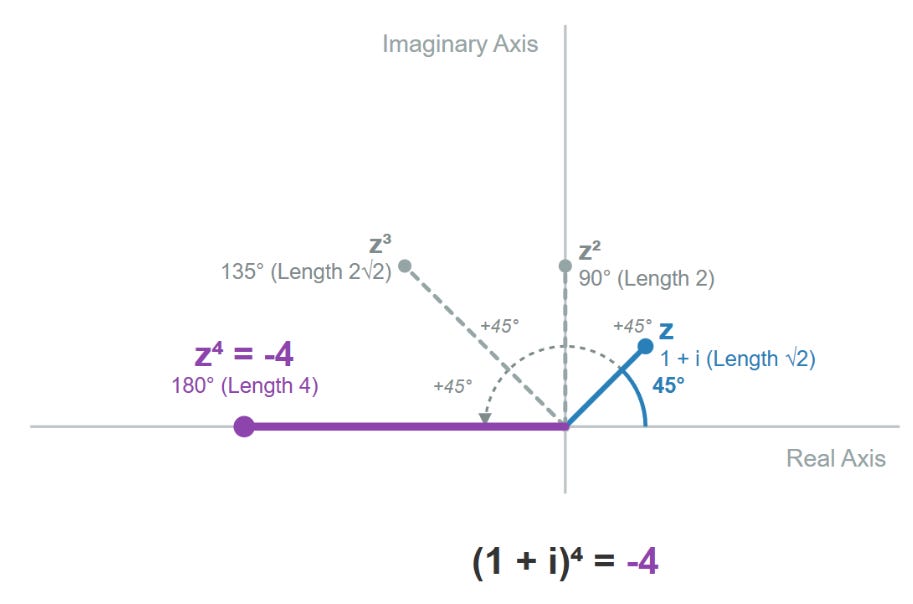
Multiplication contains an even deeper idea: multiplying by i transforms and the point a + bi into and rotates our 2-dimensional point (or vector) by 90 degrees counter-clockwise:
Multiplying by i a second time turns it another 90 degrees, producing a total rotation of 180 degrees. That is why i squared equals -1: two quarter-turns point us in exactly the opposite direction on the real axis.
Thus, multiplication also maps nicely into this new world (especially when multiplying by i).
Before we explore this connection, it is worth taking a moment to understand what the trigonometric functions actually represent.
At first, sine and cosine are usually introduced as rules involving the sides of a right-angled triangle. Given an angle θ, we define:
Although these definitions are useful, they can make sine and cosine feel like little more than tools for solving triangles. Their deeper meaning becomes much clearer when we place the triangle inside a circle.
Imagine drawing a circle with a radius of 1 and then rotating a line from the positive horizontal axis through an angle θ. The endpoint of that line has two coordinates: a ho
正文由 探How 从来源站点 RSS 同步,内容未经改写;遇到排版缺失或需要图片、视频时请以原文为准。