How Anthropic ships Claude with Claude: Separating the Brain from the Hands
Katelyn Lesse and Angela Jiang on Opus 5.5, the Claude Platform, and the engineering behind AI agents.
以下正文同步自 Latent Space,版权归原站所有,已转换为易读排版。
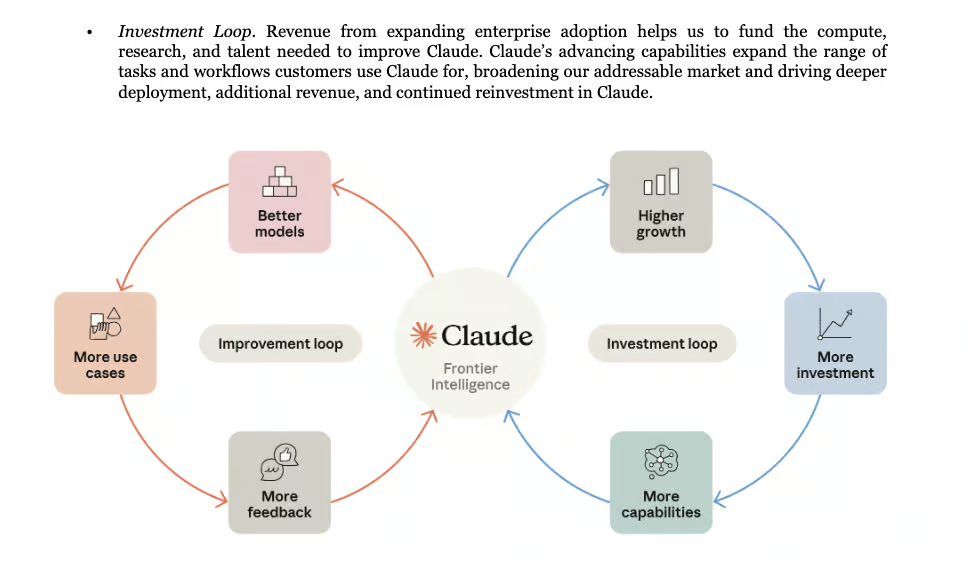
Watch the full episode on YouTube As we learned from the Anthropic S-1 filings yesterday, the lab has some of the highest revenue and research efficiency in human history, particularly with -126% loss to 19% GAAP profit turnaround in the last year. The company credits this to their two core loops: Improvement and Investment: Today we go inside how Anthropic works. Now the dust has settled on Opus 5.5 and it has lasted a month as the generally accepted #1 LLM in the world, we dive into its launch, and how Anthropic ships Claude with Claude with Katelyn Lesse and Angela Jiang, heads of Engineering and Product respectively. The team is working under two kinds of pressure. The models are getting more capable, which makes safe deployment and access decisions harder. At the same time, usage is growing fast enough that ordinary infrastructure choices—like how much CPU an API consumes—become strategic. Those problems meet in the product choices that reach developers.
A model launch is also an API launch
Anthropic's Opus 5.5 launch emphasizes both model quality and cost. We discuss feedback that the previous Opus generations were be too verbose, alongside the need for stronger intelligence per dollar. Anthropic says the new model costs less to run than its predecessor; the exact saving depends on the workload and its use of cached context. The less visible launch work involves changes to how people integrate the API. One example we discuss is protecting model reasoning against extraction used for distillation. Preserving thinking blocks across turns helps address this, but a new requirement can also break a customer's existing harness. Katelyn also describes what being part of early access programs actually looks like in practice: Customers run evaluations in their own harnesses, report surprising behavior, and sometimes pass along less formal impressions. The useful part is not just a benchmark score: it is seeing the model in environments and tasks Anthropic's own products do not cover. As we have said for 4 straight years now on the podcast, having good evals is golden.
The brain and the hands
Our favorite mental model in the episode is the distinction between an agent's brain and its hands. In Managed Agents, Anthropic separates the session log and harness from the sandbox that executes code. The harness can persist while an execution environment is created when needed; a failed sandbox does not have to take the whole agent session with it. We covered this in the Thariq pod: Claude Code’s Next Era — Thariq Shihipar, Anthropic — Latent Space Shipping Opus/Sonnet 5.5, Mods, Plugins, Projects, Tag while Pacing the Frontier Latent Space The same separation gives security a useful architectural property. If generated code runs in a sandbox that never receives a service credential, there is no credential in that sandbox for the code to read. The episode describes credentials held separately and attached through a proxy, alongside controls on where sandbox traffic can go. Anthropic's containment write-up describes the wider set of isolation and network controls used across its products. The distinction matters for performance too. The guests say an earlier approach put the whole coding agent in a sandbox behind an API. Starting the environment and agent added work before the first response; if the sandbox disappeared, so did the running agent. Separating the pieces allowed the platform to pursue lower latency and better reliability while keeping execution isolated. It is a helpful lens for anyone designing an agent runtime. Ask which parts need to survive, which parts execute untrusted work, and which secrets actually need to be present where code runs. The implementation will differ between products, but those questions remain useful.
An agent that helps another agent remember
Managed Agents also provides a base for experiments in memory and multi-agent workflows. Dreaming is simply implemented as one agent inspecting another agent's prior work and writing memories back. That makes the feature an example of building a higher-level behavior out of the same underlying managed-agent primitives. Their account of the roadmap is more nuanced than a list of features. Memory and learning remain important, but the team says more of its immediate attention has moved to safety as model launches have become harder. They also discuss keeping the base harness relatively simple, while letting developers experiment with verifiers, parallel agents and other strategies on top. Ideas mentioned for future platform capabilities should be treated as plans, not shipped promises. The conversation about evaluations follows naturally. A harness is an application, but improving one starts to resemble research: pick a goal, measure behavior, inspect failures, and iterate. The guests and hosts discuss using models to help build and analyze evaluations, while retaining enough judgment to decide whether the evaluation reflects a real user's job.
Show notes
- Claude Opus 5.5 announcement — Anthropic's launch notes on model behavior, evaluation and pricing.
- Katelyn Lesse and Angela Jiang at Anthropic's partner summit — Anthropic identifies their platform engineering and product roles.
- Scaling Managed Agents: Decoupling the brain from the hands — The session, harness and sandbox architecture discussed in the episode.
- How Anthropic contains Claude across products — How Anthropic describes isolation, credentials and network controls across its products.
- Effective harnesses for long-running agents — Earlier Anthropic work on the challenge of maintaining progress across context windows.
- Anthropic model system cards — The company's public model evaluation and safety documentation.
- Anthropic S-1 breakdown — The numbers and context behind the newly recorded introduction.
Timestamps
0:00 Anthropic’s S-1 and this interview 1:06 Revenue per employee and efficiency 3:13 The improvement and investment loops 4:04 Why Claude Platform matters 6:25 Training incidents and production safeguards 7:30 Opus 5.5 launch and pricing 9:25 Distillation and preserved thinking 14:35 Product and engineering at Anthropic 18:05 Scaling the Claude Platform 19:25 Model access and safety decisions 26:25 Trust grants and product roadmaps 30:25 How Anthropic launches models 35:55 Benchmarks and model personalization 42:10 Claude Managed Agents 44:25 Memory, dreaming, and agent harnesses 48:25 Evaluating agents 53:25 CPU constraints and scaling 56:05 Rebuilding the Messages API in Rust 1:03:25 The brain and the hands 1:05:25 Protecting credentials and sandboxes 1:08:25 Training incidents versus production 1:10:55 Pacing and launching frontier models 1:12:25 Safety classifiers and model routing 1:19:25 Emerging agent workloads 1:20:55 Fighting AI slop 1:27:25 Management, writing, and working styles 1:33:25 Building Anthropic's DevRel team 1:40:25 Developer relations and product voices 1:43:25 What to try with Opus 5.5
Transcript
Automatically transcribed draft. Names and wording may need correction; speaker identities have not been assigned. 0:00 Hi, today we're trying something new. We're launching coverage of Anthropic for the IPO. They just filed the S1 as of today. And so we're releasing a series of podcasts leading up to the IPO, which is expected to be in two weeks for $2 trillion. And it's one of the fastest growing companies of all time with a reported lifetime cash raise of hundreds of over $100 billion and a lifetime burn of less than $10 billion. So there are a lot of efficiency stories to dive into there, and I think that's something that we want to cover, how Anthropic is simultaneously shipping the strongest models in the world while also doing it very, very efficiently and building an incredible business. So I've pulled out, you know, a lot of you know, if you've been listening to the podcast, that I have a former life as a financial analyst. 0:50 And I pulled out some statements from the S1, which I thought would be interesting to give context to today's podcast. and we're just trying this as a new thing because I feel like some of you want that personal relationship with us talking directly to camera rather than talking to our guests which we've done for four years so the first thing I want to highlight is that Anthropic is an extraordinarily efficient company by human count and that's maybe obvious because it's an AI company so obviously they're using AI very well but I think the degree to which they have changed as a company over the past one year is not well understood. So a trillion 12 month revenue per employee is now 1:32 6.6 million. As compared to one year ago, it was 1.4 million. So they've grown almost five times the revenue per employee. And I think that's something that we need to dive into more because I think any business owner, any engineer, you want to increase your revenue per employee, not just to increase profitability, but also to increase the amount you can pay your people. This is obviously tracked by a significantly increase in revenue per dollar of compute. And it's notable that basically in Q2 of 2025, Anthropic was basically losing half a dollar for every dollar of revenue. And now it's making $2 for every $1 in cost. And I think that's an interesting analogy of how enormously huge this inflection in Anthropics revenues and business outlook has been over the past one year. 2:27 This year was extremely critical for Anthropics to execute well, and it has done that. And I think we're basically going to drive deeper into this and tell that story as much as we can from the podcast external point of view. um the one consequence of this entire increase is that anthropic has just reported its first profitable quarter like not adjusted profit which is profit after we take out all the things that cost us money no this is generally accepted accounting principles gap profit uh of 19 and that is enormous again completely flipping from one year ago more than flipping like one 3:03 year ago, it was losing 129% of every revenue dollar that came in. So the primary attribution, I think, that explains this extraordinary efficiency. As you know, Claude loves loops, Boris loves loops, Dario loves loops, and there's two loops going on in Anthropic. The first is the improvement loop. Basically, there is the cycle of you have Claude, Claude leads to better models, Better models lead to more use cases. More use cases generate more feedback, and that leads to a better cloud. And then there's also the investment loop. So revenue from expanding adoption leads to higher growth. Higher growth leads to more investment, and more investment leads to more capabilities. 3:45 That leads to a better cloud. So these two loops basically spin together and form an infinite loop that is driving the increase in efficiency until the end of time, according to the Adoptic S1. So I think that is our transition from the overall efficiency story to how they execute it. And today we're going to focus a lot on the Claude Platform because that is primarily one of the three things that they call the diffusion of cloud in the Anthropic S1. So they call this Claude Platform our comprehensive agentic development environment. They provide customers with direct access to their primitives to build, deploy, scale their own applications that leverage Cloud's capabilities within their own products and workflows. 4:30 I think one thing that comes up a lot in the discussion in this podcast is the concept of ad fooding, where a lot of Cloud's products is actually built with the same Claude Platform that is available to you. So something that's also interesting in the Claude Platform that was disclosed is over 50% of their customers with $100,000 or more revenue on a trading telephone basis use Claude Platform. And so that is an increase in adoption and emergence of Anthropic not only as a model lab, but as also a hyperscaler and a Claude Platf
正文由 探How 从来源站点 RSS 同步,内容未经改写;遇到排版缺失或需要图片、视频时请以原文为准。